



Master Powers, Exponents, Roots
Master Powers,
Exponents & Roots
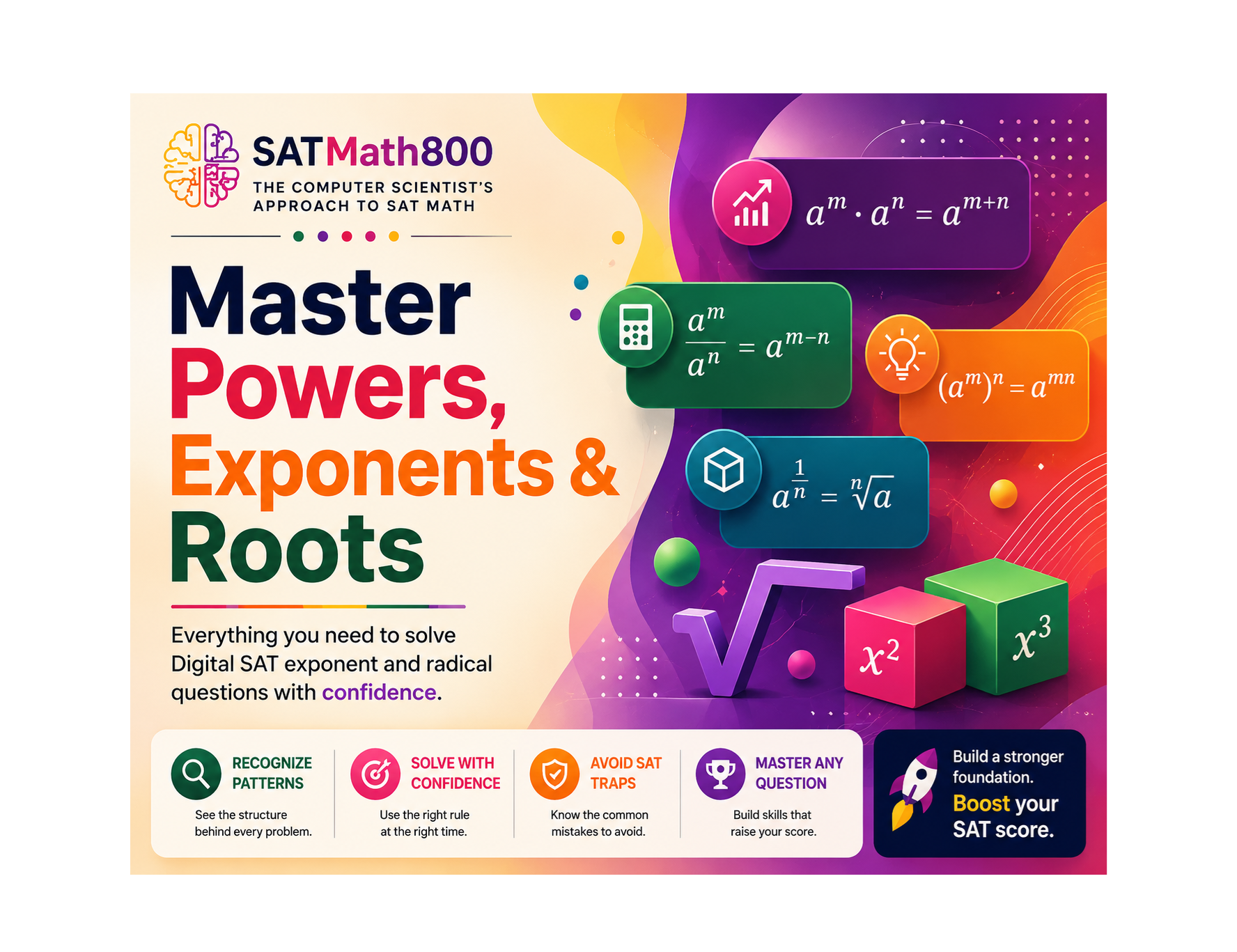
Learn the exponent and radical patterns that appear repeatedly on the Digital SAT. This lesson focuses on understanding ideas—not memorizing isolated formulas.
By the end of this lesson you will be able to
- Apply exponent rules confidently.
- Simplify square and cube roots.
- Convert between radicals and fractional exponents.
- Solve SAT-style exponent questions efficiently.

🚀 Quick Check
Try these four questions before reading the lesson. Don’t worry if you’re unsure—by the end of this page you should be able to answer every one confidently.
Evaluate
Simplify
Evaluate
Which expression is equivalent to
Discover the Pattern
Great SAT students don’t memorize dozens of formulas. Instead, they learn to recognize mathematical patterns. Let’s discover the first one together.
🧠 What changed?
The base never changed. Only the exponent changed.
Every time we multiplied powers with the same base, the exponents were simply added together.
Instead of memorizing this rule, remember the pattern:
🎯 Why Does This Work?
Let’s expand a simple example.
means
Now count the total number of factors.
Nothing magical happened. You simply counted how many copies of the base you had. That is why the exponents are added.
Build the Rule
Now that you’ve discovered the pattern, let’s organize it into a rule you’ll remember during the SAT.
What changes?
- The base stays the same.
- Add the exponents.
- Do not multiply the bases.
Think Like This
Every exponent tells you how many copies of the base exist. When two groups are multiplied, all the copies join together.
Same base → Add exponents.
Try It Yourself
Reveal Answer
What changes?
- The base stays the same.
- Subtract the exponents.
- The numerator loses copies of the base.
Why?
Cancel common factors. Three copies remain.
Same base → Subtract exponents.
Try It Yourself
Reveal Answer
What changes?
- The base stays the same.
- Multiply the exponents.
- Never add them.
Think Visually
Each copy of the power is repeated again. Instead of adding groups, you’re multiplying how many groups there are.
Power of a power → Multiply exponents.
Try It Yourself
Reveal Answer
⚠️ SAT Trap
The Digital SAT often tests whether you truly understand exponent rules—or whether you’re applying them mechanically. Let’s look at three mistakes that appear again and again.
A common mistake is to think
This is incorrect.
Students often write
Some students incorrectly simplify
Before simplifying any exponent expression, ask yourself one question:
Square Roots & Cube Roots at a Glance
You do not need to memorize endless tables. Recognize the patterns that appear repeatedly on the Digital SAT.
Perfect Squares
| \(1^2\) | \(=1\) |
| \(2^2\) | \(=4\) |
| \(3^2\) | \(=9\) |
| \(4^2\) | \(=16\) |
| \(5^2\) | \(=25\) |
| \(6^2\) | \(=36\) |
| \(7^2\) | \(=49\) |
| \(8^2\) | \(=64\) |
| \(9^2\) | \(=81\) |
| \(10^2\) | \(=100\) |
| \(11^2\) | \(=121\) |
| \(12^2\) | \(=144\) |
| \(13^2\) | \(=169\) |
| \(14^2\) | \(=196\) |
| \(15^2\) | \(=225\) |
Most Digital SAT questions involving square roots use perfect squares up to about \(15^2\). Recognizing these values instantly saves time.
Perfect Cubes
| \(1^3\) | \(=1\) |
| \(2^3\) | \(=8\) |
| \(3^3\) | \(=27\) |
| \(4^3\) | \(=64\) |
| \(5^3\) | \(=125\) |
| \(6^3\) | \(=216\) |
| \(7^3\) | \(=343\) |
| \(8^3\) | \(=512\) |
| \(9^3\) | \(=729\) |
| \(10^3\) | \(=1000\) |
Cube roots appear less often than square roots, but recognizing common perfect cubes helps you simplify expressions quickly.
🎯 SAT Strategy
Instead of asking, “Do I remember this number?” ask, “Is this a perfect square or a perfect cube?”
This simple habit helps you identify opportunities to simplify expressions without unnecessary calculations.
Fractional Exponents: The Bridge Between Powers and Roots
Many students think fractional exponents are a new topic. They aren’t. They are simply another way of writing roots. Once you understand this connection, many SAT questions become much easier.
The Key Idea
Square Root
Fractional Exponent
Cube Root
Fractional Exponent
Remember This Pattern
The denominator tells you which root to take.
Worked Example
Simplify
Show Solution
Rewrite the exponent as a square root.
Try It Yourself
Reveal Answer
SAT Connection
The SAT often mixes exponent rules and roots in the same problem. Whenever you see a fractional exponent, ask yourself:
This simple step frequently turns a difficult-looking expression into one you can simplify mentally.
🎯 Guided SAT Practice
Let’s apply everything you’ve learned. Work through each question before revealing hints or solutions.
Simplify
💡 Hint 1
💡 Hint 2
✅ Full Solution
Simplify
💡 Hint 1
💡 Hint 2
✅ Full Solution
Evaluate
💡 Hint 1
💡 Hint 2
✅ Full Solution
Simplify
Show Solution
Evaluate
Show Solution
Simplify
Show Solution
🎯 Challenge Complete!
If you solved all three questions correctly without using the solutions, you’ve built a solid foundation in powers, exponents, and roots. If not, revisit the relevant rule cards and try again. Mastery comes from understanding the patterns—not memorizing isolated formulas.
✅ You Should Now Be Able To
- ✓ Multiply powers with the same base.
- ✓ Divide powers with confidence.
- ✓ Apply the power-of-a-power rule.
- ✓ Simplify square and cube roots.
- ✓ Convert between radicals and fractional exponents.
- ✓ Recognize common SAT exponent traps.
🎯 SAT Success Checklist
- ☐ I understand WHY exponent rules work.
- ☐ I can solve exponent problems without memorizing steps.
- ☐ I recognize perfect squares instantly.
- ☐ I recognize perfect cubes instantly.
- ☐ I know when to rewrite a fractional exponent as a root.
- ☐ I’m ready for mixed SAT exponent questions.
📋 One-Minute Formula Review
Before leaving, take one minute to review the essential rules.
🚀 Keep Improving Your SAT Score
You’re making progress one topic at a time. Continue building your SAT Math skills with more free lessons, formula sheets, and full-length practice tests on SATMath800.

One thought on “Master Powers, Exponents, Roots”