


SAT Percentage Problems | Must Learn Before the SAT Test
Watch the Video Lesson
Replace the placeholder below with your YouTube Shorts or full video embed code.
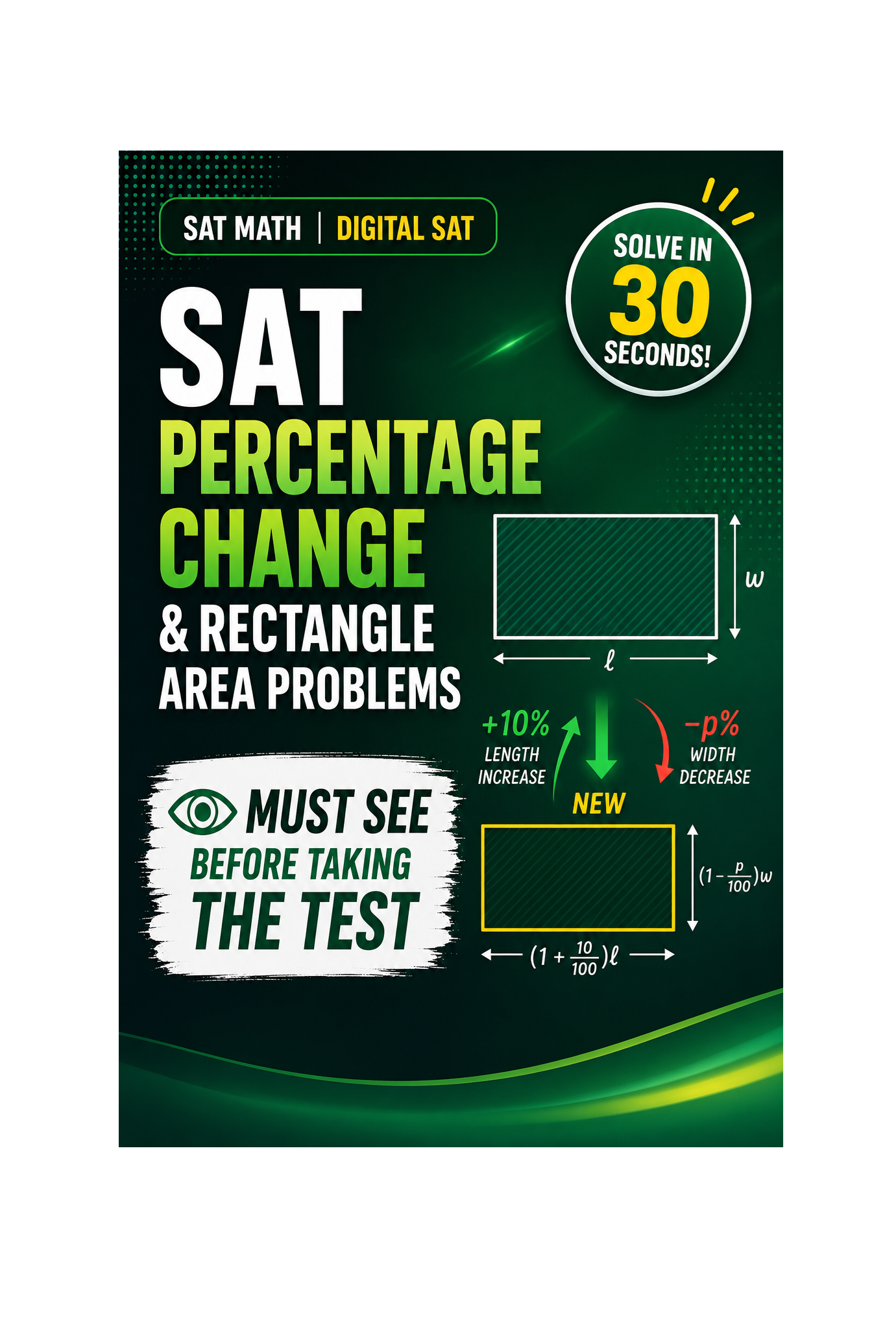
SAT Percentage Change & Rectangle Area Problems
Learn the powerful SAT percentage-change trick that turns difficult rectangle area questions into easy mental math by using convenient numbers instead of unnecessary variables.
- Length increases by 20%
- Width decreases by 10%
- Find the percentage change in area
You Must Be Able to Solve These Before the SAT
Rectangle area questions involving percentage increases and decreases appear frequently on the Digital SAT Math section. Many students lose time because they immediately introduce variables and start doing complicated algebra.
In this video lesson, you will learn the easy-number strategy that allows you to solve SAT percentage-change questions in seconds under SAT time pressure.
Why Variables Make This Look Harder
Suppose a rectangle has length l and width w. This is a common SAT percentage change problem involving rectangle area.
Step 1 — Percentage Increase in Length
The length increases by 20%. A 20 percent increase means:
$$20\%=\frac{20}{100}=0.20$$Add this increase to the original length:
$$l+0.20l$$ $$=(1+0.20)l$$ $$=1.20l$$Step 2 — Percentage Decrease in Width
The width decreases by 10%. A 10 percent decrease means:
$$10\%=\frac{10}{100}=0.10$$Subtract this decrease from the original width:
$$w-0.10w$$ $$=(1-0.10)w$$ $$=0.90w$$Step 3 — Compute the New Area
Now multiply the new dimensions to find the new rectangle area:
$$A’=(1.20l)(0.90w)$$ $$A’=1.08lw$$Practice Question — Increase One Side, Decrease the Other
This example is very similar to the rectangle-area percentage-change questions that appear on the Digital SAT Math section.
A rectangle has length l and width w. The length is increased by 20%, and the width is decreased by 30%.
By what percentage does the area change?
Step 1 — Choose Convenient Numbers
Because only the percentage change matters, choose easy numbers that make the arithmetic simple:
$$l=100,\qquad w=10$$Step 2 — Compute the Original Area
The original area is:
$$A_{\text{original}}=100\times10=1000$$Step 3 — Increase the Length by 20%
A 20% increase means multiply by 1.20:
$$100\times1.20=120$$Step 4 — Decrease the Width by 30%
A 30% decrease means multiply by 0.70:
$$10\times0.70=7$$Step 5 — Compute the New Area
Now multiply the new dimensions:
$$A_{\text{new}}=120\times7=840$$Step 6 — Find the Actual Change
Compare the new area with the original area:
$$840-1000=-160$$The negative sign tells us that the area has decreased.
Step 7 — Compute the Percentage Change
Use the percentage-change formula:
$$\frac{-160}{1000}\times100\%=-16\%$$The area decreases by $$16\%$$
This is the key SAT lesson: when one dimension increases and the other decreases, the effects do not cancel out. Always compute the new area first, then compare it with the original area.
Try This Before the SAT
Now solve a similar question completely on your own using the 100-and-10 SAT strategy.
A rectangle has length l and width w. The length is increased by 30%, and the width is decreased by 20%.
By what percentage does the area change?
Do not use variables.
Use the SAT smart strategy:
$$l=100,\qquad w=10$$Answer these four questions:
- What is the original area?
- What is the new length after the 30% increase?
- What is the new width after the 20% decrease?
- What is the percentage change in the area?
Solve this question yourself before checking the solution. If you can solve it correctly in under 60 seconds, you are developing the exact mental process needed for Digital SAT percentage-change questions.
Solve it yourself, then continue to the next section of this lesson for a harder SAT-style question.
Find the Missing Percentage
This problem is written in the exact style frequently used on the Digital SAT Math section. Instead of finding the area change, you must work backward to find the unknown percentage.
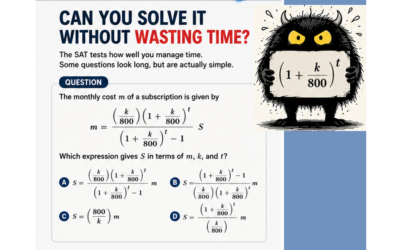
A rectangle was altered by increasing its length by 10 percent and decreasing its width by p percent. If these alterations decreased the area of the rectangle by 12 percent, what is the value of p?
Answer Choices
- A) 12
- B) 15
- C) 20
- D) 22
Step 1 — Translate the Changes into Multipliers
A 10% increase in length means:
$$1+0.10=1.10$$A decrease of p% in width means:
$$1-\frac{p}{100}$$Step 2 — Use the Area Information
The area decreased by 12%, so the new area is 88% of the original area:
$$0.88$$Set up the equation:
$$1.10\left(1-\frac{p}{100}\right)=0.88$$Step 3 — Solve for p
Divide both sides by 1.10:
$$1-\frac{p}{100}=\frac{0.88}{1.10}=0.80$$Subtract 0.80 from 1:
$$\frac{p}{100}=0.20$$Multiply by 100:
$$p=20$$C) 20
SAT Test-Taking Insight
Many students incorrectly subtract the percentages directly:
$$10\%-12\%=2\%$$This is not valid because percentage changes affecting different dimensions must be handled using multiplicative factors.
$$ (1+\text{increase})(1-\text{decrease}) =1+\text{overall change} $$ This single pattern is one of the fastest ways to solve Digital SAT rectangle area percentage problems.
Solve It Without Variables
This is the SATMath800 practical method. Instead of working with unknowns such as l and w, we always choose convenient numbers:
$$l=100,\qquad w=10$$
Now solve the SAT question using only arithmetic.
A rectangle was altered by increasing its length by 10% and decreasing its width by p%. If the area decreased by 12%, what is the value of p?
Step 1 — Compute the Original Area
Using our convenient dimensions:
$$A_{\text{original}}=100\times10=1000$$$$1000$$
Step 2 — Increase the Length by 10%
A 10% increase means add 10 to 100:
$$100+10=110$$$$110$$
Step 3 — Determine the New Area
The area decreased by 12%.
First find 12% of 1000:
$$0.12\times1000=120$$Subtract this from the original area:
$$1000-120=880$$$$880$$
Step 4 — Find the New Width
Area equals length times width, so:
$$110\times w_{\text{new}}=880$$Divide both sides by 110:
$$w_{\text{new}}=\frac{880}{110}=8$$$$8$$
Step 5 — Compare the Widths
The width changed from 10 to 8.
The decrease is:
$$10-8=2$$Now compute the percentage decrease:
$$\frac{2}{10}\times100\%=20\%$$$$p=20$$ Correct choice: C) 20
Why This Method Is SAT-Friendly
Notice that we never introduced algebraic expressions such as l, w, or p/100. We used only easy numbers:
Start with 100 and 10.
Find the original area.
Apply the percentage changes directly.
Use the new area to recover the missing dimension.
Compare old and new dimensions to get the percentage change.
This practical approach is often faster and less error-prone than solving the problem with variables, making it an excellent strategy for Digital SAT percentage-change questions under time pressure.