




Circles in the Coordinate Plane
Circles in the Coordinate Plane
From the geometry behind a circle to the standard equation, general form, completing the square, and the fastest SAT shortcuts.
What does a circle mean?
A circle is the set of all points that are the same distance from one fixed point.
Center
The fixed point is called the center.
Radius
The constant distance from the center is the radius.
Every point
Every point on the circle is exactly r units from the center.
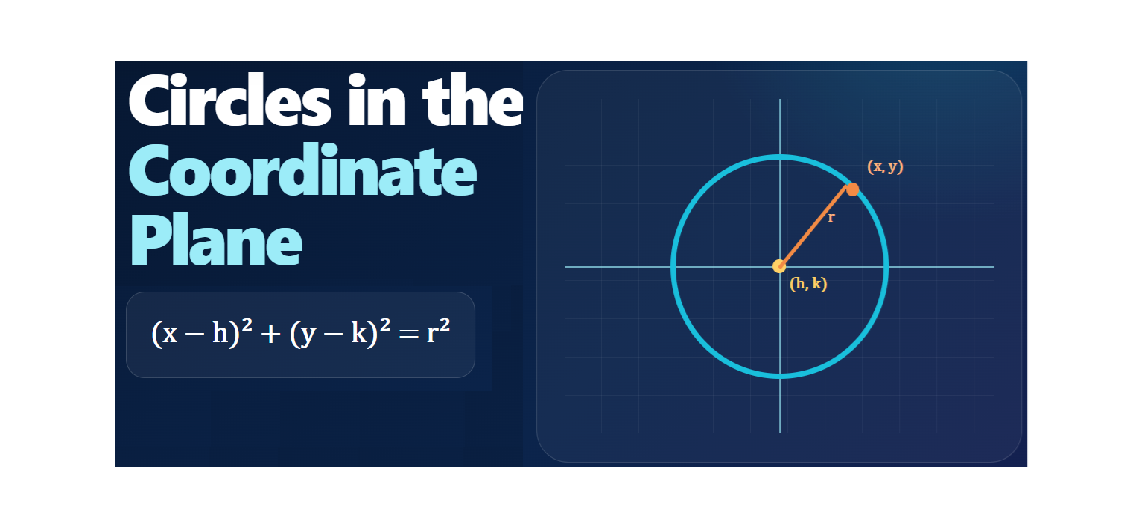
Let the center be \((h,k)\)
Instead of assuming that the center is at the origin, let the center be anywhere on the coordinate plane.
The center is represented by
Here, \(h\) tells us the horizontal location and \(k\) tells us the vertical location.
Now choose any point \(P=(x,y)\) on the circle. The horizontal and vertical differences between \(P\) and the center are:
A circle can be centered anywhere
Before memorizing an equation, look at what a circle actually means on the coordinate plane.
Center
The center can be anywhere on the coordinate plane: \((h,k)\).
Radius
Every point on the circle is exactly \(r\) units from the center.
A point on the circle
If \(P=(x,y)\), its horizontal and vertical distances from the center are \(x-h\) and \(y-k\).
From the triangle to the equation
The horizontal leg of the triangle has length \(x-h\), while the vertical leg has length \(y-k\). The radius is the hypotenuse.
The equation to recognize instantly
Standard equation of a circle
Center
Read directly from the equation: \[ (h,k) \]
Radius
Take the square root of the right side: \[ r=\sqrt{r^2} \]
Important sign rule
The signs inside the parentheses appear opposite to the center coordinates.
Extract the center and radius
Completing the square
Sometimes the SAT gives us a circle in general form instead of standard form.
How do we create the squared form?
Look at the coefficient of the linear term. Divide it by \(2\), then square the result.
The coefficient of \(x\) is \(-10\).
Therefore the squared form must be
because
The coefficient of \(y\) is \(6\).
Therefore:
because
But where did those extra numbers come from?
Completing the square creates extra constants. We cannot simply add them to one side and ignore them.
But
So we have introduced \(+25\).
Complete the square correctly
Group the x and y terms
Add \(25\) and \(9\)
Rewrite each trinomial
Now the answer is visible
Center
Radius
Standard form
There is a faster way
If the equation has the form
you can find the center without fully completing the square.
The center shortcut
Take the coefficient of \(x\), divide by \(-2\). Then take the coefficient of \(y\), divide by \(-2\).
Why does the shortcut work?
Start with the \(x\)-part of the general form:
Completing the square tells us to divide \(D\) by \(2\), then square it.
The resulting squared expression is
Compare this with
Find the center quickly
Finding the radius from general form
Once we know the coefficients \(D,E,F\), we can also determine the radius without writing every intermediate line.
Therefore,
Find the radius quickly
Which method should you use?
Need the center?
Use \[ \left(-\frac D2,-\frac E2\right) \] when the equation is in general form.
Need the radius?
Use the radius formula if the problem only asks for the radius.
Need the whole equation?
Complete the square and convert the equation to standard form.
Computer Scientist’s SAT strategy
Do not perform ten algebraic steps when the question only requires one piece of information. Identify exactly what the SAT is asking for, then choose the shortest valid route.
Common circle mistakes
Flipping the signs
\((x-4)^2\) means \(h=4\), not \(-4\).
Forgetting the square root
If \[ r^2=49, \] then the radius is \(7\), not \(49\).
Ignoring added constants
Completing the square changes both sides. The extra values must be accounted for.
Your circle toolkit
Standard form
Center from general form
Radius from general form
Remember the structure
Center → distances → Pythagorean theorem → circle equation.
Once you understand that chain, the formulas stop being isolated facts and become different ways of describing the same geometric idea.
See the circle. Then choose the shortest path.
A circle in the coordinate plane is not just an equation. It is a geometric relationship between a center, a radius, and every point on the circle.
When the SAT gives you general form, recognize the coefficients and decide whether the long way or the shortcut is more efficient.
One final habit
Don’t solve the equation just because you can. Solve exactly what the question asks.
SAT Circle Questions

One thought on “Circles in the Coordinate Plane”