



Master Operator Precedence
Master
Operator Precedence
Operator precedence is much more than remembering PEMDAS. This Digital SAT operator precedence lesson focuses on fractions, exponents, square roots, absolute values, and mixed operations that frequently appear in College Board SAT Math practice tests. On the Digital SAT, expressions often combine several of these ideas in a single problem. This lesson teaches you how to identify the correct operation first, avoid common SAT traps, and solve confidently without guessing.
Learn the most common operator precedence situations.
Avoid mistakes that cost easy points.
Practice expressions that mix several concepts together.
✅ Fraction bar groups the numerator
✅ Roots before subtraction
Can You Spot the First Operation?
Before learning the rules, test your intuition. Don’t calculate the final answer yet. Simply decide which operation should be performed first.
Show Answer
Multiplication comes before addition.
Show Answer
The fraction bar groups the numerator. Evaluate the numerator before dividing.
Show Answer
Exponents have higher priority than addition.
Show Answer
Multiplication and division have equal priority. Always work from left to right.
⚠️ SAT Observation
Notice that none of these questions asked you to compute the final answer. Top SAT students first ask: “What should I do first?” That single habit prevents many careless mistakes.
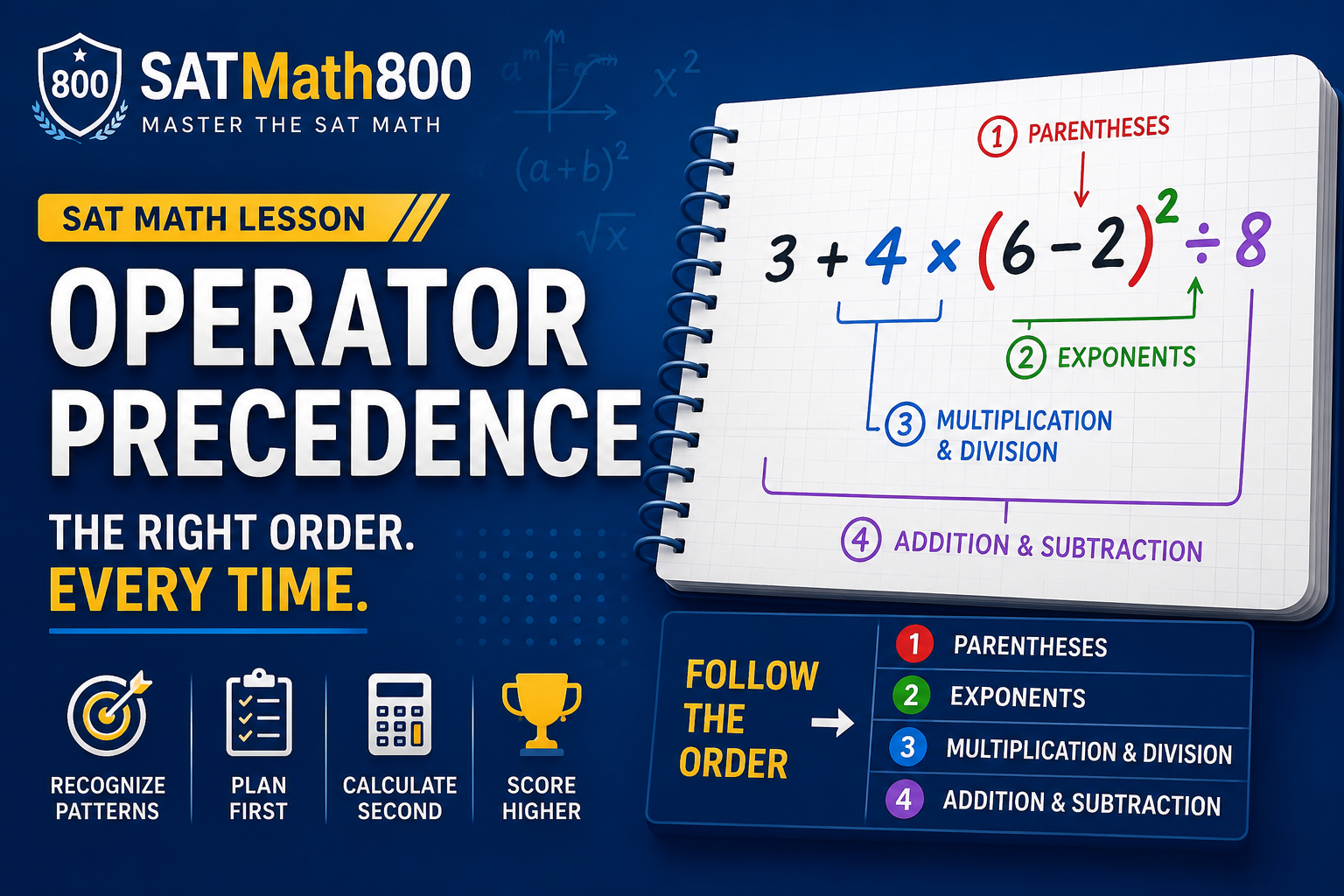
Operator Precedence Rules
Instead of memorizing a long acronym, learn the priority levels. Whenever two operations have the same priority, solve them from left to right.
Always simplify the innermost parentheses first.
Evaluate powers and roots before multiplication or division.
These have equal priority. Always work from left to right.
Also equal priority. Work from left to right.
⚠ SAT Trap #1
Many students memorize PEMDAS and incorrectly think Multiplication comes before Division. It does not. Both have the same priority. Likewise, Addition and Subtraction also share the same priority. Always work left → right.
⭐ A Better Way to Think
“What letter comes next in PEMDAS?”
“What is the highest-priority operation I can perform right now?”
Recognize the Pattern Before You Calculate
The Digital SAT rarely tests operator precedence in isolation. Instead, it combines several ideas into one expression. Learn to recognize these patterns, and you’ll solve problems faster with fewer mistakes.
Parentheses First
\[ 14 \]
Exponent First
\[ 13 \]
Fraction Bar
\[ 4 \]
Left → Right
\[ 8 \]
Square Root
\[ 19 \]
Absolute Value
\[ 8 \]
Mixed Operations
\[ 15 \]
Fraction + Exponent
💡 SATMath800 Strategy
Don’t memorize individual questions. Instead, build a mental library of patterns. When you recognize the structure of a problem, choosing the first operation becomes almost automatic. Top Digital SAT scorers don’t just know the rules—they recognize these patterns instantly.
⚡ Quick Pattern Challenge
Without solving completely, identify the first operation in each expression.
The Fraction Bar Is a Grouping Symbol
This is one of the most overlooked ideas on the Digital SAT. A fraction bar behaves exactly like a pair of parentheses. Everything above the bar belongs together. Everything below the bar belongs together. Many students lose easy points because they ignore this simple rule.
Think of this…
Fraction
Equivalent Parentheses
Both expressions mean exactly the same thing. The fraction bar automatically groups the numerator and denominator.
Worked Examples
\[ =5 \]
\[ =2 \]
\[ =\frac{16}{4} \]
\[ =4 \]
\[ =\frac{25}{5} \]
\[ =5 \]
\[ =\frac{26}{5} \]
\[ =\frac{10}{2} \]
\[ =5 \]
⚠ SAT Trap #2
Students often simplify
like this:
❌ Incorrect. The numerator is grouped by the fraction bar. You must simplify
before dividing by 3.
🎯 Digital SAT Check
Choose the correct answer.
B) 6
C) 4
D) 24
Show Solution
B) 6
C) 7
D) 9
Show Solution
B) 3
C) 4
D) 6
Show Solution
B) 3
C) 4
D) 5
Show Solution
Mistakes That Cost Easy Points
Most students know the rules of operator precedence. The problem is not knowledge—it’s rushing. The Digital SAT often hides simple mistakes inside expressions that look familiar. Learn to recognize these traps before they recognize you.
🎯 SAT Trap #1
❌ Common Mistake
Multiply first because “Multiplication comes before Division.”
✅ Correct Thinking
Multiplication and division have equal priority. Always work left → right.
🎯 SAT Trap #2
❌ Common Mistake
Students divide first.
✅ Correct Thinking
The fraction bar groups the numerator.
🎯 SAT Trap #3
❌ Common Mistake
Students invent parentheses that do not exist.
✅ Correct Thinking
🎯 SAT Trap #4
❌ Common Mistake
Ignore the absolute value until the end.
✅ Correct Thinking
🧠 Think Like a Top Scorer
Before touching your calculator, pause for two seconds and ask yourself:
Where are the grouping symbols?
Are there any exponents or roots?
Which operation has the highest priority?
If two operations have equal priority, where do I start?
🔥 SAT Trap Challenge
Each expression contains a common trap. Try solving it before revealing the solution.
Show Solution
Show Solution
Show Solution
Show Solution
Mixed-Concept SAT Questions
These questions are designed to feel much closer to the actual Digital SAT. Notice that each problem combines two or three different concepts—fractions, exponents, roots, absolute values, and operator precedence.
Question 1
Warm-UpShow Solution
Question 2
Exponent + FractionShow Solution
Question 3
Root + FractionShow Solution
Question 4
Absolute ValueShow Solution
Question 5
Real SAT StyleShow Solution
Question 6
ChallengeShow Solution
📊 Quick Score Check
Strong SAT readiness.
Review fraction grouping.
Repeat Parts 03–05.
💡 SATMath800 Observation
Notice how the hardest questions did not require advanced algebra. They required recognizing the correct order of operations inside a fraction. This is exactly the type of reasoning the Digital SAT rewards.
Can You Think Like an 800 Scorer?
These questions combine several ideas in a single expression. Slow down. Identify the operations in the correct order before you calculate. This is much closer to what you’ll encounter on the Digital SAT.
Challenge 1
💡 Show Hint
✅ Show Solution
Challenge 2
💡 Show Hint
✅ Show Solution
Challenge 3
💡 Show Hint
✅ Show Solution
Challenge 4
💡 Show Hint
✅ Show Solution
Challenge 5
💡 Show Hint
✅ Show Solution
Challenge 6 ★
💡 Show Hint
✅ Show Solution
🎯 Reflection
If these problems felt difficult, don’t worry. Notice that none required advanced mathematics. The challenge came from recognizing the correct order of operations while several concepts appeared together. That’s exactly how the Digital SAT increases difficulty. Students who develop this habit make fewer careless mistakes and solve problems more efficiently.
Solve Faster Without Taking Shortcuts
On the Digital SAT, speed comes from recognizing patterns, not rushing. These habits help you solve expressions correctly while saving valuable time.
Scan Before Solving
Before touching your calculator, spend two seconds looking for
- Parentheses
- Fraction bars
- Exponents
- Square roots
- Absolute values
Find the Highest Priority
Ask yourself only one question:
Everything else becomes much easier.
Group Before Dividing
Whenever you see a fraction, mentally replace it with parentheses.
Think
Equal Priority?
Multiplication and division
Addition and subtraction
⏱️ 20-Second Challenge
Without writing intermediate steps, solve each expression mentally if possible. Try to finish all four in under 20 seconds.
Answer
Answer
Answer
Answer
🏁 Beat the Clock
How quickly can you identify the first operation? Don’t calculate the final answer. Simply point to the operation that must happen first.
Show Answer
Show Answer
Show Answer
Show Answer
💡 Speed Secret
The fastest students don’t actually calculate faster. They simply recognize the structure of an expression almost instantly. Their brain immediately notices:
- ✔ Fraction bar
- ✔ Exponent
- ✔ Square root
- ✔ Parentheses
- ✔ Left-to-right operations
That quick scan usually takes less than two seconds and prevents many careless mistakes.
🎯 SATMath800 Speed Rule
Don’t begin calculating until you know exactly which operation comes first. That one habit makes you both faster and more accurate.
What You Should Remember
Excellent work! You’ve finished one of the most important arithmetic skills on the Digital SAT. Operator precedence is not about memorizing an acronym—it is about recognizing mathematical structure.
Grouping First
Parentheses and fraction bars create groups. Always simplify those groups before moving on.
Powers & Roots
Evaluate exponents and square roots before multiplication, division, addition, or subtraction.
Left → Right
Multiplication and division share the same priority. Addition and subtraction do too. Always move from left to right.
Think Before Solving
The first operation is usually more important than the final calculation. Pause before you start.
🧠 The SATMath800 Method
Every Digital SAT math problem becomes easier when you follow the same thinking process.
🏁 Final 60-Second Check
Try these without looking back at the lesson.
Answer
Answer
Answer
Answer
📈 What’s Next?
Operator precedence appears throughout the Digital SAT, especially when combined with algebra, functions, and equations. The next lesson builds directly on these skills.
Fractions & Rational Expressions
Learn how to simplify, compare, and manipulate fractions efficiently.
Pattern Recognition
Review this lesson until identifying the first operation becomes automatic.
💬 One Final Thought
Master yourself first.
The SAT measures how you compare with other students. Every lesson you complete makes you a stronger problem solver than you were yesterday. Don’t chase perfection. Build consistent habits, recognize patterns, and let your progress compound over time.