



SAT Quadratics and Factors Questions
SAT Quadratics, Factors, and Second-Degree Equations
These problems are modeled on a pattern that appears in College Board’s recent Digital SAT practice tests. Instead of practicing random algebra exercises, you are working on the kinds of quadratic factorization, polynomial roots, and coefficient-matching questions that frequently appear on official SAT exams.
The SAT Pattern
Whenever the SAT says a quadratic expression has a factor of x + kb, where b is a positive integer constant, we can model the general factorization as:
Here, a is the coefficient of $x^2$ from the given options, and c is an unknown integer constant. By expanding the expression, matching the constant term to find c, and analyzing the middle coefficient equation, we can test every choice rigorously to ensure b yields a positive integer.
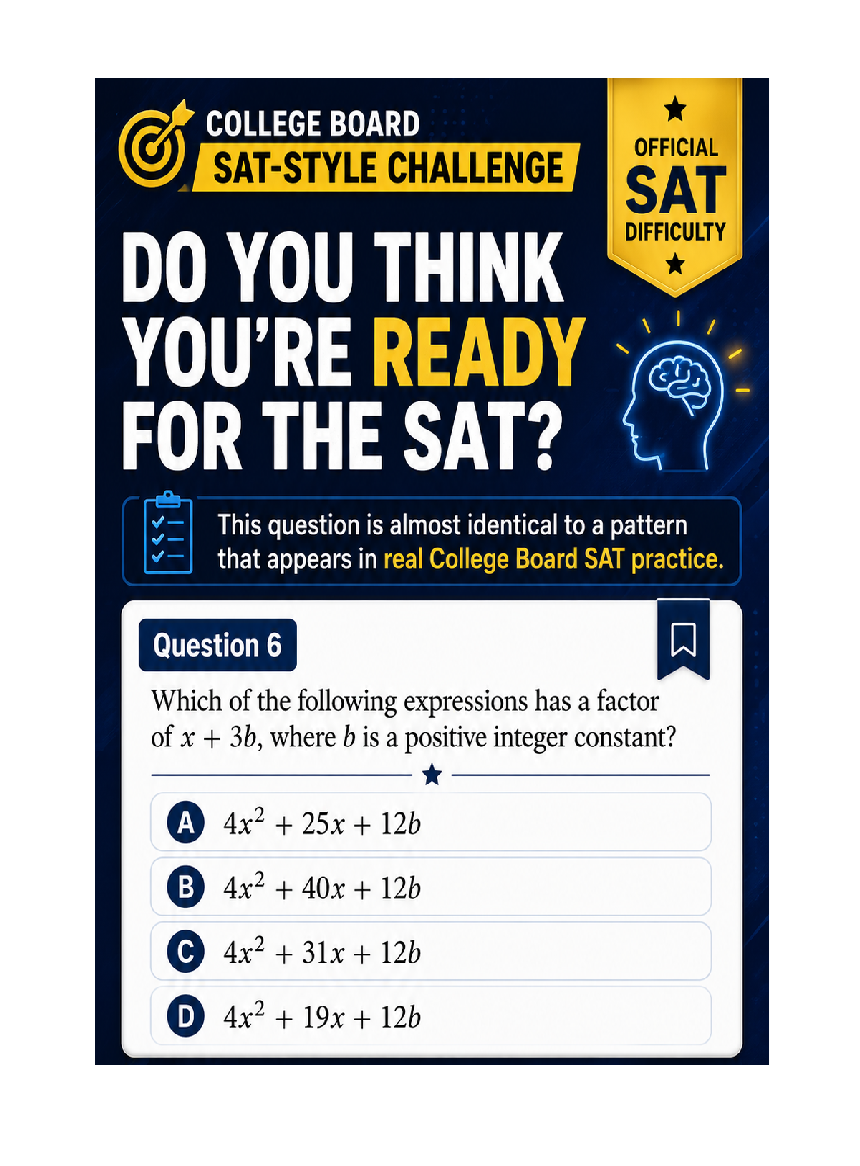
Featured SAT-Style Question
Step 1 — Set up the general factored form
Since the leading coefficient of the quadratic options is $4$ and the given factor is x + 3b, we set up the product with an unknown constant term c:
Step 2 — Expand the product
Step 3 — Match the constant term to find c
Equating our expanded constant term $3bc$ to the constant term present in all options ($12b$):
Since b is a positive integer ($b \neq 0$), we divide both sides by b:
Step 4 — Analyze the middle coefficient and test all choices one by one
Substituting $c = 4$ into our middle coefficient expression $(12b + c)$ gives:
We now set this equal to the middle coefficient of each option one by one to solve for b and show why incorrect choices fail to produce a positive integer:
$12b + 4 = 19$
$12b = 15 \implies b = \frac{15}{12} = 1.25$
Result: Not an integer ❌
$12b + 4 = 25$
$12b = 21 \implies b = \frac{21}{12} = 1.75$
Result: Not an integer ❌
$12b + 4 = 31$
$12b = 27 \implies b = \frac{27}{12} = 2.25$
Result: Not an integer ❌
$12b + 4 = 40$
$12b = 36 \implies b = 3$
Result: $b = 3$ (Positive integer! Correct ✅)
Additional Bluebook-Style Practice
Practice Question 1
Which expression has a factor of x + 3b, where b is a positive integer constant?
Step 1: Assume general factored form
Step 2: Expand
Step 3: Match constants to find c
Step 4: Test choices using middle coefficient $6b + 5$
$6b = 8 \implies b = \frac{4}{3}$ (Not an integer ❌)
$6b = 14 \implies b = \frac{7}{3}$ (Not an integer ❌)
$6b = 18 \implies b = 3$ (Constant check fails: $45b \neq 15b$ ❌)
$6b = 24 \implies b = 4$ (Positive integer! Correct ✅)
Practice Question 2
Which expression has a factor of x + 4b, where b is a positive integer constant?
Step 1: Assume general factored form
Step 2: Expand
Step 3: Match constants to find c
Step 4: Test choices using middle coefficient $16b + 5$
$16b = 20 \implies b = \frac{5}{4}$ (Not an integer ❌)
$16b = 28 \implies b = \frac{7}{4}$ (Not an integer ❌)
$16b = 36 \implies b = \frac{9}{4}$ (Not an integer ❌)
$16b = 48 \implies b = 3$ (Positive integer! Correct ✅)
Practice Question 3
Which expression has a factor of x + 2b, where b is a positive integer constant?
Step 1: Assume general factored form
Step 2: Expand
Step 3: Match constants to find c
Step 4: Test choices using middle coefficient $10b + 5$
$10b = 12 \implies b = 1.2$ (Not an integer ❌)
$10b = 17 \implies b = 1.7$ (Not an integer ❌)
$10b = 22 \implies b = 2.2$ (Not an integer ❌)
$10b = 30 \implies b = 3$ (Positive integer! Correct ✅)
Practice Question 4
Which expression has a factor of x + 5b, where b is a positive integer constant?
Step 1: Assume general factored form
Step 2: Expand
Step 3: Match constants to find c
Step 4: Test choices using middle coefficient $15b + 3$
$15b = 19 \implies b = \frac{19}{15}$ (Not an integer ❌)
$15b = 25 \implies b = \frac{5}{3}$ (Not an integer ❌)
$15b = 30 \implies b = 2$ (Positive integer! Correct ✅)
$15b = 37 \implies b = \frac{37}{15}$ (Not an integer ❌)
Answer Key
| Question | Answer |
|---|---|
| Featured Question | D |
| Practice Question 1 | D |
| Practice Question 2 | D |
| Practice Question 3 | D |
| Practice Question 4 | C |
SAT Quadratics Strategy Summary
A Reliable Digital SAT Method
- Write the factorization pattern (ax + c)(x + kb) using the leading coefficient and given factor.
- Expand to obtain the general quadratic expression in terms of b and c.
- Match the constant term to solve for c.
- Test each answer choice against the middle coefficient expression to verify which option yields a valid positive integer for b.
This method completely eliminates guesswork on Digital SAT questions involving factors, roots, quadratic expressions, and polynomial equations.