




The Computer Scientist’s SAT Challenge #1
Can You Solve This Without Writing a Single Equation?
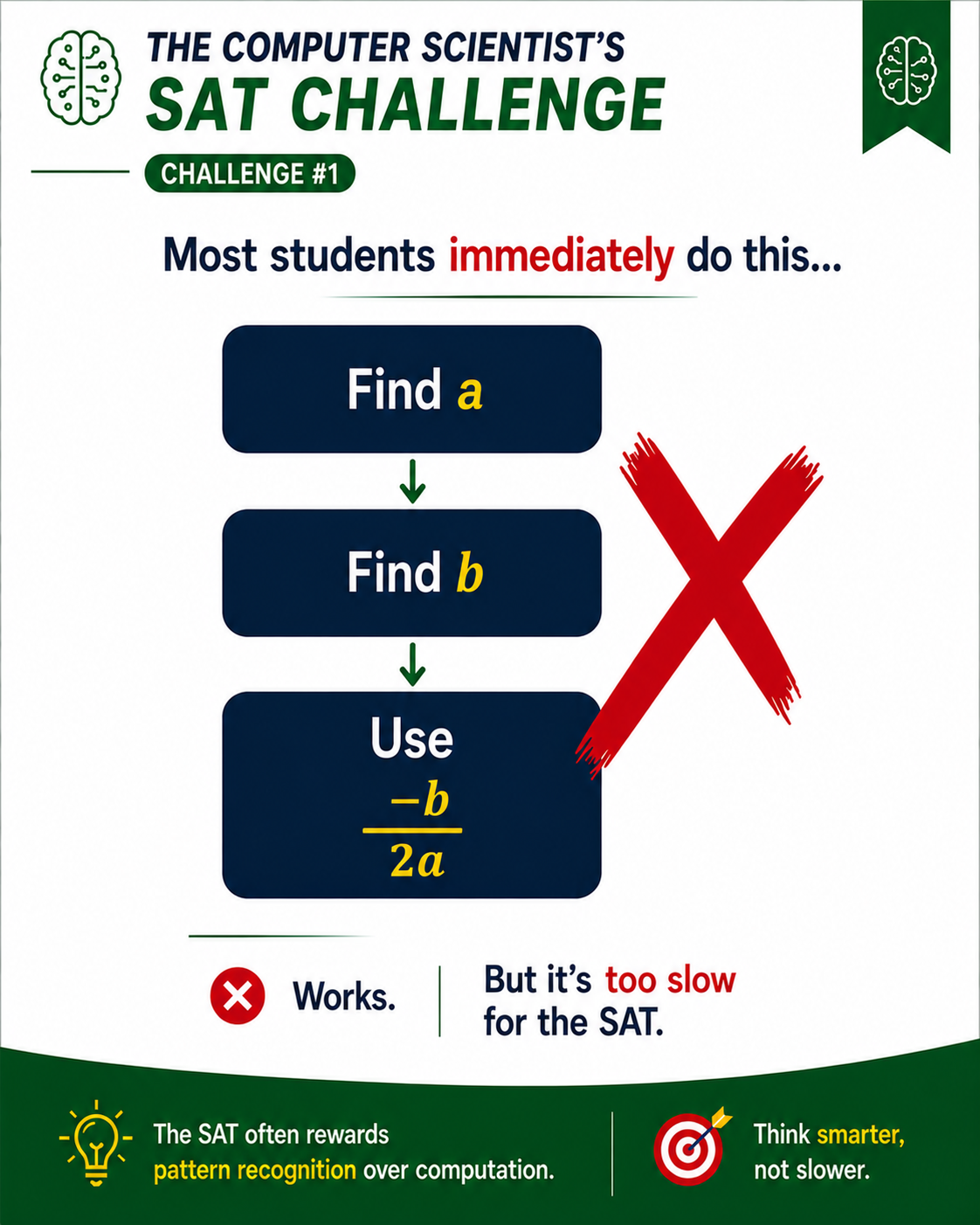
Many students solve quadratic function problems on the digital SAT using long, tedious procedures: finding coefficients a and b, and then plugging them into the vertex formula. While this works, it is far too slow for the rigorous time constraints of the SAT.
The Challenge:
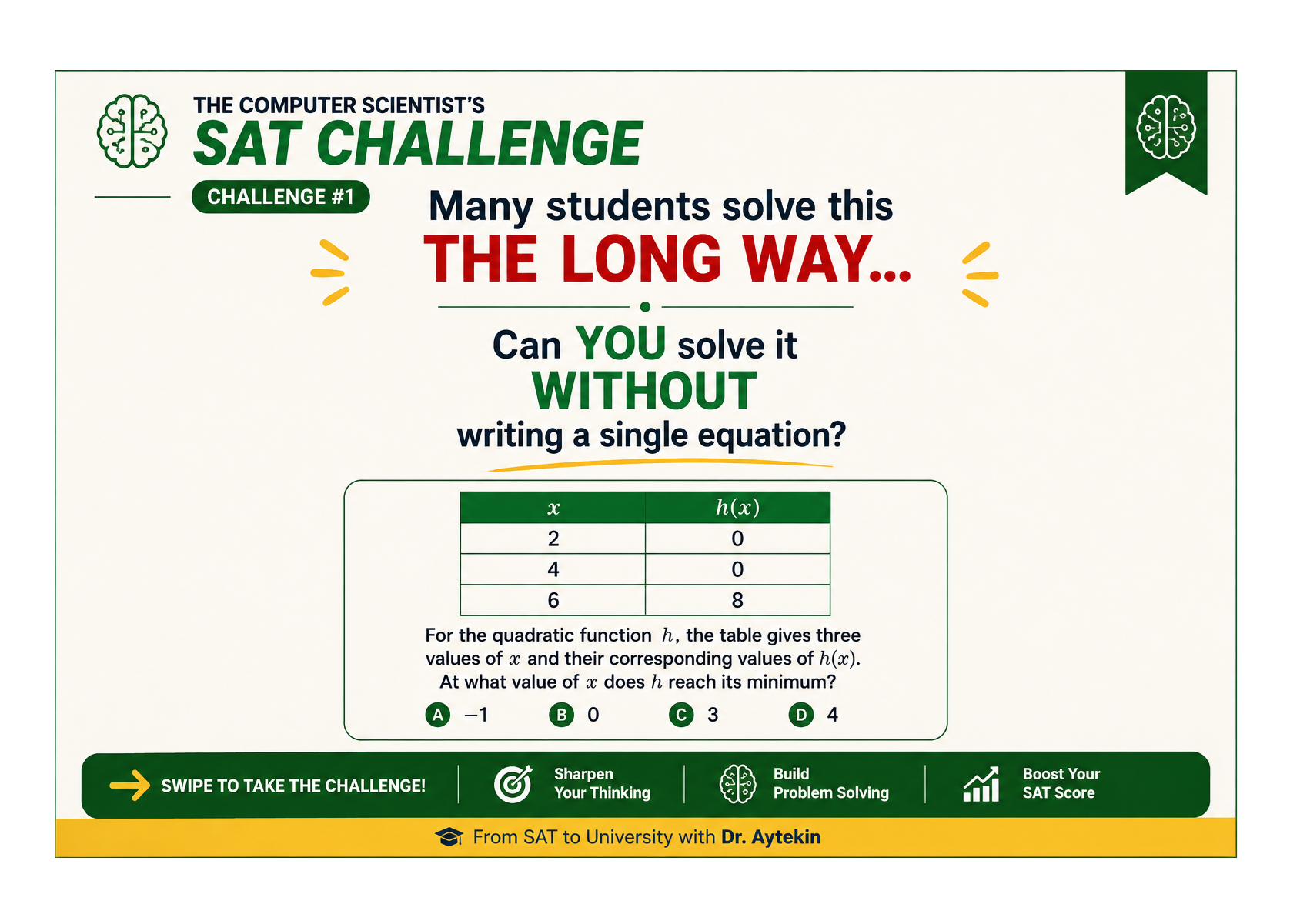
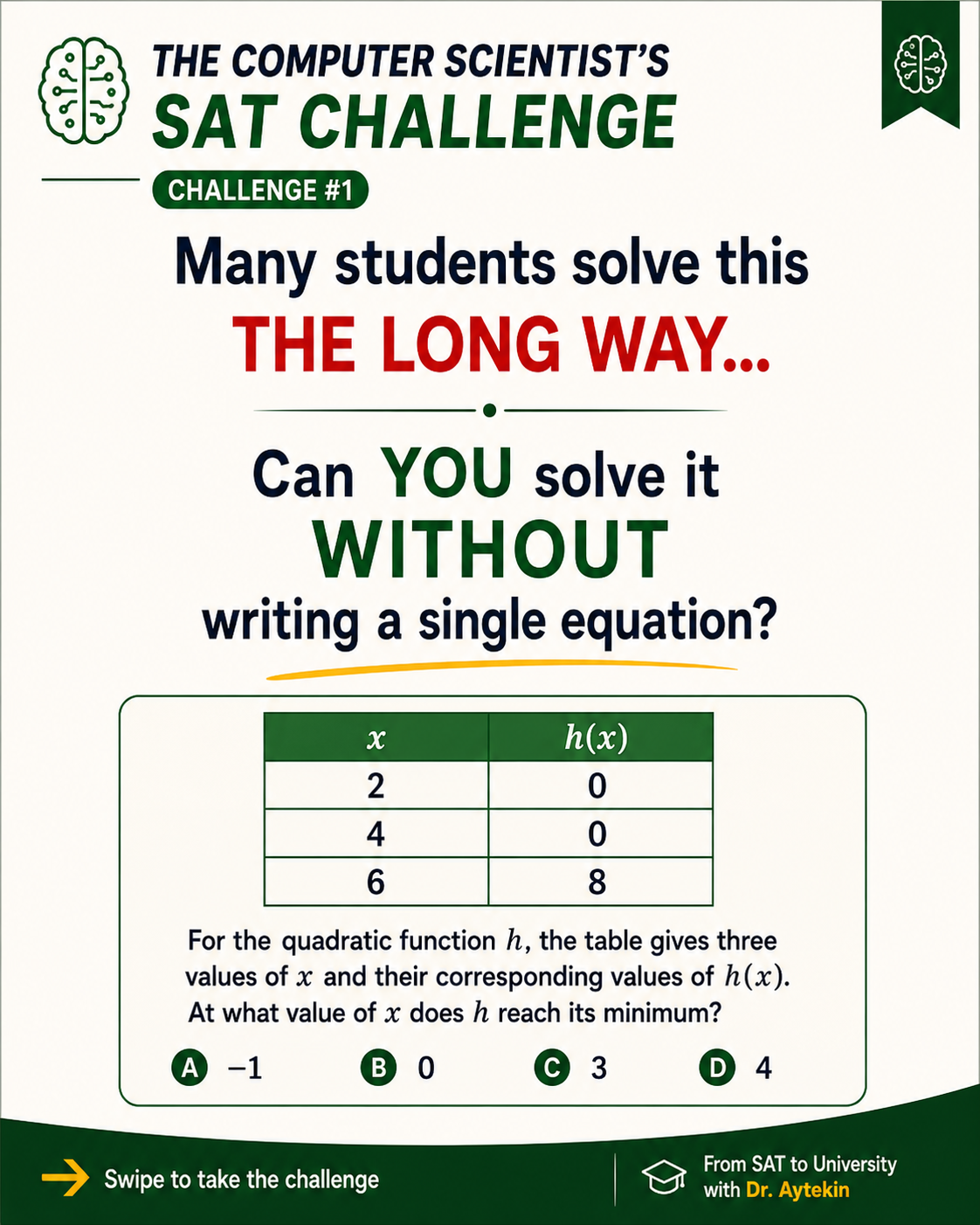
For the quadratic function h, the table gives three values of x and their corresponding values of h(x):
Options: A) -1 B) 0 C) 3 D) 4
For the quadratic function h, the table gives three values of x and their corresponding values of h(x):
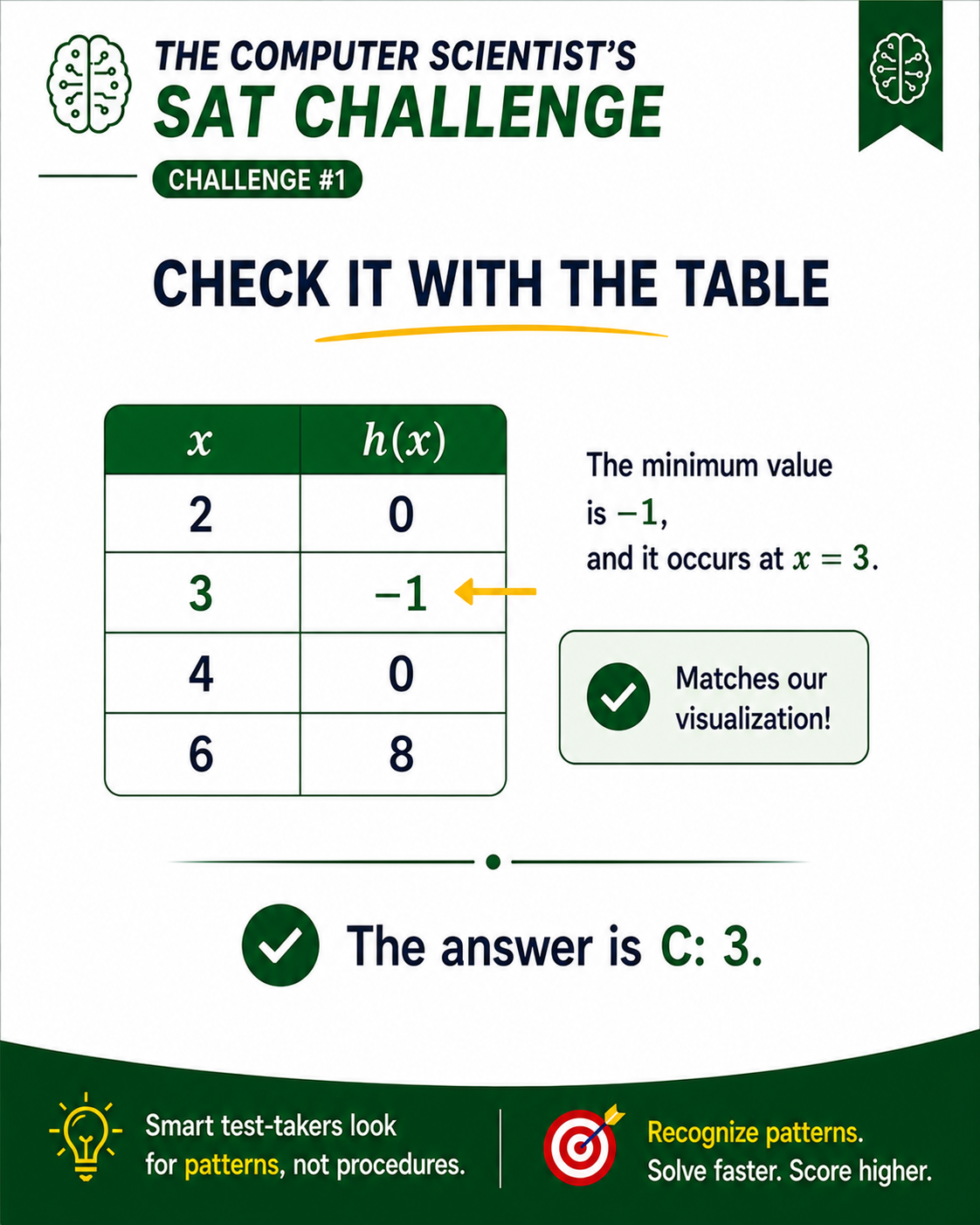
- When x = 2, h(x) = 0
- When x = 4, h(x) = 0
- When x = 6, h(x) = 8
Options: A) -1 B) 0 C) 3 D) 4
The Long Way vs. The Smart Way
Most students immediately attempt to solve for a and b. But smart test-takers look for structural clues and patterns.
Step-by-Step Breakdown: The Computer Scientist Method
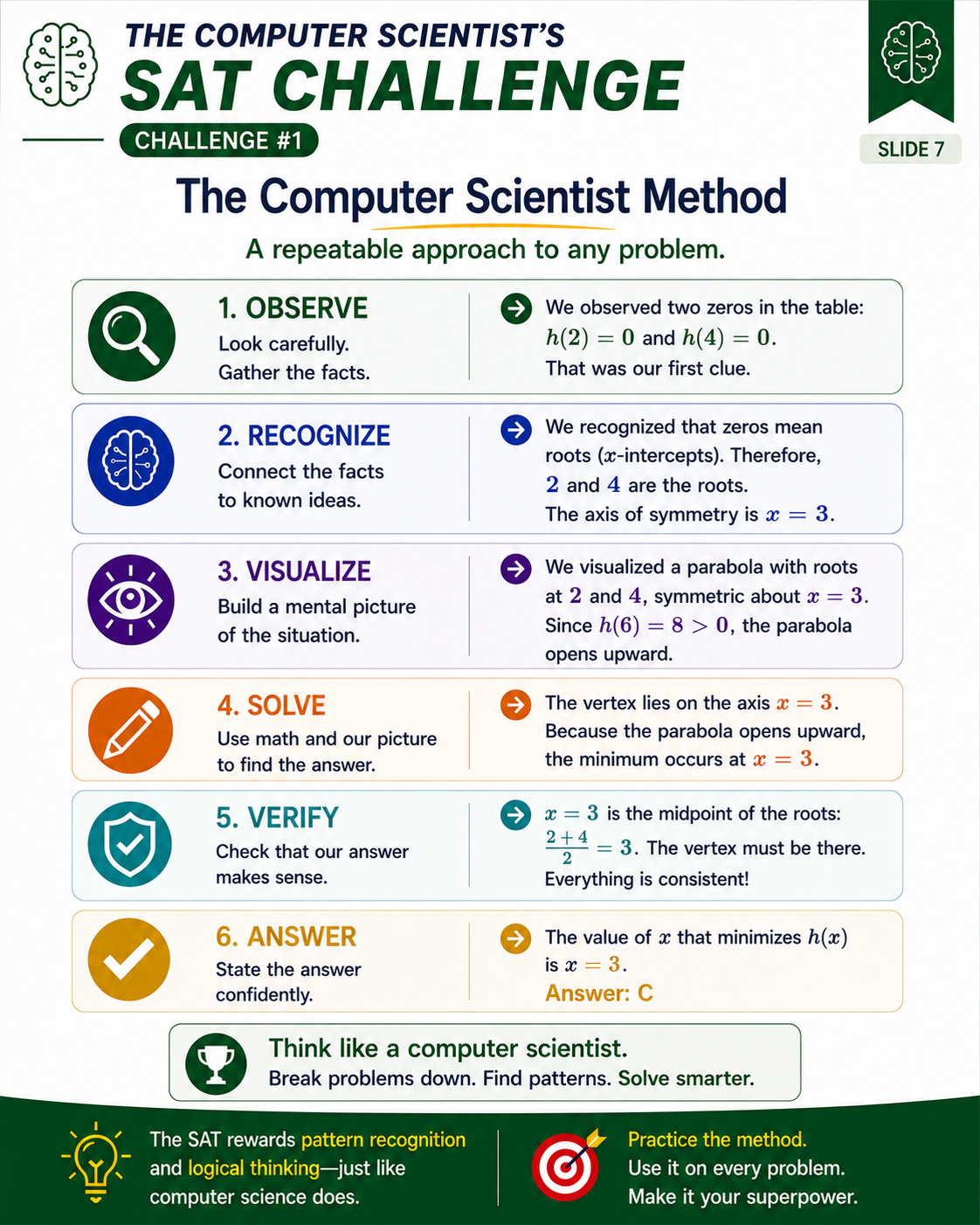
- Observe: Look closely at the table. Notice that h(2) = 0 and h(4) = 0. Two zeros in a table are never a coincidence—they are clues.
- Recognize: Whenever h(x) = 0, the graph crosses the x-axis. Therefore, 2 and 4 are the roots (or x-intercepts) of the quadratic function.
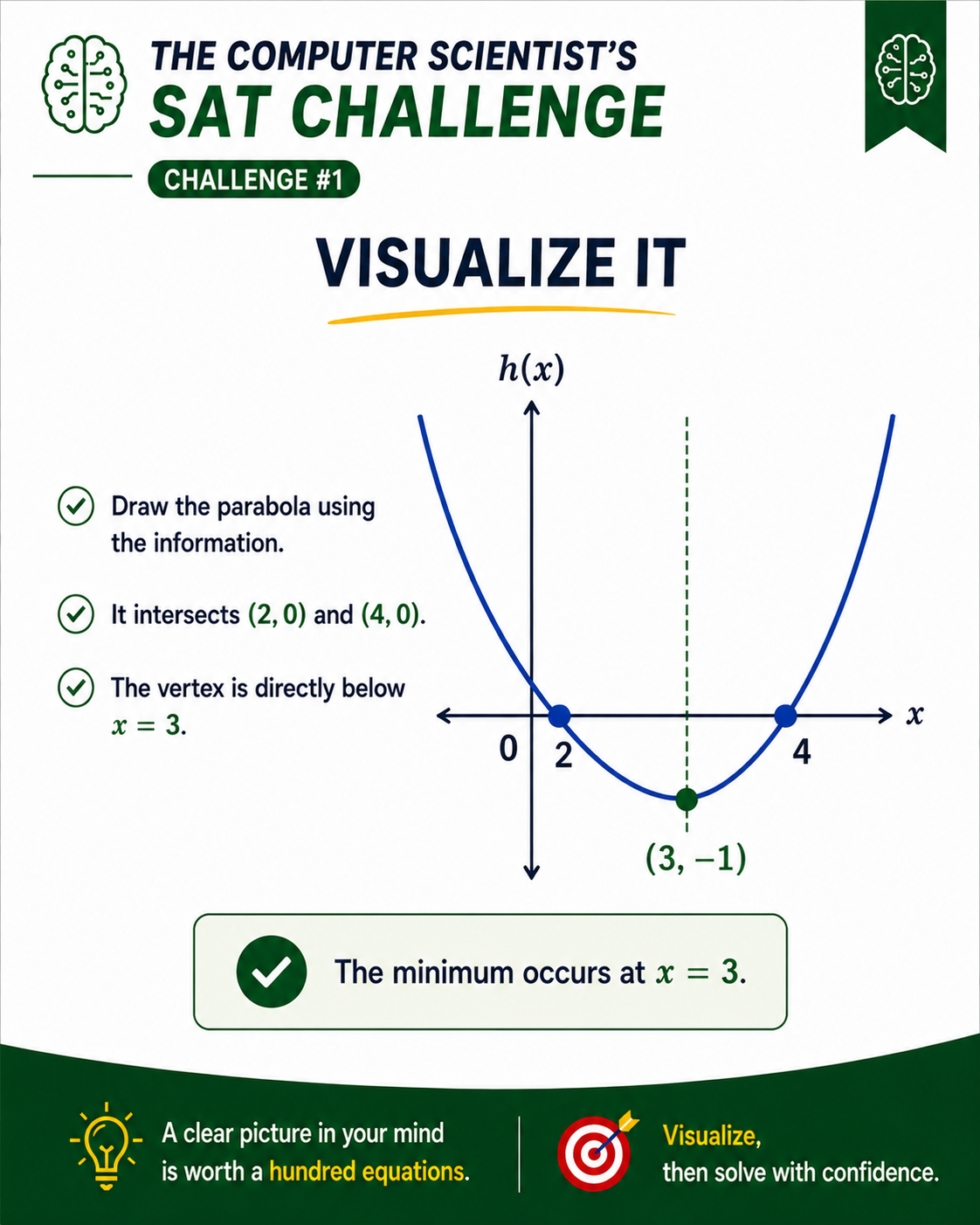
- Visualize: Every parabola is perfectly symmetric. Because the roots are at 2 and 4, the axis of symmetry lies exactly halfway between them: (2 + 4) / 2 = 3.
- Solve & Verify: Since the parabola opens upward, the minimum value must occur directly on the axis of symmetry at x = 3. Checking the table or visualizing the vertex point (3, -1) confirms our result.
Final Answer
The correct option is C: 3.
Want Weekly SAT Challenges?
Master pattern recognition, build deep conceptual understanding, and optimize your test performance.
Follow @drvargun on Instagram