



SAT Function Translation: Right or Left? Up or Down? (Digital SAT Shortcut)
SAT Function Translation Trick: Right or Left? Up or Down?
This is one of the most common Digital SAT graph transformation questions. Students often lose points because they mix up left vs. right and up vs. down. In this lesson, we’ll turn that confusion into a simple pattern you can recognize in under 10 seconds.
Watch the 20-Second Explanation
Perfect if you came from Instagram or YouTube Shorts.
🎥 Quick walkthrough: identify the inside change, identify the outside change, and choose the correct SAT answer without graphing every point.
We’ll make it easy for you.
These SAT questions are not about memorizing dozens of graphs. They are about recognizing two predictable patterns that appear again and again on the Digital SAT.
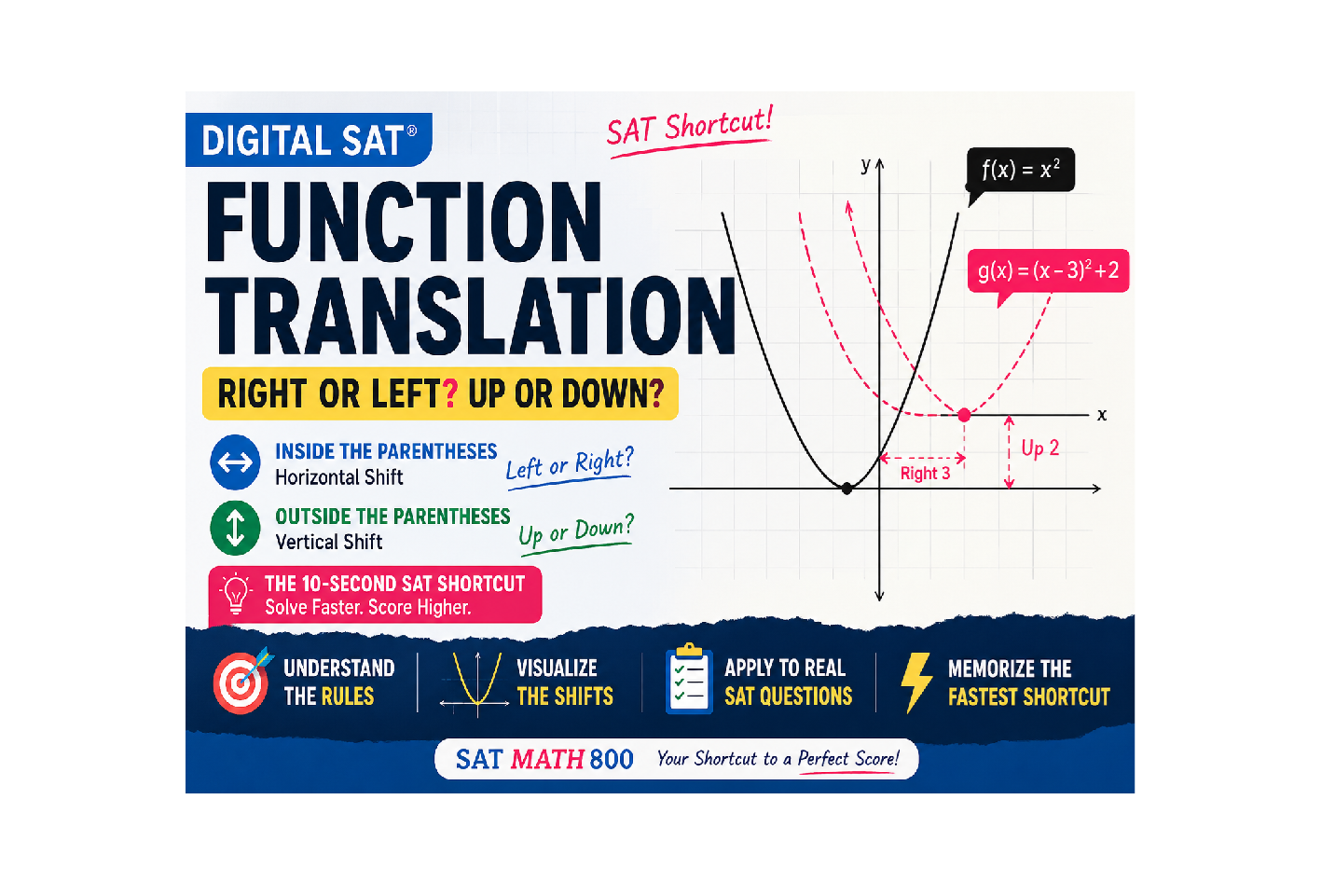
The expression inside the parentheses controls the horizontal shift.
The number outside the parentheses controls the vertical shift.
The Inside Rule
The first thing to check is the expression inside the parentheses. This controls the horizontal movement of the graph — and this is the part that confuses many SAT students because the direction is opposite of what it looks like.
Step 1 — Find the inside part
Inside = opposite direction
The expression is (x − 3), so the graph moves RIGHT 3 units.
Think of the inside change as happening first. It shifts the entire graph horizontally before anything else happens.
Visualize the horizontal shift
Original → shifted right 3Remember this SAT shortcut
Horizontal shifts are controlled by the expression inside the parentheses. The easiest way to remember them is to focus on the sign.
A minus sign inside the parentheses moves the graph to the right.
A plus sign inside the parentheses moves the graph to the left.
The Outside Rule
After identifying the horizontal shift, look at the number outside the parentheses. This controls the vertical movement of the graph. Unlike the inside rule, the outside rule follows the same direction as the sign.
Step 2 — Find the outside part
Outside = same direction
The expression is +2, so the graph moves UP 2 units.
The outside change happens after the horizontal shift. It moves the entire graph up or down.
Visualize the vertical shift
Shifted right 3 → then moved up 2Remember this SAT shortcut
Vertical shifts are much easier than horizontal shifts because the sign keeps its normal direction.
A positive number outside the parentheses moves the graph up.
A negative number outside the parentheses moves the graph down.
Solve the SAT Question
Let’s return to the original Digital SAT-style question and solve it exactly the way you should approach it during the exam.
The function f(x) = x² is transformed to create a new function:
Which statement describes the transformation from f to g?
Inside the parentheses
This controls the horizontal shift. Because the sign is minus inside, the graph moves RIGHT 3 units.
Outside the parentheses
This controls the vertical shift. Because the sign is plus outside, the graph moves UP 2 units.
Combine the two moves
The SAT often hides a very simple pattern inside a complicated-looking expression. Instead of trying to graph every point, train yourself to ask only two questions:
What is happening inside the parentheses?
What is happening outside the parentheses?
The 10-Second SAT Shortcut
Here’s the pattern that appears repeatedly on the Digital SAT. If you memorize this one template, you can solve many graph translation questions almost instantly.
Think of h as the horizontal shift and k as the vertical shift.
| Expression | Horizontal | Vertical |
|---|---|---|
| (x − 3)² + 2 | Right 3 | Up 2 |
| (x + 1)² − 4 | Left 1 | Down 4 |
| (x − 6)² − 1 | Right 6 | Down 1 |
When this question appears on your laptop during the SAT, don’t start graphing points. Instead, follow this mental checklist:
This is one of the fastest SAT graph questions.
Once you remember Inside → Opposite and Outside → Same, function translations become pattern recognition problems instead of graphing problems.
Practice a few of these every day and you’ll start recognizing the correct SAT answer almost immediately.