



Master Decimals for the Digital SAT
Master Decimals for the Digital SAT
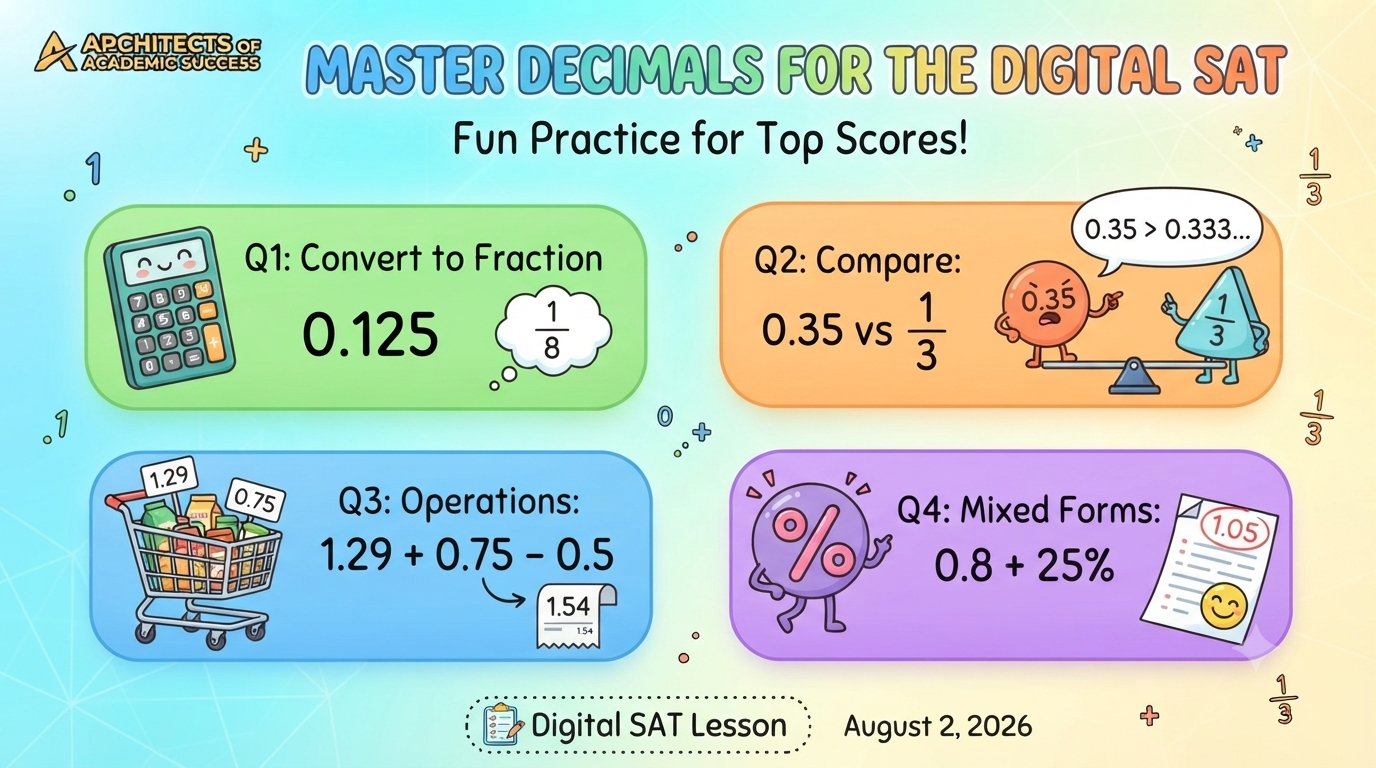
Decimals are simply another way to write fractions. This Digital SAT lesson focuses on decimal comparison, converting fractions and decimals, and decimal operations that frequently appear in College Board SAT Math practice tests. On the SAT, many problems become much easier when you can switch naturally between fractions, decimals, and percentages. This lesson will help you recognize equivalent forms, avoid common decimal traps, and solve confidently without guessing.
Quick Check
Already Know This?
- Write 1/2 as a decimal.
- Write 0.75 as a fraction.
- Which is greater: 0.8 or 0.78?
- Round 6.47 to the nearest tenth.
- Which is greater: 0.49 or 1/2?
Warm-Up
- Convert 4/5 to a decimal.
- Convert 0.25 to a fraction.
- Which is larger: 0.62 or 0.7?
- Write 0.125 as a fraction.
- Which is larger: 0.09 or 0.1?
The Big Idea
Decimals are simply another way to write fractions. The number has not changed — only the notation has.
Whenever you see a decimal, ask yourself:
“Would this problem become easier as a fraction?”
Strong SAT students switch naturally between fractions, decimals, and percentages.
Decimal, Fraction, and Percent Relationship
Fraction
Decimal
Percent
Why This Matters on the Digital SAT
Many SAT questions hide simple arithmetic behind different representations.
For example, these three expressions are exactly the same quantity:
Students who recognize these equivalences immediately can solve problems much faster and avoid unnecessary calculations.
Decimal Place Value
Each place to the right of the decimal point is 10 times smaller than the place before it.
Tenths
Hundredths
Thousandths
Important: The number of digits after the decimal point matters because it tells you the place value of each digit.
Trailing Zeros Do Not Change the Value
You may add zeros to the end of a decimal without changing its value.
This is extremely useful when comparing decimals because it allows you to give both numbers the same number of decimal places.
Guided Example — Comparing Decimals
Which Number Is Greater?
Step 1: Give both numbers the same number of decimal places.
Step 2: Compare the digits from left to right.
- Tenths: 7 = 6? No. The first number has 7 tenths, the second has 6 tenths.
Another Comparison Example
Which Number Is Greater?
Add a trailing zero to the second number:
Compare place values:
- Tenths: 4 = 4
- Hundredths: 0 < 5
SAT Trap — 0.09 vs 0.1
Many students think 0.09 is greater than 0.1 because 9 is larger than 1. This is a place value mistake.
Rewrite both numbers with the same number of decimal places:
Now compare:
- 0.09 = 9 hundredths
- 0.10 = 10 hundredths
Try These Yourself
Question 1
Which is greater?
Question 2
Which is greater?
Question 3
Write with the same number of decimal places:
Solutions
Solution 1
Answer: 0.83
Solution 2
Answer: 0.30
Solution 3
Now they are easy to compare.
Converting Fractions to Decimals
To convert a fraction to a decimal, divide the numerator by the denominator.
Think of the fraction bar as a division symbol.
Example 1
Example 2
Example 3
Guided Example — A More Challenging Fraction
Convert 7/8 to a decimal.
Step 1: Divide 7 by 8.
Step 2: Check the result.
Converting Decimals to Fractions
Use the place value of the last digit.
Tenths
Hundredths
Thousandths
Always simplify the fraction if possible.
Simplifying Fractions
Simplify 125/1000
Both numbers are divisible by 125.
Common SAT Decimal Equivalents
0.5
0.25
0.75
0.2
0.4
0.8
0.125
0.375
SAT-Style Conversion Practice
Question 1
Convert 3/5 to a decimal.
Question 2
Write 0.45 as a fraction in simplest form.
Question 3
Which fraction is equal to 0.375?
- A) 1/4
- B) 3/8
- C) 2/5
- D) 5/8
Mixed Representation Challenge
Arrange these numbers from least to greatest:
Step 1: Convert everything to decimals.
Step 2: Compare the decimals.
Key Idea to Remember
For SAT problems involving fractions, decimals, and percentages:
- Use fractions when denominators are simple (2, 4, 5, 8, 10, 20).
- Use decimals when comparing numbers.
- Use percentages when the problem talks about parts out of 100.
Adding Decimals
The most important rule is:
Notice that the decimal points stay in the same vertical line.
Subtracting Decimals
Example
Writing 5.00 instead of 5 makes the subtraction much easier.
Multiplying Decimals
Ignore the decimal points first, multiply normally, and then place the decimal point in the final answer.
Example: 0.25 × 8
Step 1: Ignore the decimal point.
Step 2: The original number 0.25 has 2 decimal places, so move the decimal point two places left.
Dividing Decimals
Example: 3.6 ÷ 0.6
Dividing by a decimal is inconvenient, so make the divisor a whole number.
Multiply both numbers by 10.
When Decimals Meet Fractions
Sometimes converting the decimal to a fraction is faster.
Example: 0.5 × 18
Instead of multiplying decimals, use:
This is often the fastest calculator-free SAT method.
Word Problem — Money
Example
A notebook costs $3.75 and a pen costs $1.45. What is the total cost?
Step 1: Add the decimals.
Step 2: Interpret the result.
Word Problem — Measurement
Example
A rope is 12.8 meters long. A piece of 4.35 meters is cut off. How much rope remains?
Step 1: Write the numbers with the same number of decimal places.
Step 2: Subtract.
SAT Speed Shortcuts
0.5 of a Number
Half of the number.
0.25 of a Number
One fourth of the number.
0.75 of a Number
Three fourths of the number.
0.2 of a Number
One fifth of the number.
SAT-Style Practice Set A
These questions are designed to feel similar to the short calculator and non-calculator style questions that appear in recent Digital SAT Math practice tests.
Question 1 — Decimal Addition
A student buys a notebook for $4.75 and a pen for $2.48. What is the total cost?
Line up the decimal points.
Question 2 — Comparing Decimals
Which number is greatest?
- A) 0.58
- B) 0.605
- C) 0.59
- D) 0.580
Rewrite them with the same number of decimal places.
Compare from left to right:
Question 3 — Fraction to Decimal
What decimal is equivalent to 7/20?
Question 4 — Decimal to Fraction
Write 0.625 as a fraction in simplest form.
Divide numerator and denominator by 125.
Mixed Operations Practice
Question 5 — Multiplication Shortcut
Compute without a calculator:
Use the fraction form:
First divide:
Then multiply:
Question 6 — Division with Decimals
Compute:
Multiply both numbers by 10.
Bluebook-Style Challenge Question
Challenge
Which expression has the greatest value?
- A) 0.4 × 15
- B) 0.25 × 24
- C) 3.6 ÷ 0.6
- D) 0.75 × 8
Evaluate each choice.
All four expressions are equal.
What the SAT Is Really Testing
Notice that most of these questions were not about difficult arithmetic. The SAT is usually testing whether you can:
- recognize equivalent forms,
- choose an efficient representation,
- avoid place-value mistakes,
- and organize decimal operations correctly.
SAT-Style Practice Set B
These questions combine decimals with fractions, percentages, and multi-step reasoning — the type of thinking that appears frequently on the Digital SAT.
Question 7 — Percent and Decimal Connection
A store reduces the price of a $80 item by 25%. What is the sale price?
Convert the percent to a decimal.
Find the discount.
Subtract from the original price.
Question 8 — Multi-Step Decimal Problem
A student studies for 2.5 hours on Monday and 1.75 hours on Tuesday. If the student studies for 0.5 hours less on Wednesday than on Tuesday, how many total hours did the student study?
Find Wednesday’s study time.
Add all three days.
Question 9 — Choosing the Efficient Representation
Compute without a calculator:
Recognize that:
Then:
Mixed Representation Challenge
Arrange these numbers from least to greatest:
Step 1: Convert everything to decimals.
Step 2: Compare the decimals.
Digital SAT Challenge Problem
Challenge
Evaluate:
Speed Test — Can You Do These Mentally?
1
Answer: 7
2
Answer: 5
3
Answer: 12
4
Answer: 9
Common SAT Decimal Mistakes
Mistake 1
Thinking 0.09 > 0.1
Mistake 2
Adding without aligning decimals
Mistake 3
Forgetting to simplify a decimal fraction
Mini Practice Quiz
Quiz 1
Which is greater?
Quiz 2
Write 0.48 as a simplified fraction.
The Real SAT Skill
Notice how the hardest questions became easier when we changed the representation:
- 0.5 → 1/2
- 0.25 → 1/4
- 0.75 → 3/4
- 0.125 → 1/8
Quick Reference — Fractions, Decimals, and Percents
0.5
50%
0.25
25%
0.75
75%
0.2
20%
0.4
40%
0.8
80%
0.125
12.5%
0.375
37.5%
Final SAT Challenge
Solve without a calculator:
Step 1 — First Product
Step 2 — Second Product
Step 3 — Division
Step 4 — Combine
What You Should Remember for the Digital SAT
Before you finish this chapter, make sure you can do all of the following confidently:
- Compare decimals by aligning decimal places.
- Add and subtract decimals by lining up decimal points.
- Multiply decimals by counting decimal places.
- Divide decimals by making the divisor a whole number.
- Convert between fractions, decimals, and percentages quickly.
- Recognize common SAT decimal equivalents such as 0.25, 0.5, 0.75, 0.2, and 0.125.
30-Second Review
Compare
Convert
Multiply
Divide
Chapter Mastery Checklist
Check each skill that you can now do confidently:
- ☐ Convert a fraction to a decimal
- ☐ Convert a decimal to a simplified fraction
- ☐ Compare decimals correctly
- ☐ Add and subtract decimals without errors
- ☐ Multiply and divide decimals efficiently
- ☐ Use fraction shortcuts for common decimals
- ☐ Solve multi-step decimal word problems
- ☐ Move easily between fractions, decimals, and percentages