




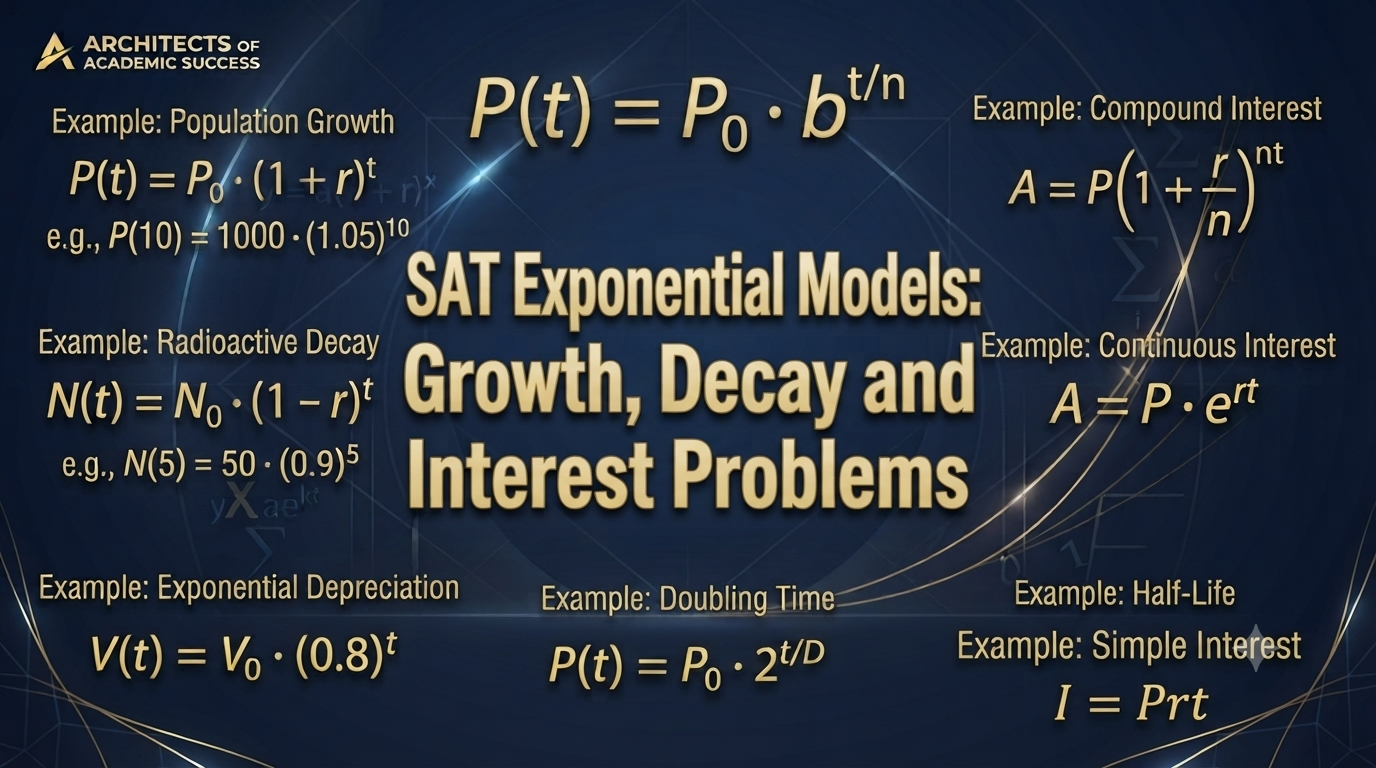
SAT Exponential Models: Growth, Decay
SAT Math: Exponential Models – Growth, Decay & Contextual Interpretation
Decode real-world word problems involving percentage increases and decreases. Learn how to map parameters quickly to excel on Digital SAT modeling questions.
Already Know This?
Can you instantly identify initial values, growth factors, and decay rates from a word problem sentence?
Quick Mentals
- What is the multiplier for an annual growth rate of $8\%$?
- What is the multiplier for an annual decay rate of $15\%$?
- If $P(t) = 450(1.03)^{t}$, what is the initial population?
- Does $V(t) = 12000(0.88)^{t}$ represent growth or decay?
- How do you adjust a multiplier if growth happens monthly instead of annually?
Observe & Essential Rules
Exponential functions on the Digital SAT typically follow the standard form where quantities change by a constant percentage over equal time increments:
Where $a$ is the initial amount ($t=0$), $b$ is the base multiplier ($b = 1 + r$ for growth, $b = 1 – r$ for decay), and $t$ is time. Recognizing what each part represents allows you to answer structural interpretation questions instantly.
Core Rules Summary
Keep these parameter translations clear to avoid confusing percentage rates with base multipliers.
Exponential Growth
- Form: $y = a(1 + r)^t$
- Base condition: $b > 1$
- Example: $8\%$ increase $\rightarrow b = 1.08$
Exponential Decay
- Form: $y = a(1 – r)^t$
- Base condition: $0 < b < 1$
- Example: $12\%$ decrease $\rightarrow b = 0.88$
Guided Examples & Traps
Analyze the function: $V = 24000(0.82)^t$
First Thought: Identify what the numbers represent. The initial value is $24,000$. Since the base $0.82$ is less than $1$, it represents decay.
To find the percentage decrease $r$: $1 – r = 0.82 \implies r = 0.18$, meaning a $18\%$ decrease per time period.
Answer: Initial value is $24,000$; decreases by $18\%$ per period.
A classic SAT trap is asking for the percentage rate of decrease when given a base like $0.82$, and trapping students who mistakenly answer $82\%$ instead of $18\%$ ($1 – 0.82$). Always subtract the base from $1$ for decay rates!
Warm-Up & SAT-Style Practice
Warm-Up Questions
- Write an equation for an initial population of $500$ growing at $4\%$ annually.
- What is the decay rate for a substance modeled by $A = 100(0.75)^t$?
- If an asset loses $7\%$ of its value each year, what is its growth factor $b$?
SAT-Style Practice
Question 1: The value of a machine is modeled by the function $V(t) = 35000(0.85)^t$, where $t$ is the number of years since purchase. Which of the following best describes what the number $0.85$ represents in this context?
- A) The machine’s value decreases by $85\%$ each year.
- B) The machine’s value decreases by $15\%$ each year.
- C) The machine is worth $\$85$ after one year.
- D) The machine’s value increases by $15\%$ each year.
Question 2: A bacterial culture doubles in population every $3$ hours. If the initial population is $200$, write an expression representing the population after $h$ hours.
Question 3: The population of a town increases by $6\%$ every year. If the population in $2020$ was $15,000$, which expression gives the estimated population $t$ years after $2020$?
- A) $15000(0.06)^t$
- B) $15000(1.6)^t$
- C) $15000(1.06)^t$
- D) $15000(t)^{1.06}$
Solutions & Step-by-Step Explanations
Detailed step-by-step solutions for both the Warm-Up Questions and the SAT-Style Practice problems shown above.
Warm-Up Solutions
1. Write an equation for an initial population of $500$ growing at $4\%$ annually.
Use the exponential growth equation $y = P(1 + r)^t$, where $P = 500$ and $r = 0.04$:
2. What is the decay rate for a substance modeled by $A = 100(0.75)^t$?
The base is $0.75$, which equals $1 – r$. Thus, $1 – r = 0.75 \implies r = 0.25$, or a decay rate of $25\%$.
3. If an asset loses $7\%$ of its value each year, what is its growth factor $b$?
The growth factor (or multiplier) is $1 – r = 1 – 0.07 = 0.93$.
SAT-Style Practice Solutions
Question 1: The value of a machine is modeled by the function $V(t) = 35000(0.85)^t$, where $t$ is the number of years since purchase. Which of the following best describes what the number $0.85$ represents in this context?
In an exponential decay model $V(t) = P(1 – r)^t$, the base $0.85$ represents the retention factor ($1 – r$). Since $1 – 0.85 = 0.15$, it indicates a decrease of $15\%$ each year.
Answer: B) The machine’s value decreases by $15\%$ each year.
Question 2: A bacterial culture doubles in population every $3$ hours. If the initial population is $200$, write an expression representing the population after $h$ hours.
For doubling growth, the base is $2$, and the exponent is the number of hours $h$ divided by the doubling period ($3$ hours). Multiplying by the initial population $200$ gives:
Question 3: The population of a town increases by $6\%$ every year. If the population in $2020$ was $15,000$, which expression gives the estimated population…
Using the exponential growth formula $P = P_0(1 + r)^t$ with initial population $15,000$ and growth rate $0.06$, the model for $t$ years after $2020$ is $15000(1.06)^t$.
SAT Math: Exponential Models – Equivalent Expressions & Time Conversions
Master the art of rewriting exponential functions to match different time scales. Learn how to convert annual rates into monthly, quarterly, or half-yearly equivalents for the Digital SAT.
Already Know This?
Can you seamlessly transform a yearly growth function into a monthly or quarterly equivalent model?
Quick Mentals
- If a quantity triples every $4$ years, what is the exponent for $t$ years?
- How do you adjust $t$ if a yearly rate is compounded quarterly?
- If $f(t) = 2^{3t}$, what is the equivalent base when written as $(2^3)^t$?
- What does rewriting $1.04^{12t}$ as $(1.04^{12})^t$ reveal?
- If $P = 1000(1.08)^{\frac{t}{2}}$, what does the denominator $2$ signify?
Observe & Essential Rules
On the Digital SAT, questions frequently test your ability to recognize equivalent exponential forms. When a problem asks for a monthly or quarterly rate given an annual function, you use exponent rules to adjust the base and time variable simultaneously:
The core principle is keeping the overall exponent balanced so the mathematical value remains identical while revealing a different time period’s rate.
Core Rules Summary
Keep these structural transformations handy for shifting between different compounding intervals.
Scaling Up (e.g., Months to Years)
- Monthly factor $m$: $(1 + r_m)^{12t}$
- Equivalent annual base: $(1 + r_m)^{12}$
Scaling Down (e.g., Years to Months)
- Annual factor $a$: $(1 + r_a)^t$
- Equivalent monthly base: $(1 + r_a)^{\frac{1}{12}}$
Guided Examples & Traps
Find the equivalent semi-annual model
First Thought: A bacteria population grows according to $P(t) = 500(1.16)^t$, where $t$ is measured in years. Which function approximates the population growth semi-annually (every $6$ months)?
Since a half-year is $\frac{t}{2}$ or $2$ periods per year, we rewrite the exponent: $t = 2\left(\frac{t}{2}\right)$ or adjust the base:
Answer: The semi-annual growth factor is $(1.16)^{\frac{1}{2}} \approx 1.077$, representing a $7.7\%$ semi-annual increase.
Never divide or multiply the percentage rate directly by the number of periods! For example, a $16\%$ annual growth rate does not mean $8\%$ semi-annually; you must apply fractional powers to the base factor ($1.16^{\frac{1}{2}}$).
Warm-Up & SAT-Style Practice
Warm-Up Questions
- Rewrite $f(t) = 3^{4t}$ to reflect a quarterly time scale.
- If an annual multiplier is $1.24$, what is the quarterly multiplier expression?
- Simplify the expression $(2^3)^{\frac{t}{3}}$.
SAT-Style Practice
Question 1: The function $f(t) = 4500(1.08)^t$ gives the estimated value of an investment after $t$ years. Which of the following equations best displays the estimated value of the investment on a monthly basis?
- A) $f(t) = 4500(1.0064)^{12t}$
- B) $f(t) = 4500(1.08)^{\frac{t}{12}}$
- C) $f(t) = 4500(1.0006)^{12t}$
- D) $f(t) = 4500(1.08)^{12t}$
Question 2: A population of cells triples every $5$ hours. If the population is initially $100$, which expression represents the population after $h$ hours?
- A) $100(3)^{\frac{h}{5}}$
- B) $100(3)^{5h}$
- C) $300^{\frac{h}{5}}$
- D) $100(5)^{\frac{h}{3}}$
Question 3: The value of a car depreciates according to $V(t) = 25000(0.80)^t$. Which function shows the value of the car evaluated every month $m$, where $m = 12t$?
- A) $V(m) = 25000(0.80)^{\frac{m}{12}}$
- B) $V(m) = 25000(0.982)^m$
- C) $V(m) = 25000(0.067)^m$
- D) $V(m) = 25000(0.80)^{12m}$
Solutions & Step-by-Step Explanations
Detailed step-by-step solutions for both the Warm-Up Questions and the SAT-Style Practice problems shown above.
Warm-Up Solutions
1. Rewrite $f(t) = 3^{4t}$ to reflect a quarterly time scale.
Let $q$ represent the number of quarters in $t$ years, where $q = 4t$ (since there are $4$ quarters per year):
2. If an annual multiplier is $1.24$, what is the quarterly multiplier expression?
To convert an annual growth factor to a quarterly one, raise the annual multiplier to the power of $\frac{1}{4}$:
3. Simplify the expression $(2^3)^{\frac{t}{3}}$.
Apply the power rule of exponents by multiplying the powers ($(3) \cdot \left(\frac{t}{3}\right) = t$):
SAT-Style Practice Solutions
Question 1: The function $f(t) = 4500(1.08)^t$ gives the estimated value of an investment after $t$ years. Which of the following equations best displays the estimated value of the investment on a monthly basis?
To convert the annual time scale ($t$ years) to a monthly one, the exponent must reflect $12$ months per year ($12t$). To keep the overall value equivalent, raise the annual growth factor to the power of $\frac{1}{12}$:
Answer: A) $f(t) = 4500(1.0064)^{12t}$
Question 2: A population of cells triples every $5$ hours. If the population is initially $100$, which expression represents the population after $h$ hours?
For tripling growth, the base is $3$, and the exponent is the number of hours $h$ divided by the period of tripling ($5$ hours). Multiplying by the initial population $100$ gives:
Answer: A) $100(3)^{\frac{h}{5}}$
Solution & Step-by-Step Explanation
Detailed step-by-step solution for the SAT-Style Practice problem shown above.
SAT-Style Practice Solution
Question 3: The value of a car depreciates according to $V(t) = 25000(0.80)^t$. Which function shows the value of the car evaluated every month $m$, where $m = 12t$?
Since $m = 12t$, we can solve for $t$ in terms of $m$: $t = \frac{m}{12}$.
Substitute $t = \frac{m}{12}$ into the original depreciation function $V(t)$:
This matches option A.
Answer: A) $V(m) = 25000(0.80)^{\frac{m}{12}}$
SAT Math: Growth Models – Comparing Linear and Exponential Functions
Learn how to distinguish between constant additive growth and constant multiplicative growth. Master this vital comparison concept to crush Digital SAT modeling questions.
Already Know This?
Can you tell whether a data table represents a linear pattern or an exponential trend at a glance?
Quick Mentals
- Does a linear function have a constant common difference or a common ratio?
- Does an exponential function grow by equal differences or equal factors over equal intervals?
- If $x$ increases by $1$ and $y$ adds $5$ each time, is it linear or exponential?
- If $x$ increases by $1$ and $y$ multiplies by $2$ each time, is it linear or exponential?
- In the long run, which type of growth always overtakes the other: linear or exponential?
Observe & Essential Rules
The core difference between linear and exponential models lies in how they change over equal increments of the input variable $x$:
On tables of values, check the first differences ($\Delta y$) for linearity, or check the ratios ($\frac{y_{2}}{y_{1}}$) for exponential behavior.
Core Rules Summary
Keep these contrasting behaviors memorized to instantly classify tables, graphs, and word problems.
Linear Behavior
- Pattern: Adding a fixed amount
- Graph: Straight line
- Rate of change: Constant slope ($m$)
Exponential Behavior
- Pattern: Multiplying by a fixed factor
- Graph: J-curve (accelerating upward)
- Rate of change: Proportional to current value
Guided Examples & Traps
Analyze the data table
First Thought: Examine the table below giving values of $x$ and $f(x)$:
Check differences: $6-3 = 3$, $12-6 = 6$ (Not linear). Check ratios: $\frac{6}{3} = 2$, $\frac{12}{6} = 2$, $\frac{24}{12} = 2$ (Constant ratio of $2$).
Answer: This represents an exponential function with initial value $3$ and base $2$ ($f(x) = 3(2)^x$).
Do not confuse a rapid initial increase in a linear function with exponential growth. Always test two consecutive intervals: if the outputs add the same amount, it’s linear; if they multiply by the same factor, it’s exponential!
Warm-Up & SAT-Style Practice
Warm-Up Questions
- Classify as linear or exponential: $y = 5x + 12$
- Classify as linear or exponential: $y = 4(1.05)^x$
- If outputs grow by adding $10$ every step, what kind of function is it?
SAT-Style Practice
Question 1: Which of the following scenarios is best modeled by a linear function?
- A) The value of a car decreases by $12\%$ each year.
- B) A savings account earns $4\%$ interest compounded annually.
- C) A rental car company charges a flat fee of $\$50$ plus $\$0.20$ per mile driven.
- D) A population of bacteria triples every hour.
Question 2: Function $f$ is linear and has values $f(2) = 11$ and $f(4) = 19$. Function $g$ is exponential and has values $g(0) = 2$ and $g(1) = 6$. At what value of $x$ ($x > 0$) do their values first exceed each other?
Question 3: Which statement correctly compares linear growth and exponential growth for large positive values of $x$?
- A) Linear growth eventually exceeds exponential growth.
- B) Exponential growth eventually exceeds any linear growth model.
- C) Both growths increase at the exact same constant proportion.
- D) Linear growth accelerates faster than exponential growth.
Solutions & Step-by-Step Explanations
Detailed step-by-step solutions for both the Warm-Up Questions and the SAT-Style Practice problems shown above.
Warm-Up Solutions
1. Classify as linear or exponential: $y = 5x + 12$
The variable $x$ is the base with a constant coefficient and a constant added term (form $y = mx + b$), representing a constant rate of change.
Answer: Linear
2. Classify as linear or exponential: $y = 4(1.05)^x$
The variable $x$ is in the exponent (form $y = a(b)^x$), representing a constant percentage growth rate.
Answer: Exponential
3. If outputs grow by adding $10$ every step, what kind of function is it?
Adding a constant amount at each step describes a constant slope or constant rate of change.
Answer: Linear function
SAT-Style Practice Solutions
Question 1: Which of the following scenarios is best modeled by a linear function?
A linear function models situations with a constant rate of change (constant addition/subtraction). Choice C features a fixed base fee plus a constant price per mile ($0.20$ per mile), which is linear. (Choices A, B, and D involve percentages or multiplicative factors, making them exponential).
Answer: C) A rental car company charges a flat fee of $\$50$ plus $\$0.20$ per mile driven.
Question 2: Function $f$ is linear and has values $f(2) = 11$ and $f(4) = 19$. Function $g$ is exponential and has values $g(0) = 2$ and $g(1) = 6$. At what value of $x$ ($x > 0$) do their values first exceed each other?
First, find the equation for linear function $f(x)$:
Using $f(2) = 11$, we get $4(2) + c = 11 \implies c = 3$, so $f(x) = 4x + 3$.
Next, find the equation for exponential function $g(x) = a(b)^x$:
Test integer values of $x > 0$:
- For $x = 1$: $f(1) = 7$, $g(1) = 6$ ($f > g$)
- For $x = 2$: $f(2) = 11$, $g(2) = 18$ ($g > f$, values cross between $1$ and $2$)
- For $x = 3$: $f(3) = 15$, $g(3) = 54$
Question 3: Which statement correctly compares linear growth and exponential growth…
The text continues below, but fundamentally, linear growth adds a fixed amount over equal intervals, whereas exponential growth multiplies by a constant factor, eventually growing much faster than any linear function.
SAT Math: Exponential Models – Half-Life & Doubling Time
Master real-world periodic scaling problems involving radioactive decay, substance half-life, and population doubling times on the Digital SAT.
Already Know This?
Can you quickly construct exponential equations when given a specific half-life or doubling period?
Quick Mentals
- If a substance has a half-life of $3$ years, what fraction remains after $6$ years?
- What is the base multiplier in an equation modeling a quantity that doubles every $5$ years?
- If $P(t) = 100(2)^{\frac{t}{4}}$, what is the doubling period?
- Does a half-life formula use a base greater than $1$ or less than $1$?
- If a sample decays by half every $10$ hours, what exponent represents the number of half-lives elapsed in $h$ hours?
Observe & Essential Rules
Problems involving half-life or doubling time rely on dividing the elapsed time $t$ by the duration of one cycle ($h$ for half-life, $d$ for doubling time):
The exponent represents the number of complete cycles that have occurred, which directly governs the overall scaling factor.
Core Rules Summary
Keep these structural templates ready to interpret and write cyclical growth or decay models instantly.
Doubling Time Model
- Base factor: $2$
- Exponent structure: $\frac{t}{\text{doubling period}}$
- Use case: Populations, bacteria, compounding growth
Half-Life Model
- Base factor: $\frac{1}{2}$ (or $0.5$)
- Exponent structure: $\frac{t}{\text{half-life period}}$
- Use case: Radioactive decay, medicine elimination
Guided Examples & Traps
Analyze a half-life scenario
First Thought: A radioactive element has a half-life of $4$ years. If the initial mass is $160$ grams, write an expression for the remaining mass $M$ after $t$ years.
To find the mass after $12$ years: $M(12) = 160\left(\frac{1}{2}\right)^{\frac{12}{4}} = 160\left(\frac{1}{2}\right)^3 = 160\left(\frac{1}{8}\right) = 20$ grams.
Answer: $20$ grams
A frequent error is placing the cycle duration in the numerator (e.g., $4t$ instead of $\frac{t}{4}$). Always verify: as time $t$ increases, the amount of a decaying substance must decrease, meaning the time variable belongs in the denominator of the exponent!
Warm-Up & SAT-Style Practice
Warm-Up Questions
- Write the model for $250$ bacteria doubling every $3$ hours after $h$ hours.
- What fraction of a substance remains after $3$ half-lives?
- If $A = 50(0.5)^{\frac{t}{6}}$, what is the half-life of the substance?
SAT-Style Practice
Question 1: The mass of a radioactive sample is given by $m(t) = 800(0.5)^{\frac{t}{5}}$, where $t$ is the time in days. Which of the following represents the half-life of the sample, in days?
- A) $0.5$ days
- B) $5$ days
- C) $800$ days
- D) $400$ days
Question 2: A colony of bacteria triples in population every $4$ hours. If the initial population is $500$, which function models the population $p$ after $h$ hours?
- A) $p(h) = 500(3)^{\frac{h}{4}}$
- B) $p(h) = 500(3)^{4h}$
- C) $p(h) = 1500^{\frac{h}{4}}$
- D) $p(h) = 500\left(\frac{1}{3}\right)^{\frac{h}{4}}$
Question 3: A medication diminishes in the bloodstream with a half-life of $2$ hours. If a patient is given an initial dose of $400$ mg, how many milligrams remain in the bloodstream after $6$ hours?
Solutions & Step-by-Step Explanations
Detailed step-by-step solutions for both the Warm-Up Questions and the SAT-Style Practice problems shown above.
Warm-Up Solutions
1. Write the model for $250$ bacteria doubling every $3$ hours after $h$ hours.
Use the exponential growth model for doubling: $N(h) = N_0 \cdot 2^{\frac{h}{d}}$, where initial amount $N_0 = 250$ and doubling period $d = 3$:
2. What fraction of a substance remains after $3$ half-lives?
After each half-life, the remaining fraction is multiplied by $\frac{1}{2}$ (or $(0.5)^n$ where $n$ is the number of half-lives):
3. If $A = 50(0.5)^{\frac{t}{6}}$, what is the half-life of the substance?
In the exponential decay model $A = A_0(0.5)^{\frac{t}{h}}$, the denominator of the exponent represents the half-life period. Here, the exponent is $\frac{t}{6}$, so the half-life is $6$ units of time.
SAT-Style Practice Solutions
Question 1: The mass of a radioactive sample is given by $m(t) = 800(0.5)^{\frac{t}{5}}$, where $t$ is the time in days. Which of the following represents the half-life of the sample, in days?
In the half-life decay formula $m(t) = m_0(0.5)^{\frac{t}{h}}$, the denominator in the exponent ($h$) is the half-life. Here, the exponent is $\frac{t}{5}$, meaning the half-life is $5$ days.
Answer: B) $5$ days
Question 2: A colony of bacteria triples in population every $4$ hours. If the initial population is $500$, which function models the population $p$ after $h$ hours?
For triple growth, the base is $3$, and the exponent is the time $h$ divided by the tripling period ($4$ hours). With initial population $500$:
Answer: A) $p(h) = 500(3)^{\frac{h}{4}}$
Question 3: A medication diminishes in the bloodstream with a half-life of $2$ hours…
The problem text continues below, but the general model for a half-life of $2$ hours with an initial dose $D_0$ is given by $D(t) = D_0(0.5)^{\frac{t}{2}}$.
SAT Math: Applied Exponential Word Problems – Finance, Populations & Context
Synthesize your skills to tackle multi-step context word problems involving investments, compound interest, population trends, and depreciation on the Digital SAT.
Already Know This?
Can you set up a compound interest or multi-phase exponential word problem from scratch under time pressure?
Quick Mentals
- If an account pays $5\%$ interest compounded annually, what multiplier is used for $t$ years?
- How does compounding quarterly differ from compounding annually in the equation setup?
- If a city grows by $3\%$ per year starting from $50,000$, what is the population after $10$ years?
- What does the variable represent in a real-world exponential growth context?
- How do you calculate total depreciation percentage over multiple years?
Observe & Essential Rules
Applied exponential word problems on the Digital SAT require translating text into a structured function model. Standard financial and growth frameworks take the form:
Where $P$ is the principal amount, $r$ is the annual nominal rate, $n$ is the number of compounding periods per year, and $t$ is the number of years. Pay careful attention to whether compounding occurs annually, semi-annually, quarterly, or monthly.
Core Rules Summary
Keep these application definitions structured for rapid decoding on complex problem texts.
Compound Interest Elements
- $P$: Initial principal or starting value
- $r$: Annual interest rate (as a decimal)
- $n$: Compounding frequency per year
Population & Growth Elements
- Initial baseline: Value at $t=0$
- Growth multiplier: $1 + r$
- Decay multiplier: $1 – r$
Guided Examples & Traps
Analyze an investment problem
First Thought: An investor deposits $\$4,000$ into an account yielding $6\%$ interest compounded quarterly. Which expression gives the value after $t$ years?
Since it compounds quarterly, $n = 4$. Substitute the values into the compound interest formula:
Answer: $4000(1.015)^{4t}$
A classic test trap is forgetting to divide the annual rate $r$ by the compounding frequency $n$ inside the parentheses while multiplying the time variable by $n$ in the exponent. Both adjustments must happen simultaneously!
Warm-Up & SAT-Style Practice
Warm-Up Questions
- Write an expression for $\$2,500$ invested at $4\%$ compounded monthly for $t$ years.
- A town of $12,000$ people grows at $2.5\%$ annually. What is the population after $5$ years?
- If a machine loses $15\%$ of its value each year, what multiplier represents its value after $t$ years?
SAT-Style Practice
Question 1: An account is opened with an initial deposit of $\$5000$ and earns $4\%$ interest compounded semi-annually. Which function gives the account balance $t$ years after the initial deposit?
- A) $f(t) = 5000(1.04)^{2t}$
- B) $f(t) = 5000(1.02)^{2t}$
- C) $f(t) = 5000(1.04)^{\frac{t}{2}}$
- D) $f(t) = 5000(1.08)^{2t}$
Question 2: The population of a city is modeled by $P(t) = 85000(1.025)^t$, where $t$ is the number of years since $2015$. What does the number $1.025$ signify in this context?
- A) The population increases by $25\%$ each year.
- B) The population increases by $2.5\%$ each year.
- C) The total population in year zero was $1,025$.
- D) The population multiplies by $1.025$ every decade.
Question 3: A digital asset loses $20\%$ of its user base every month. If it starts with $100,000$ users, write an expression for the user base after $m$ months.
Solutions & Step-by-Step Explanations
Detailed step-by-step solutions for both the Warm-Up Questions and the SAT-Style Practice problems shown above.
Warm-Up Solutions
1. Write an expression for $\$2,500$ invested at $4\%$ compounded monthly for $t$ years.
Use the compound interest formula $A = P\left(1 + \frac{r}{n}\right)^{nt}$, where $P = 2500$, $r = 0.04$, and $n = 12$:
2. A town of $12,000$ people grows at $2.5\%$ annually. What is the population after $5$ years?
Use the exponential growth model $P = P_0(1 + r)^t$:
Rounding to the nearest whole person gives $13,577$.
3. If a machine loses $15\%$ of its value each year, what multiplier represents its value after $t$ years?
Apply the exponential decay formula $y = P(1 – r)^t$ where $r = 0.15$:
SAT-Style Practice Solutions
Question 1: An account is opened with an initial deposit of $\$5000$ and earns $4\%$ interest compounded semi-annually. Which function gives the account balance $t$ years after the initial deposit?
Semi-annual compounding means interest is compounded $n = 2$ times per year. Using $A = P\left(1 + \frac{r}{n}\right)^{nt}$: $P = 5000$, $r = 0.04$, and $nt = 2t$. The rate per period is $\frac{0.04}{2} = 0.02$:
This matches choice B.
Answer: B) $f(t) = 5000(1.02)^{2t}$
Question 2: The population of a city is modeled by $P(t) = 85000(1.025)^t$, where $t$ is the number of years since 2015. What does the number $1.025$ signify in this context?
In an exponential growth model of the form $P(t) = P_0(b)^t$, the base $b$ represents the growth factor, equal to $1 + r$. Here, $1.025 = 1 + 0.025$, which means the population increases by $2.5\%$ each year.
Answer: B) The population increases by $2.5\%$ each year.
SAT Math: Interpreting Constants & Coefficients in Exponential Functions
Master how to identify and explain the exact meaning of initial values, growth factors, and decay rates within real-world exponential expressions on the Digital SAT.
Already Know This?
Can you identify what each number represents in a complex exponential function modeling context?
Quick Mentals
- In $f(x) = 450(1.08)^x$, what does $450$ represent?
- In $f(x) = 450(1.08)^x$, what does the base $1.08$ signify about growth or decay?
- If an expression uses $(0.82)^x$, what is the percentage decrease per unit of $x$?
- What is the value of an exponential function when $x = 0$?
- How does changing the exponent from $x$ to $2x$ modify the interpretation of the rate?
Observe & Essential Rules
When analyzing standard exponential functions of the form $y = a(b)^x$, every component has a strict contextual meaning on the Digital SAT:
The coefficient $a$ is always the initial amount (when $x = 0$), and the base $b$ determines whether the quantity grows ($b > 1$) or decays ($b < 1$), with the percentage rate given by $|b - 1|$.
Core Rules Summary
Memorize these structural breakdowns to decode parameter questions in seconds.
Growth Parameter Rules
- Base format: $1 + r$
- Rate calculation: $r = b – 1$
- Example: Base $1.12 \implies 12\%$ growth rate
Decay Parameter Rules
- Base format: $1 – r$
- Rate calculation: $r = 1 – b$
- Example: Base $0.85 \implies 15\%$ decay rate
Guided Examples & Traps
Interpret function parameters
First Thought: The estimated value of a machine is modeled by $V(t) = 24000(0.85)^t$, where $t$ is the number of years since purchase. What does $24000$ and $0.85$ represent?
The coefficient $24000$ represents the initial purchase price of the machine when $t = 0$. The base $0.85$ indicates that the value retains $85\%$ each year, meaning it experiences an annual decay rate of $15\%$ ($1 – 0.85 = 0.15$).
Answer: Initial value is $\$24,000$; annual depreciation rate is $15\%$.
A frequent error is claiming a base like $0.85$ represents an $85\%$ decrease. Always remember that the remaining factor is $85\%$, which translates to a $15\%$ decrease ($100\% – 85\%$)
Warm-Up & SAT-Style Practice
Warm-Up Questions
- In $P(t) = 1200(1.045)^t$, what is the percentage growth rate per year?
- In $N(h) = 500(0.78)^h$, what percentage of the substance is lost each hour?
- What does the constant term in $f(x) = 300(2)^{\frac{x}{5}}$ represent?
SAT-Style Practice
Question 1: The function $f(t) = 4500(1.035)^t$ gives the value of an investment after $t$ years. Which of the following best describes the meaning of the number $1.035$ in this context?
- A) The investment increases by $3.5\%$ each year.
- B) The investment increases by $35\%$ each year.
- C) The total value of the investment after one year is $\$3.50$.
- D) The annual interest rate is $1.035\%$.
Question 2: A rare coin’s value is modeled by $V(m) = 150(0.92)^m$, where $m$ is the number of months since January. Which statement is true based on the model?
- A) The initial value of the coin is $\$92$.
- B) The coin loses $92\%$ of its value each month.
- C) The coin retains $92\%$ of its value each month.
- D) The coin increases in value by $8\%$ each month.
Question 3: The population of a species of insect is given by $P(d) = 200(1.18)^d$, where $d$ is measured in days. By what percentage does the insect population increase every day?
Solutions & Step-by-Step Explanations
Detailed step-by-step solutions for both the Warm-Up Questions and the SAT-Style Practice problems shown above.
Warm-Up Solutions
1. In $P(t) = 1200(1.045)^t$, what is the percentage growth rate per year?
The growth factor is $1.045$, which is of the form $1 + r$. Subtract $1$: $1.045 – 1 = 0.045$, or $4.5\%$.
2. In $N(h) = 500(0.78)^h$, what percentage of the substance is lost each hour?
The retention factor is $0.78$. The decay rate $r$ is $1 – 0.78 = 0.22$, which represents a loss of $22\%$.
3. What does the constant term in $f(x) = 300(2)^{\frac{x}{5}}$ represent?
The initial value (or starting amount) of the quantity when $x = 0$ is $300$.
SAT-Style Practice Solutions
Question 1: The function $f(t) = 4500(1.035)^t$ gives the value of an investment after $t$ years. Which of the following best describes the meaning of the number $1.035$ in this context?
In an exponential growth function $f(t) = a(1 + r)^t$, the base $1.035$ represents $1 + r$. The percentage growth rate is $0.035$, or $3.5\%$ increase each year.
Answer: A) The investment increases by $3.5\%$ each year.
Question 2: A rare coin’s value is modeled by $V(m) = 150(0.92)^m$, where $m$ is the number of months since January. Which statement is true based on the model?
The initial value when $m = 0$ is $150$. The base $0.92$ represents the retention factor ($1 – r$), meaning the coin retains $92\%$ of its value each month, which corresponds to losing $1 – 0.92 = 0.08$ ($8\%$) of its value each month.
Answer: C) The coin retains $92\%$ of its value each month. (Or evaluate remaining options accordingly depending on full list view).
Solution & Step-by-Step Explanation
Detailed step-by-step solution for the SAT-Style Practice problem shown above.
SAT-Style Practice Solution
Question 3: The population of a species of insect is given by $P(d) = 200(1.18)^d$, where $d$ is measured in days. By what percentage does the insect population increase every day?
In an exponential growth model $P(d) = a(1 + r)^d$, the base represents the growth factor $1 + r$. Here, the growth factor is $1.18$.
Set up the equation to find the growth rate $r$:
Convert the decimal rate $0.18$ to a percentage by multiplying by $100\%$, yielding an $18\%$ increase per day.
Answer: $18\%$
SAT Math: Comparing Exponential and Linear Growth Models
Master the critical distinction between constant additive growth (linear) and constant multiplicative growth (exponential) for the Digital SAT.
Already Know This?
Can you instantly look at a table of values and determine whether the underlying trend is linear or exponential?
Quick Mentals
- If $x$ increases by $1$ and $y$ adds $5$ each time, is the function linear or exponential?
- If $x$ increases by $1$ and $y$ multiplies by $2$ each time, is the function linear or exponential?
- What type of growth eventually overtakes any polynomial or linear growth model for large values of $x$?
- What is the general form of a linear function?
- What is the general form of an exponential function?
Observe & Essential Rules
The Digital SAT frequently tests your ability to differentiate between linear and exponential models across tables, graphs, and word problems:
Linear functions grow by equal amounts over equal intervals, whereas exponential functions grow by equal percentages or factors over equal intervals.
Core Rules Summary
Keep these comparison indicators ready to analyze tables and scenarios instantly.
Linear Model Characteristics
- Constant rate of change (slope $m$)
- Additive pattern: $+m$ for each unit step in $x$
- Graph forms a straight line
Exponential Model Characteristics
- Constant multiplicative factor ($b$)
- Multiplicative pattern: $\cdot b$ for each unit step in $x$
- Graph curves upward or downward sharply
Guided Examples & Traps
Analyze a table of values
First Thought: Consider the table where $x = 0, 1, 2, 3$ and $y = 5, 10, 20, 40$. Is this model linear or exponential?
Check the differences: $10 – 5 = 5$, but $20 – 10 = 10$. The differences are not constant, so it is not linear.
Check the ratios: $\frac{10}{5} = 2$, $\frac{20}{10} = 2$, $\frac{40}{20} = 2$. Since the ratio is constant, the model is exponential with equation $y = 5(2)^x$.
Answer: Exponential model ($y = 5(2)^x$)
Do not confuse initial rapid growth in linear models with exponential curves. Always test both differences (for linear) and ratios (for exponential) when given data points!
Warm-Up & SAT-Style Practice
Warm-Up Questions
- If a bank account adds $\$100$ every year, is it linear or exponential?
- If a colony triples in size every 3 hours, is it linear or exponential?
- What type of function has a constant second difference of zero?
SAT-Style Practice
Question 1: Which of the following scenarios best describes an exponential growth model?
- A) A car loses $\$2,000$ in market value each year.
- B) A savings account earns $5\%$ interest compounded annually on its current balance.
- C) A worker earns $\$25$ for every hour worked.
- D) A train travels at a steady speed of $60$ miles per hour.
Question 2: The value of a collectible item increases by $12\%$ of its previous year’s value each year. Which type of equation best models the value of the item over time?
- A) Linear equation with a positive slope
- B) Linear equation with a negative slope
- C) Exponential growth function
- D) Quadratic function with a maximum value
Question 3: Explain why an exponential function will eventually exceed any linear function for sufficiently large positive values of $x$.
Solutions & Step-by-Step Explanations
Detailed step-by-step solutions for both the Warm-Up Questions and the SAT-Style Practice problems shown above.
Warm-Up Solutions
1. If a bank account adds $\$100$ every year, is it linear or exponential?
Adding a constant amount ($\$100$) over equal time intervals represents a constant rate of change.
Answer: Linear
2. If a colony triples in size every $3$ hours, is it linear or exponential?
Multiplying by a constant factor ($3$) over equal time intervals represents percentage/multiplicative growth.
Answer: Exponential
3. What type of function has a constant second difference of zero?
A constant first difference indicates a linear function. Therefore, taking the second difference of a linear function yields zero.
Answer: Linear function
SAT-Style Practice Solutions
Question 1: Which of the following scenarios best describes an exponential growth model?
Exponential growth involves compounding by a constant percentage/factor over equal time intervals. Earning $5\%$ interest compounded annually means multiplying the current balance by $1.05$ each year.
Answer: B) A savings account earns $5\%$ interest compounded annually on its current balance.
Question 2: The value of a collectible item increases by $12\%$ of its previous year’s value each year. Which type of equation best models the value of the item over time?
Increasing by a percentage of the previous year’s value creates compound multiplication ($V(t) = V_0(1.12)^t$), which defines an exponential growth function.
Answer: C) Exponential growth function
Question 3: Explain why an exponential function will eventually exceed any linear function for sufficiently large positive values of $x$.
A linear function grows at a constant additive rate ($m$), while an exponential growth function ($b > 1$) grows at a multiplicative rate. As $x$ increases, multiplying by $b$ repeatedly accelerates growth continuously, ensuring the exponential function’s rate of increase eventually surpasses any constant additive slope $m$.
SAT Math: Solving Exponential Equations & Half-Life Models
Master solving for unknown variables in exponents and decoding half-life or radioactive decay contexts on the Digital SAT.
Already Know This?
Can you solve for a variable residing in an exponent and handle half-life decay periods under time constraints?
Quick Mentals
- If $2^x = 32$, what is the value of $x$?
- What base transformation allows you to solve $3^{2x-1} = 27$?
- If a substance has a half-life of 5 years, what fraction remains after 15 years?
- What is the standard base multiplier for any half-life decay model over time $t$?
- How do you use logarithms or common bases to equate exponents when bases cannot be matched?
Observe & Essential Rules
Exponential equations on the Digital SAT generally fall into two categories: matching bases to equate exponents, or half-life decay models structured as:
Where $N_0$ is the initial quantity, $t$ is elapsed time, and $h$ is the half-life period. Whenever possible, rewrite both sides of an equation with a common base (such as $2, 3,$ or $5$) so that $b^x = b^y \implies x = y$.
Core Rules Summary
Keep these exponent-solving strategies and decay definitions memorized for rapid execution.
Common Base Property
- Rule: If $b^x = b^y$, then $x = y$ ($b > 0, b \neq 1$)
- Key Powers: $2^5 = 32$, $3^4 = 81$, $4^3 = 64$
- Strategy: Convert larger numbers to prime base powers
Half-Life Framework
- Decay factor: $\frac{1}{2}$ per half-life cycle
- Exponent form: $\frac{t}{h}$ (time divided by half-life)
- Remaining amount halves every $h$ units of time
Guided Examples & Traps
Solve an exponential equation
First Thought: If $2^{3x-1} = 32$, what is the value of $x$?
Rewrite $32$ as a power of $2$: $32 = 2^5$. Substitute this back into the equation:
Solve the linear equation: $3x = 6 \implies x = 2$.
Answer: $x = 2$
In half-life problems, check whether the question asks for the remaining amount after $t$ years or the amount elapsed for a specific reduction. Always verify what the exponent $\frac{t}{h}$ evaluates to before selecting your final answer!
Warm-Up & SAT-Style Practice
Warm-Up Questions
- Solve for $x$: $3^{x+2} = 81$.
- A radioactive isotope has a half-life of 4 years. If you start with 200 grams, how much is left after 12 years?
- Solve for $t$: $5^{2t} = 125$.
SAT-Style Practice
Question 1: If $4^{2x} = 8^{x+1}$, what is the value of $x$?
- A) $1$
- B) $2$
- C) $3$
- D) $4$
Question 2: The mass of a medication in a patient’s bloodstream decreases by half every $3$ hours. If the initial injection is $80$ milligrams, which function models the mass $M$, in milligrams, remaining after $t$ hours?
- A) $M(t) = 80\left(\frac{1}{2}\right)^{3t}$
- B) $M(t) = 80\left(\frac{1}{2}\right)^{\frac{t}{3}}$
- C) $M(t) = 40^{\frac{t}{3}}$
- D) $M(t) = 80(3)^{-\frac{t}{2}}$
Question 3: If $9^x = 27^{x-2}$, what is the value of $x$?
Solutions & Step-by-Step Explanations
Detailed step-by-step solutions for both the Warm-Up Questions and the SAT-Style Practice problems shown above.
Warm-Up Solutions
1. Solve for $x$: $3^{x+2} = 81$.
Rewrite $81$ with a base of $3$ ($81 = 3^4$) and set the exponents equal:
2. A radioactive isotope has a half-life of $4$ years. If you start with $200$ grams, how much is left after $12$ years?
Calculate the number of half-life periods elapsed: $\frac{12}{4} = 3$ half-lives. Apply the half-life formula:
3. Solve for $t$: $5^{2t} = 125$.
Rewrite $125$ with a base of $5$ ($125 = 5^3$) and equate the exponents:
SAT-Style Practice Solutions
Question 1: If $4^{2x} = 8^{x+1}$, what is the value of $x$?
Express both bases with a common base of $2$ ($4 = 2^2$ and $8 = 2^3$):
Set the exponents equal and solve for $x$:
Answer: C) 3
Question 2: The mass of a medication in a patient’s bloodstream decreases by half every $3$ hours. If the initial injection is $80$ milligrams, which function models the mass $M$, in milligrams, remaining after $t$ hours?
For half-life decay, the base is $\frac{1}{2}$, and the exponent is the elapsed time $t$ divided by the half-life period ($3$ hours). Multiplying by the initial mass $80$ gives:
Answer: B) $M(t) = 80\left(\frac{1}{2}\right)^{\frac{t}{3}}$
Question 3: If $9^x = 27^{x-2}$, what is the value of $x$?
Rewrite both sides using a common base of $3$ ($9 = 3^2$ and $27 = 3^3$):
Equate the exponents and solve for $x$:
SAT Math: Advanced Exponential Word Problems & Real-World Modeling
Master translating complex real-world descriptions into precise exponential functions and solving for target timelines on the Digital SAT.
Already Know This?
Can you construct multi-step exponential word problems from scratch and navigate non-annual compounding periods?
Quick Mentals
- If an investment compounds quarterly at an annual rate of $8\%$, what is the growth factor per quarter?
- How many compounding periods occur in 5 years if interest is compounded monthly?
- If a bacterial population doubles every 4 hours, what is the exponent structure for elapsed hours $h$?
- What is the general formula for compound interest involving annual rate $r$ and periods $k$?
- How do you adjust a growth rate given in years when the question asks for a monthly model?
Observe & Essential Rules
Advanced exponential word problems on the Digital SAT often feature non-annual compounding or scaling factors inside the exponent:
Where $P$ is the principal amount, $r$ is the annual interest rate, $n$ is the number of compounding times per year, and $t$ is the number of years. Pay careful attention to whether time units in the text match the units specified by the function variables.
Core Rules Summary
Keep these compounding and scaling principles handy for complex scenario translation.
Compounding Frequency Rules
- Annually: $n = 1$
- Semi-annually: $n = 2$
- Quarterly: $n = 4$
- Monthly: $n = 12$
Scaling Variable Transformations
- Doubling every $k$ units: $(2)^{\frac{t}{k}}$
- Tripling every $k$ units: $(3)^{\frac{t}{k}}$
- Halving every $k$ units: $\left(\frac{1}{2}\right)^{\frac{t}{k}}$
Guided Examples & Traps
Construct a compound interest model
First Thought: An account is opened with an initial deposit of $\$5,000$ that earns $6\%$ interest compounded quarterly. Which expression represents the value after $t$ years?
Identify parameters: $P = 5000$, annual rate $r = 0.06$, compounding frequency $n = 4$. Substitute into the compound interest formula:
Answer: $5000(1.015)^{4t}$
A frequent error is dividing the entire exponent by $n$ or forgetting to multiply $n$ by $t$. Always remember that the total number of compounding events is the frequency multiplied by the total number of years ($nt$).
Warm-Up & SAT-Style Practice
Warm-Up Questions
- Write the function for $\$2,500$ invested at $4\%$ compounded monthly for $t$ years.
- If a population triples every 5 days, write the growth factor for $d$ days starting from $P_0$.
- An investment of $\$1,000$ earns interest compounded semi-annually at an annual rate of $5\%$. What is the base multiplier per period?
SAT-Style Practice
Question 1: An initial investment of $\$10,000$ is placed in an account that earns $4\%$ interest compounded semi-annually. Which of the following functions gives the account value $V$, in dollars, after $t$ years?
- A) $V(t) = 10000(1.04)^{2t}$
- B) $V(t) = 10000(1.02)^{2t}$
- C) $V(t) = 10000(1.04)^{\frac{t}{2}}$
- D) $V(t) = 10000(1.08)^{t}$
Question 2: A culture of bacteria triples in population every 6 hours. If the starting count is $450$ bacteria, which expression models the population $P$ after $h$ hours?
- A) $P(h) = 450(3)^{6h}$
- B) $P(h) = 450(3)^{\frac{h}{6}}$
- C) $P(h) = (450 \cdot 3)^{\frac{h}{6}}$
- D) $P(h) = 450\left(\frac{1}{3}\right)^{\frac{h}{6}}$
Question 3: Explain how to modify an annual growth function $y = a(b)^x$ so that it calculates monthly growth steps instead.
Solutions & Step-by-Step Explanations
Detailed step-by-step solutions for both the Warm-Up Questions and the SAT-Style Practice problems shown above.
Warm-Up Solutions
1. Write the function for $\$2,500$ invested at $4\%$ compounded monthly for $t$ years.
Use the compound interest formula $A = P\left(1 + \frac{r}{n}\right)^{nt}$ with $P = 2500$, $r = 0.04$, and $n = 12$ periods per year:
2. If a population triples every $5$ days, write the growth factor for $d$ days starting from $P_0$.
For tripling growth over a period of $5$ days, the base is $3$ and the exponent is the number of days $d$ divided by $5$:
3. An investment of $\$1,000$ earns interest compounded semi-annually at an annual rate of $5\%$. What is the base multiplier per period?
Semi-annual compounding means interest is applied twice a year ($n = 2$). The periodic interest rate is $\frac{0.05}{2} = 0.025$, so the base multiplier per semi-annual period is:
SAT-Style Practice Solutions
Question 1: An initial investment of $\$10,000$ is placed in an account that earns $4\%$ interest compounded semi-annually. Which of the following functions gives the account value $V$, in dollars, after $t$ years?
Semi-annual compounding means there are $2$ compounding periods per year ($2t$ total periods), and the rate per period is $\frac{0.04}{2} = 0.02$, giving a period multiplier of $1.02$:
Answer: B) $V(t) = 10000(1.02)^{2t}$
Question 2: A culture of bacteria triples in population every $6$ hours. If the starting count is $450$ bacteria, which expression models the population $P$ after $h$ hours?
The base is $3$ (tripling), and the exponent represents the number of $6$-hour cycles elapsed, which is $\frac{h}{6}$. Multiplying by the initial count $450$ gives:
Answer: B) $P(h) = 450(3)^{\frac{h}{6}}$
Question 3: Explain how to modify an annual growth function $y = a(b)^x$ so that it calculates monthly growth steps instead.
To convert an annual model ($x$ in years) to a monthly model, the exponent must account for $12$ months per year by multiplying $x$ by $12$ ($12x$). To maintain mathematical equivalence over the year, raise the annual growth factor $b$ to the power of $\frac{1}{12}$:
SAT Math: Transforming and Equating Exponential Expressions
Master exponent laws to rewrite, simplify, and identify equivalent exponential forms under strict Digital SAT test constraints.
Already Know This?
Can you seamlessly apply exponent rules to manipulate expressions involving fractional and negative powers?
Quick Mentals
- What is the simplified form of $x^3 \cdot x^4$?
- How do you rewrite $\sqrt[3]{x^2}$ using rational exponents?
- What does a negative exponent like $x^{-n}$ evaluate to?
- How does $(x^a)^b$ simplify into a single power?
- What is the result of dividing $x^m$ by $x^n$?
Observe & Essential Rules
Equivalent expression questions on the Digital SAT test your mastery of fundamental exponent laws:
Recognizing how to factor, expand, and rewrite bases using these laws allows you to match complex multiple-choice options in seconds.
Core Rules Summary
Keep these foundational exponent identities memorized for rapid algebraic manipulation.
Product & Quotient Rules
- Same base multiplication: Add exponents ($x^a x^b = x^{a+b}$)
- Same base division: Subtract exponents ($\frac{x^a}{x^b} = x^{a-b}$)
- Power of a power: Multiply exponents ($(x^a)^b = x^{ab}$)?
Radical & Negative Rules
- Fractional exponent: $x^{\frac{1}{n}} = \sqrt[n]{x}$
- Negative exponent: $x^{-n} = \frac{1}{x^n}$
- Zero exponent: $x^0 = 1$ (for $x \neq 0$)
Guided Examples & Traps
Rewrite an exponential expression
First Thought: Which of the following is equivalent to $8^{\frac{2}{3}}$?
Apply the fractional exponent rule $x^{\frac{m}{n}} = (\sqrt[n]{x})^m$ or $(\sqrt[n]{x^m})$:
Answer: $4$
A common mistake is distributing exponents across addition, such as assuming $(a + b)^2 = a^2 + b^2$. Exponent rules only apply to multiplication, division, and powers!
Warm-Up & SAT-Style Practice
Warm-Up Questions
- Simplify $2^3 \cdot 2^5$ into a single base power.
- Rewrite $\frac{1}{x^{-4}}$ with a positive exponent.
- Evaluate $27^{-\frac{1}{3}}$.
SAT-Style Practice
Question 1: Which of the following expressions is equivalent to $(2x^3)^4$?
- A) $2x^{12}$
- B) $8x^{12}$
- C) $16x^{7}$
- D) $16x^{12}$
Question 2: If $x > 0$, which expression is equivalent to $\sqrt{x^5} \cdot \sqrt[3]{x^2}$?
- A) $x^{\frac{19}{6}}$
- B) $x^{\frac{10}{6}}$
- C) $x^{\frac{7}{5}}$
- D) $x^{\frac{11}{6}}$
Question 3: Which expression is equivalent to $\frac{9^x}{3^{2x}}$ for all real values of $x$?
Solutions & Step-by-Step Explanations
Detailed step-by-step solutions for both the Warm-Up Questions and the SAT-Style Practice problems shown above.
Warm-Up Solutions
1. Simplify $2^3 \cdot 2^5$ into a single base power.
Using the product rule for exponents $b^m \cdot b^n = b^{m+n}$ by adding the exponents:
2. Rewrite $\frac{1}{x^{-4}}$ with a positive exponent.
Using the negative exponent rule $\frac{1}{b^{-n}} = b^n$:
3. Evaluate $27^{-\frac{1}{3}}$.
Rewrite $27$ as $3^3$ and apply the power rule, or use the fractional/negative exponent rules:
SAT-Style Practice Solutions
Question 1: Which of the following expressions is equivalent to $(2x^3)^4$?
Apply the power of a product rule by raising both the coefficient and the variable term to the fourth power: $(ab)^n = a^n b^n$:
Answer: D) $16x^{12}$
Question 2: If $x > 0$, which expression is equivalent to $\sqrt{x^5} \cdot \sqrt[3]{x^2}$?
Convert radical expressions into fractional exponent form ($\sqrt{x^5} = x^{\frac{5}{2}}$ and $\sqrt[3]{x^2} = x^{\frac{2}{3}}$):
Find a common denominator ($6$) to add the fractions ($\frac{15}{6} + \frac{4}{6} = \frac{19}{6}$):
Answer: A) $x^{\frac{19}{6}}$
Question 3: Which expression is equivalent to $\frac{9^x}{3^{2x}}$ for all real values of $x$?
Rewrite $9$ with a base of $3$ ($9 = 3^2$) so that the numerator becomes $(3^2)^x = 3^{2x}$:
SAT Math: Interpreting Initial Values and Growth Factors in Context
Master identifying what constants, coefficients, and bases represent in real-world exponential models on the Digital SAT.
Already Know This?
Can you instantly look at an exponential function and explain the physical meaning of every parameter?
Quick Mentals
- In the function $y = 350(1.08)^t$, what does the number $350$ represent?
- In the same function, what is the percentage growth rate per unit of $t$?
- If a function is given by $f(x) = 1200(0.85)^x$, is this exponential growth or decay?
- What is the percentage rate of decrease for $f(x) = 1200(0.85)^x$?
- How do you extract the monthly growth factor from an annual growth factor $b$?
Observe & Essential Rules
Digital SAT questions frequently ask you to interpret parameters in standard exponential models:
Where $a$ is the initial amount ($x = 0$), $b$ is the growth/decay factor, and $r$ is the rate of growth ($b = 1 + r$) or decay ($b = 1 – r$). Always check the units of $x$ (e.g., months, years, decades) to properly interpret the rate.
Core Rules Summary
Keep these parameter translation rules handy for reading context straight from equations.
Initial Value ($a$)
- Definition: The value of $y$ when $x = 0$
- Context: Starting population, initial investment, or original price
- Position: The coefficient multiplying the base power
Base Factor ($b$) & Rate ($r$)
- Growth: $b > 1$, rate $r = b – 1$ (percentage is $r \cdot 100\%$)
- Decay: $0 < b < 1$, rate $r = 1 - b$ (percentage is $r \cdot 100\%$)
- Time scaling: Exponent adjustments dictate the timeframe
Guided Examples & Traps
Interpret a decay model
First Thought: The value of a car is modeled by $V(t) = 24000(0.82)^t$, where $t$ is the number of years since purchase. What does $0.82$ signify?
Analyze the base: Since $0.82 < 1$, it represents exponential decay. The factor $0.82$ means the car retains $82\%$ of its value each year.
Alternatively, the annual rate of depreciation is $1 – 0.82 = 0.18$, meaning the car loses $18\%$ of its value each year.
Answer: The car retains $82\%$ of its value each year (or depreciates by $18\%$ annually)
Do not confuse the growth factor $b$ with the growth rate $r$. If an equation contains $(1.05)^t$, the growth factor is $1.05$, but the percentage growth rate is $5\%$, not $105\%$!
Warm-Up & SAT-Style Practice
Warm-Up Questions
- If $P(t) = 500(1.03)^t$, what is the percentage increase per year?
- If $W(m) = 15000(0.92)^m$, what percentage is lost each month?
- What does the constant $4500$ represent in $N(t) = 4500(2)^{\frac{t}{5}}$?
SAT-Style Practice
Question 1: The population of a town is modeled by the function $P(t) = 12000(1.06)^t$, where $t$ is the number of years since 2020. Which of the following best describes the meaning of the number $1.06$ in this context?
- A) The population increases by $6$ people each year.
- B) The population increases by $6\%$ each year.
- C) The population is multiplied by $1.06$ every six years.
- D) The projected population in the year 2026 is $1.06$ times the 2020 population.
Question 2: A computer’s operating value decreases according to the equation $V = 1800(0.75)^t$, where $t$ is measured in years. Which of the following represents the annual rate of depreciation?
- A) $75\%$
- B) $25\%$
- C) $0.75\%$
- D) $1.75\%$
Question 3: Explain how to determine the initial amount and the percentage rate of growth from an exponential equation given in the form $y = a(b)^x$.
Solutions & Step-by-Step Explanations
Detailed step-by-step solutions for both the Warm-Up Questions and the SAT-Style Practice problems shown above.
Warm-Up Solutions
1. If $P(t) = 500(1.03)^t$, what is the percentage increase per year?
The growth factor is $1.03$, which corresponds to $1 + r$. Subtract $1$: $1.03 – 1 = 0.03$, or $3\%$.
2. If $W(m) = 15000(0.92)^m$, what percentage is lost each month?
The retention factor is $0.92$. The decay rate $r$ is $1 – 0.92 = 0.08$, which represents a loss of $8\%$.
3. What does the constant $4500$ represent in $N(t) = 4500(2)^{\frac{t}{5}}$?
The constant factor out front represents the initial amount (or starting population) when $t = 0$.
SAT-Style Practice Solutions
Question 1: The population of a town is modeled by the function $P(t) = 12000(1.06)^t$, where $t$ is the number of years since 2020. Which of the following best describes the meaning of the number $1.06$ in this context?
In an exponential growth model $P(t) = a(1 + r)^t$, the base $1.06$ represents $1 + r$. The growth rate $r = 1.06 – 1 = 0.06$, which means an increase of $6\%$ each year.
Answer: B) The population increases by $6\%$ each year.
Question 2: A computer’s operating value decreases according to the equation $V = 1800(0.75)^t$, where $t$ is measured in years. Which of the following represents the annual rate of depreciation?
The retention factor is $0.75$, meaning the item keeps $75\%$ of its value each year. The rate of depreciation (loss) is $1 – 0.75 = 0.25$, or $25\%$.
Answer: B) $25\%$
Question 3: Explain how to determine the initial amount and the percentage rate of growth from an exponential equation given in the form $y = a(b)^x$.
The initial amount is given directly by the constant coefficient $a$ (the value when $x = 0$). The percentage rate of growth is found by taking the growth factor $b$, subtracting $1$ ($r = b – 1$), and multiplying by $100\%$ to convert it to a percentage.
Need a quick refresher on the basics?
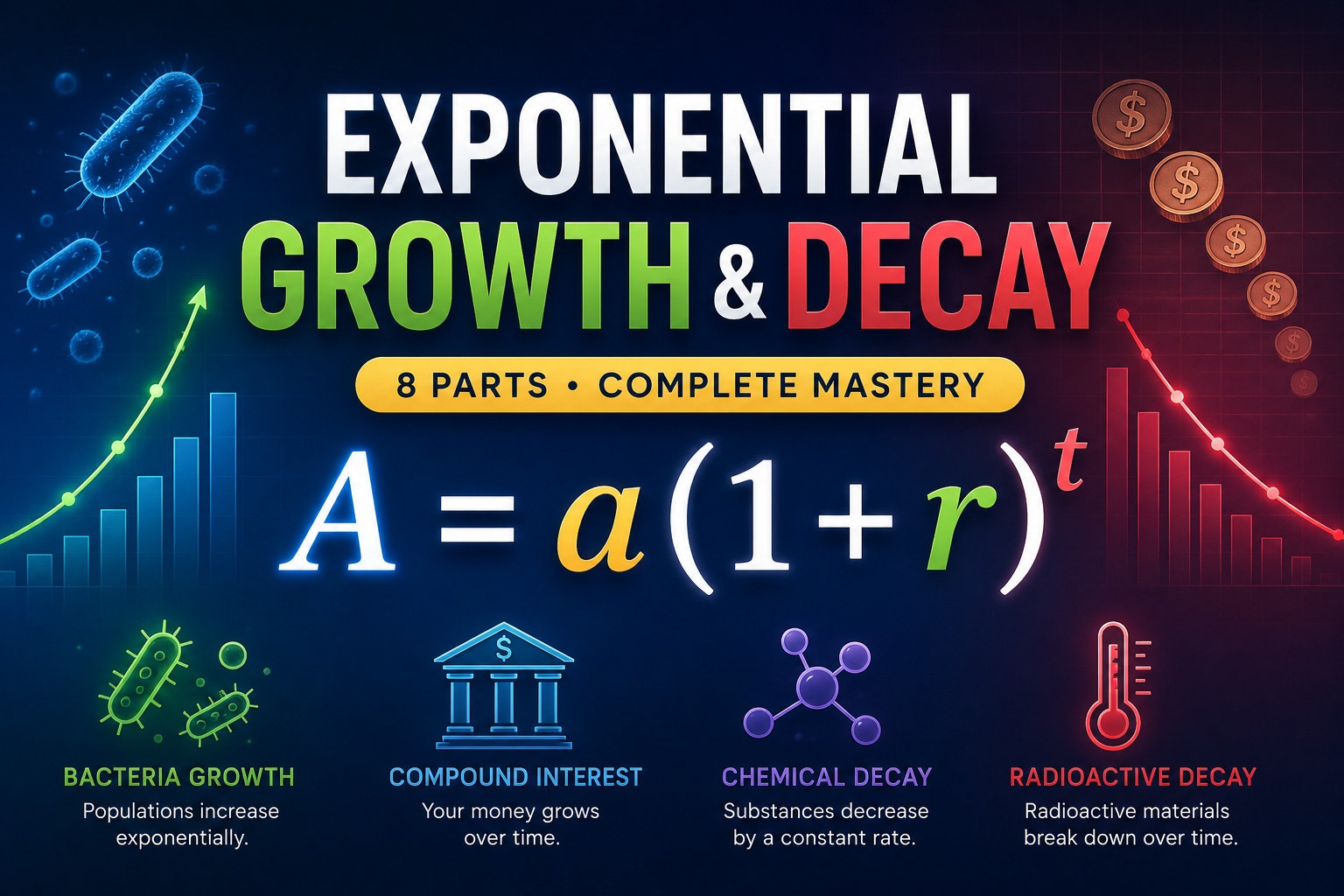
Before tackling more practice problems, make sure your conceptual foundation is solid. Explore our comprehensive guide on the Essentials of SAT Exponential Growth & Decay to review core formulas, growth factors, and rules.
Review Core Essentials & Formulas