




Essentials of SAT Exponential Growth & Decay
Essentials of SAT Exponential Growth & Decay
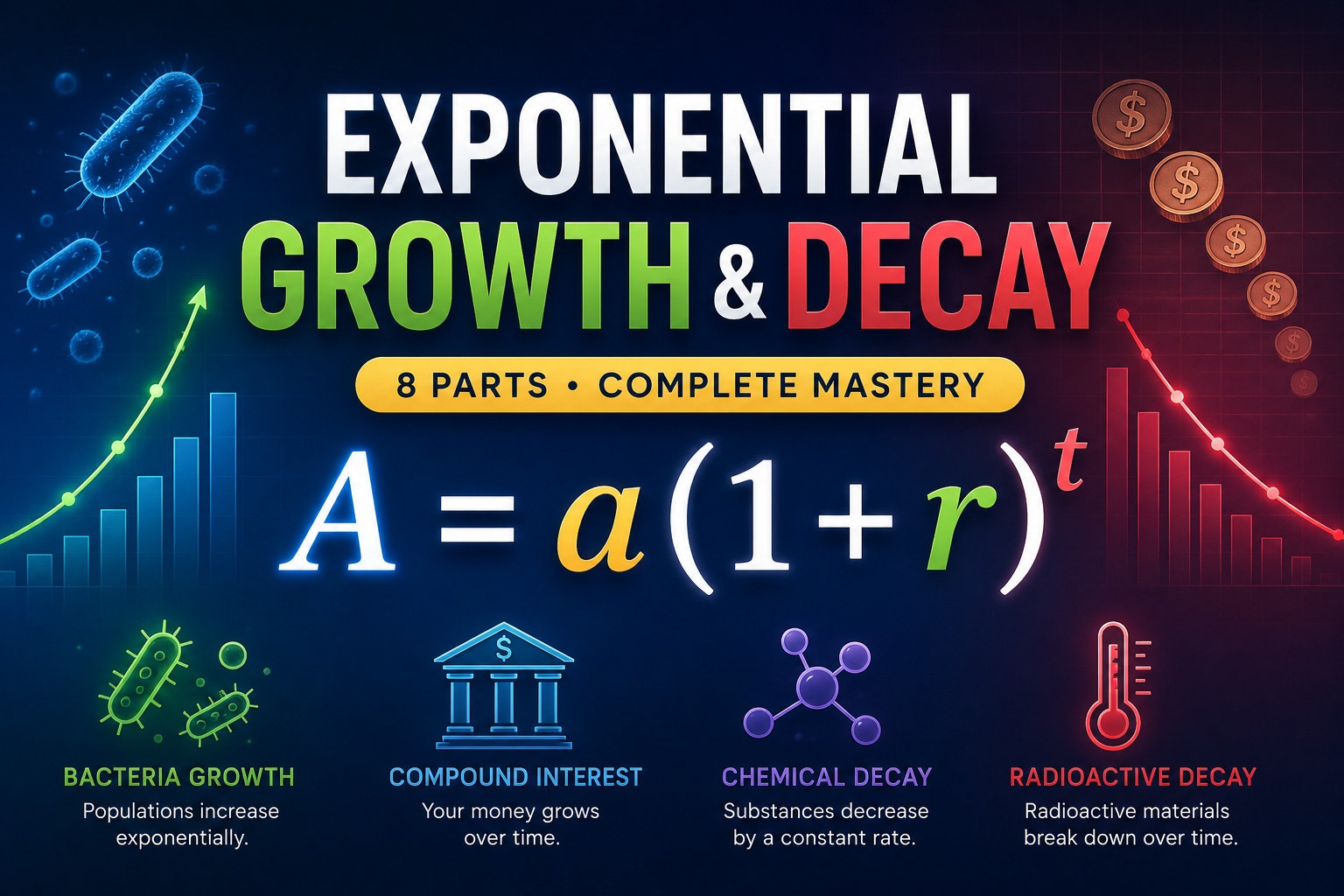
Master linear vs. exponential thinking, growth and decay models, time-unit conversions, and SAT-style reasoning with friendly step-by-step lessons and practice problems.
Choose a Lesson
Follow the lessons in order if this is your first time learning exponential growth and decay, or jump directly to the SAT practice sections.
Part 1 — Linear vs. Exponential
Recognize repeated addition and repeated multiplication quickly.
Part 2 — Exponential Growth
Understand how constant percentage growth creates exponential change.
Part 3 — Exponential Decay
Learn why multiplying by a number between 0 and 1 causes decay.
Part 4 — Building Models
Translate SAT word problems into exponential equations.
Part 5 — Word Problems
Turn real-world situations into equations with confidence.
Part 6 — Time Units
Match years, months, and quarters to the correct exponent.
Part 7 — Solving for the Unknown
Find target values and compare exponential models logically.
Part 8 — Mixed SAT Practice
Bring everything together with realistic Bluebook-style practice.
Linear Vs. Exponential Thinking
SATMath800 • From SAT to University with Dr. Aytekin
The key question: What stays the same?
Big Idea
Exponential growth is repeated multiplication by the same factor.
You may have seen an exponential equation such as y = a(b)x and thought, “What am I supposed to do with that?” Don’t worry. We are not starting with the formula. We are starting with patterns.
If you can recognize a pattern, you are already on your way to understanding exponential models.
1. Meet the Pattern Machine 🤖
Imagine a machine. Every time a number enters the machine, the machine multiplies it by 2.
Every step follows the same rule: multiply by 2.
| Step x | Value y | What happened? |
|---|---|---|
| 0 | 5 | Starting value |
| 1 | 10 | 5 × 2 |
| 2 | 20 | 10 × 2 |
| 3 | 40 | 20 × 2 |
| 4 | 80 | 40 × 2 |
The values 5, 10, 20, 40, 80 are not increasing by the same amount. They are being multiplied by the same factor: 2.
2. Same Difference or Same Multiplier?
This distinction is extremely important for the SAT.
| Pattern | What stays the same? | Type |
|---|---|---|
| 10, 20, 30, 40, 50 | Difference = 10 | Linear |
| 5, 10, 20, 40, 80 | Multiplier = 2 | Exponential |
3. A Real-Life Example: Saving Money
Linear Growth
| Month | Money |
|---|---|
| 0 | $10 |
| 1 | $20 |
| 2 | $30 |
| 3 | $40 |
| 4 | $50 |
This is linear growth because the same amount, $10, is added every month.
Exponential Growth
| Month | Money |
|---|---|
| 0 | $10 |
| 1 | $20 |
| 2 | $40 |
| 3 | $80 |
| 4 | $160 |
This is exponential growth because the same factor, 2, is used every month.
In linear growth, the amount added stays the same. In exponential growth, the amount added gets larger because each new amount is multiplied again.
4. Look at the Differences
Linear
| Value | Change |
|---|---|
| 10 | — |
| 20 | +10 |
| 30 | +10 |
| 40 | +10 |
| 50 | +10 |
Exponential
| Value | Change |
|---|---|
| 10 | — |
| 20 | +10 |
| 40 | +20 |
| 80 | +40 |
| 160 | +80 |
The exponential sequence initially looks similar to the linear sequence, but its increases keep getting larger: +10, +20, +40, +80.
When a table or sequence looks unfamiliar, don’t immediately search for a formula. First ask: What happens from one row to the next?
5. The Multiplier Does Not Have to Be 2
Students sometimes associate exponential growth with doubling. Doubling is only one example.
Because the same multiplier, 1.5, is used at every step, the pattern is exponential.
Don’t ask, “Does it double?” Ask, “Is it multiplied by the same factor each time?”
6. Quick Check ✏️
Question 1
Consider the sequence 7, 14, 28, 56, 112.
A. Linear
B. Exponential
Question 2
Consider the sequence 15, 25, 35, 45, 55.
A. Linear
B. Exponential
Question 3
A quantity follows the pattern 6, 18, 54, 162, …
A. 324
B. 486
C. 648
D. 972
7. Quick Check — Step-by-Step Solutions
Question 1
- 7 × 2 = 14
- 14 × 2 = 28
- 28 × 2 = 56
- 56 × 2 = 112
The multiplier is always 2.
Question 2
- 25 − 15 = 10
- 35 − 25 = 10
- 45 − 35 = 10
- 55 − 45 = 10
The difference is always 10.
Question 3
- 6 × 3 = 18
- 18 × 3 = 54
- 54 × 3 = 162
- 162 × 3 = 486
8. SAT Connection 🎯
The SAT may give you a table instead of an equation. You can still recognize an exponential model by checking the ratio between consecutive values.
| x | P |
|---|---|
| 0 | 20 |
| 1 | 30 |
| 2 | 45 |
| 3 | 67.5 |
Check the ratios:
If the differences are constant, think linear. If the ratios (multipliers) are constant, think exponential.
Question 4
| x | P |
|---|---|
| 0 | 40 |
| 1 | 48 |
| 2 | 57.6 |
| 3 | 69.12 |
Which statement best describes the relationship between P and x?
A. P increases by a constant amount.
B. P is multiplied by a constant factor.
C. P decreases by a constant amount.
D. P is divided by a constant factor.
Question 4 — Solution
Because P is multiplied by the same factor, 1.2, whenever x increases by 1, the relationship is exponential.
⭐ Part 1 Takeaway
Before moving on, make sure these three ideas are comfortable.
Same difference.
Same multiplier.
Whenever you see a table or sequence, ask:
Next: Percentage Growth
Now that you understand repeated multiplication, we are ready for one of the most useful ideas in exponential modeling: percentage growth.
We will discover why a 10% increase means multiplying by 1.10 — and why this simple idea appears again and again in SAT exponential-growth questions.
Growing Again and Again
SATMath800 • From SAT to University with Dr. Aytekin
Exponential growth happens when we repeatedly multiply the current amount by the same factor.
Big Idea
Exponential growth happens when we repeatedly multiply the current amount by the same factor.
This lesson is about recognizing that repeated multiplication is the real heart of exponential growth. We are not starting with a complicated formula. We are starting with a pattern that keeps happening again and again.
1. Start With One Coin 🪙
Imagine that you have 1 coin. At the end of each day, the number of coins doubles.
| Day | Number of Coins | What happened? |
|---|---|---|
| 0 | 1 | Starting amount |
| 1 | 2 | 1 × 2 |
| 2 | 4 | 2 × 2 |
| 3 | 8 | 4 × 2 |
| 4 | 16 | 8 × 2 |
| 5 | 32 | 16 × 2 |
| 6 | 64 | 32 × 2 |
We are not adding 1 coin every day. We are multiplying the current number of coins by 2.
Every step follows the same rule: ×2. That repeated multiplication is the pattern we want to recognize.
2. Why Does the Growth Get Faster?
Look at the number of coins, and then look at how much the number increases each day.
| Day | Coins | Increase from Previous Day |
|---|---|---|
| 0 | 1 | — |
| 1 | 2 | +1 |
| 2 | 4 | +2 |
| 3 | 8 | +4 |
| 4 | 16 | +8 |
| 5 | 32 | +16 |
| 6 | 64 | +32 |
Notice what stays the same and what changes:
- ×2 is constant
- +1, +2, +4, +8, +16, +32 keeps changing
Exponential growth can start slowly and then become very large because each new amount becomes the starting point for the next multiplication.
3. A Small Beginning Can Become a Big Number
Let’s continue our coin example.
| Day | Coins |
|---|---|
| 0 | 1 |
| 1 | 2 |
| 2 | 4 |
| 3 | 8 |
| 4 | 16 |
| 5 | 32 |
| 6 | 64 |
| 7 | 128 |
| 8 | 256 |
| 9 | 512 |
| 10 | 1,024 |
We started with only 1 coin. After 10 doubling steps, we have 1,024 coins.
4. Let’s Compare This With Linear Growth
Now imagine two students start with the same number of coins: 10 coins.
Student A — Linear
Adds 10 coins every day.
| Day | Coins |
|---|---|
| 0 | 10 |
| 1 | 20 |
| 2 | 30 |
| 3 | 40 |
| 4 | 50 |
| 5 | 60 |
Student B — Exponential
Doubles the number every day.
| Day | Coins |
|---|---|
| 0 | 10 |
| 1 | 20 |
| 2 | 40 |
| 3 | 80 |
| 4 | 160 |
| 5 | 320 |
At the beginning, the two patterns look similar. Then the exponential pattern pulls away very quickly.
| Day | Linear (+10) | Exponential (×2) |
|---|---|---|
| 0 | 10 | 10 |
| 1 | 20 | 20 |
| 2 | 30 | 40 |
| 3 | 40 | 80 |
| 4 | 50 | 160 |
| 5 | 60 | 320 |
| 6 | 70 | 640 |
| 7 | 80 | 1,280 |
At first the patterns may look similar. Later, the exponential pattern becomes dramatically larger. This is a common SAT comparison idea.
5. A Very Important SAT Idea
You may see a table where the numbers don’t look dramatic at all.
| x | y |
|---|---|
| 0 | 100 |
| 1 | 110 |
| 2 | 121 |
| 3 | 133.1 |
| 4 | 146.41 |
The differences are not constant:
Now check the multiplier:
The multiplier is always 1.1, so this is an exponential pattern.
For now, remember: the quantity is multiplied by the same factor at every step.
6. The “Current Amount” Matters
Suppose you have 100 and it doubles each year.
A student might think, “It increases by 100 every year.” That is true only for the first increase.
| Step | Amount | Increase |
|---|---|---|
| 0 | 100 | — |
| 1 | 200 | +100 |
| 2 | 400 | +200 |
| 3 | 800 | +400 |
| 4 | 1,600 | +800 |
The amount added changes. What stays constant is the multiplier:
The current amount becomes the starting amount for the next multiplication.
7. The Pattern in Words
Let’s describe the process without any equation.
Exponential Growth in Plain English
- Start with an amount.
- Multiply it by the same factor.
- Take the new amount.
- Multiply it by the same factor again.
- Keep repeating.
For example, with a starting amount of 50 and a multiplier of 1.2:
Every step uses the new amount.
8. A Friendly Way to Think About It
Think of exponential growth as a snowball rolling downhill.
At first, the snowball is small. As it rolls, it collects more snow. Then it has a larger surface from which to collect even more snow. So the growth becomes faster.
The same mathematical pattern can describe:
- populations,
- investments,
- bacteria,
- online followers,
- radioactive processes,
- depreciation,
- and many other real-world quantities.
The story can change. The mathematics can stay the same. Look for the repeated multiplier hiding underneath the story.
🎨 The Growing Coin Machine
Watch how repeated multiplication creates exponential growth.
Linear Growth
Add the same amount each time.
Exponential Growth
Multiply by the same factor each time.
9. Quick Check ✏️
Try these before reading the solutions. The goal is to recognize the pattern, not to rush.
Question 1
A population follows the pattern 5, 10, 20, 40, 80, …
What is the population at the next step?
A. 85
B. 100
C. 120
D. 160
Question 2
A quantity starts at 50 and is multiplied by 1.5 at each step.
Step 0 = 50
Step 1 = 75
Step 2 = ?
Step 3 = ?
A. 100, 125
B. 112.5, 168.75
C. 125, 187.5
D. 150, 225
Question 3
Two quantities start at 100.
- Quantity A increases by 20 each year.
- Quantity B increases by multiplying by 1.2 each year.
Which statement is true?
A. Both quantities increase by the same amount every year.
B. Quantity A is exponential and Quantity B is linear.
C. Quantity A is linear and Quantity B is exponential.
D. Both quantities are exponential.
10. Quick Check — Step-by-Step Solutions
Question 1
- 5 × 2 = 10
- 10 × 2 = 20
- 20 × 2 = 40
- 40 × 2 = 80
Apply the same multiplier once more:
SAT Tip: A constant multiplier tells you to continue multiplying by that same factor.
Question 2
Every step multiplies by 1.5.
SAT Tip: We multiply the current amount — not the original amount — at every step.
Question 3
Quantity A: 100, 120, 140, 160, …
Difference = +20 → Linear
Quantity B: 100, 120, 144, 172.8, …
Multiplier = ×1.2 → Exponential
SAT Tip: A constant difference signals linear growth; a constant multiplier signals exponential growth.
11. SAT-Style Practice 🎯
Now let’s make the idea look more like something you could actually encounter on the SAT.
Question 4
A town has a population of 2,000. The population is multiplied by 1.05 each year.
Which statement describes this model?
A. The population increases by 5 people each year.
B. The population increases by 50 people each year.
C. The population increases by 5% each year.
D. The population increases by 105% each year.
Question 4 — Solution
The multiplier is 1.05.
Therefore, multiplying by 1.05 means increasing the quantity by 5% each time.
SAT Lesson: A multiplier of 1.05 means 5% growth.
Question 5
The table shows the number of members of a club over several years.
| Year x | Members M |
|---|---|
| 0 | 400 |
| 1 | 440 |
| 2 | 484 |
| 3 | 532.4 |
Which type of model best represents the relationship between M and x?
A. Linear, because the number of members increases.
B. Linear, because the difference between consecutive values is constant.
C. Exponential, because the ratio between consecutive values is constant.
D. Exponential, because the differences between consecutive values are constant.
Question 5 — Solution
First, check the differences:
The differences are not constant.
Now check the ratios:
The ratio is constant, so the model is exponential.
SAT Tip: On a table-based SAT question, a constant ratio is a strong signal of an exponential model.
12. Part 2 Takeaway ⭐
Before moving on, make sure you can explain this idea in your own words:
Exponential growth means that the current amount is repeatedly multiplied by the same factor.
The multiplier stays the same, but the amount added can change.
13. Coming Next: The Magic of 10% 🚀
We’ve now seen that exponential growth is repeated multiplication.
But a very common SAT question is:
Why does this work? In the next Part, we’ll discover it from scratch, rather than asking you to memorize it.
The Magic of Percentages
SATMath800 • From SAT to University with Dr. Aytekin
A percentage change tells us how the current amount is being multiplied.
Big Idea
A percentage change tells us how the current amount is being multiplied.
This is one of the most important ideas in SAT exponential growth questions. Once you understand why a 10% increase becomes ×1.10, many exponential formulas become much easier to remember and use. Based on the approved Part 3 document.
1. What Does “10% Growth” Actually Mean?
Suppose you have 100 points. Your score grows by 10%.
What is 10% of 100?
So the new amount is:
Now suppose it grows by another 10%.
The second 10% is not 10 points. It is 10% of the new amount:
And another 10% gives:
2. Look at What Really Happened
The percentage stays the same, but the amount being added changes because we calculate 10% of the current amount.
| Step | Amount | 10% of Amount | New Amount |
|---|---|---|---|
| 0 | 100 | — | 100 |
| 1 | 100 | 10 | 110 |
| 2 | 110 | 11 | 121 |
| 3 | 121 | 12.1 | 133.1 |
| 4 | 133.1 | 13.31 | 146.41 |
The percentage stays the same. The amount being used to calculate that percentage changes.
3. Here’s the Shortcut ⭐
Instead of calculating the 10% separately every time, we can combine the original amount and the increase.
A 10% increase means × 1.10
4. Why Is It 1.10?
This is worth understanding rather than memorizing.
If something increases by 10%, we keep 100% of the original amount and add 10% more.
Translation
5. The Percentage Growth Table
| Growth | Multiplier |
|---|---|
| 1% | 1.01 |
| 5% | 1.05 |
| 10% | 1.10 |
| 15% | 1.15 |
| 20% | 1.20 |
| 25% | 1.25 |
| 50% | 1.50 |
| 100% | 2.00 |
The pattern is:
where the growth rate is written as a decimal.
6. Let’s Make It Even Easier
Imagine a 100% starting amount.
If it grows by 20%, you now have:
5% growth → ×1.05
50% growth → ×1.50
7. Now Connect It to Exponential Growth
Suppose a population increases by 10% every year.
We just learned that:
Starting with 1,000:
This is exponential growth because the same multiplier, 1.10, is used again and again.
The current amount becomes the starting amount for the next step.
🎨 The Percentage Growth Machine
Watch how a percentage increase becomes a multiplier.
📈 Repeated 10% Growth
Notice that the same machine is used again and again.
The exponent counts how many times the ×1.10 machine is used.
8. A Visual Way to See It 🎨
The Percentage Growth Machine
The second increase is 10% of $550, not 10% of the original $500.
9. The Exponential Formula Appears Naturally
Suppose:
- a = starting amount
- r = growth rate written as a decimal
- x = number of growth periods
Each period multiplies the amount by 1 + r.
For example, if a quantity starts at 500 and grows by 20% per year:
10. Why Is There an Exponent?
The exponent simply counts how many times we multiply by the growth factor.
| Number of Periods | Expression | Meaning |
|---|---|---|
| 1 | 500(1.20) | one multiplication |
| 2 | 500(1.20)2 | two multiplications |
| 3 | 500(1.20)3 | three multiplications |
| x | 500(1.20)x | x multiplications |
The exponent is counting repeated multiplication — the same idea we learned in Part 2.
11. A Common Mistake ⚠️
Suppose a quantity increases by 10% each year.
A student might write:
That is not the correct model for the amount itself.
0.10 represents the 10% increase, not the entire amount after growth.
The percentage increase is 0.10.
The growth multiplier is 1.10.
12. Another Common Mistake
Suppose you have $500 and it grows by 10% each year.
Someone might calculate $50 of growth every year. But the amount being increased changes.
| Year | Amount | 10% Increase |
|---|---|---|
| 0 | $500.00 | — |
| 1 | $550.00 | $50.00 |
| 2 | $605.00 | $55.00 |
| 3 | $665.50 | $60.50 |
Why? The second year’s 10% is calculated from $550, not from the original $500.
13. Let’s Try Different Growth Rates
Suppose a quantity starts at 200.
| Growth Rate | Multiplier | After One Period |
|---|---|---|
| 5% | 1.05 | 200(1.05) = 210 |
| 10% | 1.10 | 200(1.10) = 220 |
| 25% | 1.25 | 200(1.25) = 250 |
| 50% | 1.50 | 200(1.50) = 300 |
Growth rate → multiplier. Once you know the multiplier, the exponential model becomes much easier.
14. Quick Check ✏️
Try these before reading the solutions. The goal is understanding, not speed.
Question 1
A quantity increases by 20%. What is the multiplier?
A. 0.20
B. 1.02
C. 1.20
D. 2.00
Question 2
A population is currently 800 and increases by 5%.
What is the population after one growth period?
A. 805
B. 840
C. 850
D. 1,200
Question 3
A quantity starts at 400 and increases by 10% each year.
Which equation represents the quantity y after x years?
A. y = 400(0.10)x
B. y = 400(1.10)x
C. y = 400(10)x
D. y = 400 + 10x
15. Quick Check — Step-by-Step Solutions
Question 1
- 100% + 20% = 120%
- 120% = 1.20
SAT Tip: For growth, start with 1 and add the decimal form of the growth rate.
Question 2
SAT Tip: Translate the percentage into a multiplier before doing the calculation.
Question 3
Starting amount = 400
SAT Tip: A growth model uses 1 + r, not r by itself.
16. SAT-Style Practice 🎯
Question 4
A company’s number of subscribers increases by 8% each month.
At the beginning of a certain month, the company has 12,000 subscribers.
Which expression represents the number of subscribers x months later?
A. 12,000(0.08)x
B. 12,000(1.08)x
C. 12,000(1.8)x
D. 12,000 + 0.08x
Question 4 — Solution
Question 5
A scientist records the amount of a substance in a container.
| Time x | Amount A |
|---|---|
| 0 | 500 |
| 1 | 550 |
| 2 | 605 |
| 3 | 665.5 |
Which equation represents the relationship?
A. A = 500(1.05)x
B. A = 500(1.10)x
C. A = 500(0.10)x
D. A = 500 + 50x
Question 5 — Solution
Check the ratio between consecutive values:
The constant multiplier is 1.10, so:
SAT Tip: On a table-based SAT question, a constant ratio is a strong signal of an exponential model.
17. The Most Important Translation ⭐
| Words | Translation |
|---|---|
| increases by 10% | 10% = 0.10 |
| Decimal rate | 0.10 |
| Multiplier | 1 + 0.10 = 1.10 |
| Exponential model | y = a(1.10)x |
⭐ Part 3 Takeaway
Don’t memorize the formula first. Understand the story first.
A percentage increase tells you how much more than the original 100% you now have.
🚀 Coming Next
We’ve learned how to handle growth.
But what happens when something decreases?
Suppose a car loses 10% of its value each year. Do we use 0.10, 1.10, or something else?
That’s our next step. We will discover that exponential decay follows exactly the same multiplication idea — we just need to understand what remains after the decrease.
Growth and decay are two sides of the same multiplication idea.
Exponential Decay
SATMath800 • From SAT to University with Dr. Aytekin
When something decreases by the same percentage again and again, we repeatedly multiply by the percentage that remains.
Big Idea
When something decreases by the same percentage again and again, we repeatedly multiply by the percentage that remains.
This is the twin of exponential growth. The structure stays the same; only the multiplier changes.
1. Growth Has a Twin
In Part 3, we saw that a 10% increase means we keep the original 100% and add 10%.
Now imagine the opposite. Something decreases by 10%. Instead of adding 10%, we remove 10%.
10% decay → ×0.90
No scary new idea — just ask:
2. Let’s See It With a Real Number
Suppose a machine currently costs $1,000. Its value decreases by 10% each year.
After one year
After two years
The new 10% is calculated from $900.
After three years
3. Look at the Pattern
The percentage stays the same, but the amount being removed gets smaller because we always take 10% of the current value.
| Year | Value | 10% Decrease | New Value |
|---|---|---|---|
| 0 | $1,000 | — | $1,000 |
| 1 | $1,000 | $100 | $900 |
| 2 | $900 | $90 | $810 |
| 3 | $810 | $81 | $729 |
| 4 | $729 | $72.90 | $656.10 |
The percentage stays the same. The current amount changes.
4. The Shortcut
We could calculate the decrease every time. But there is an easier way.
So instead of subtracting 10%, we can simply multiply by 0.90.
The Decay Machine
Every time the amount enters, the same multiplier is used:
5. The Decay Multiplier Table
| Decrease | Multiplier |
|---|---|
| 1% | 0.99 |
| 5% | 0.95 |
| 10% | 0.90 |
| 15% | 0.85 |
| 20% | 0.80 |
| 25% | 0.75 |
| 50% | 0.50 |
| 75% | 0.25 |
where r is written as a decimal.
6. Growth vs. Decay
| Situation | What remains? | Multiplier |
|---|---|---|
| 10% growth | 110% | 1.10 |
| 10% decay | 90% | 0.90 |
| 20% growth | 120% | 1.20 |
| 20% decay | 80% | 0.80 |
| 5% growth | 105% | 1.05 |
| 5% decay | 95% | 0.95 |
Growth
Add to 1.
Decay
Subtract from 1.
Growth adds to 1.
Decay subtracts from 1.
7. Now the Formula Makes Sense
Suppose:
- a = starting amount
- r = decay rate as a decimal
- x = number of periods
Each period multiplies the current amount by 1 − r.
For a machine worth $1,000 that loses 10% each year:
We built the formula directly from:
8. Why Is the Exponent Still There?
Exactly the same reason as in growth: the exponent counts how many times the decay multiplier is applied.
Same multiplier + repeated application = exponential model.
9. A Friendly Way to Think About It
🎨 The Keep What Remains Machine
Imagine a friendly machine that keeps only 90% of whatever you give it.
“I don’t subtract the same amount. I keep 90% of whatever you give me!”
10. A Very Important SAT Trap ⚠️
Suppose something decreases by 10% each year.
A student might write:
That is wrong.
0.10 is the amount being removed, not the amount that remains.
0.10 = removed
0.90 = remaining
11. Another SAT Trap: Subtracting the Same Amount ⚠️
Suppose a car is worth $20,000 and loses 10% of its value every year.
Many students incorrectly think:
That creates this pattern:
❌ Incorrect Thinking (Linear)
| Year | Value |
|---|---|
| 0 | $20,000 |
| 1 | $18,000 |
| 2 | $16,000 |
| 3 | $14,000 |
Each year the same amount ($2,000) is removed. That is a linear decrease, not an exponential decrease.
✅ Correct Thinking (Exponential Decay)
Each year we keep 90% of the current value.
Now the pattern looks like this:
| Year | Current Value | Multiply by 0.90 | New Value |
|---|---|---|---|
| 0 | $20,000 | × 0.90 | $18,000 |
| 1 | $18,000 | × 0.90 | $16,200 |
| 2 | $16,200 | × 0.90 | $14,580 |
Why This Is Better
The 10% is not always $2,000. Each year the percentage is applied to a different current value.
- Year 1: 10% of 20,000 = 2,000
- Year 2: 10% of 18,000 = 1,800
- Year 3: 10% of 16,200 = 1,620
The amount removed gets smaller each year because the percentage is applied to the current amount, not the original amount.
12. Growth and Decay Side by Side
Start with the same amount: 1000.
| x | 10% Growth | 10% Decay |
|---|---|---|
| 0 | 1000 | 1000 |
| 1 | 1100 | 900 |
| 2 | 1210 | 810 |
| 3 | 1331 | 729 |
📈 Growth vs. Decay Comparison
Both models start at the same value. The only difference is the multiplier.
📈 10% Growth
📉 10% Decay
Same structure • Different multiplier
The models have the same structure. Only the multiplier changes: 1.10 versus 0.90.
13. Quick Check ✏️
Try these before reading the solutions. The goal is understanding, not speed.
Question 1
A quantity decreases by 20%. What is the multiplier?
A. 0.20
B. 0.80
C. 1.20
D. 1.80
Question 2
A machine is currently worth $5,000 and loses 10% of its value each year.
What will it be worth after one year?
A. $4,500
B. $4,900
C. $5,100
D. $5,500
Question 3
A population decreases by 5% each year.
Which equation represents the population P after x years if the initial population is 20,000?
A. P = 20,000(0.05)x
B. P = 20,000(0.95)x
C. P = 20,000(1.05)x
D. P = 20,000 − 0.05x
14. Quick Check — Step-by-Step Solutions
Question 1
- A 20% decrease means we keep 100% − 20% = 80%.
- Convert 80% to a decimal: 0.80.
SAT Tip: For decay, ask what percentage remains after the decrease.
Question 2
- A 10% decrease means 1 − 0.10 = 0.90.
- Multiply the current value by 0.90.
Question 3
- The decay rate is 5% = 0.05.
- The amount remaining is 1 − 0.05 = 0.95.
15. SAT-Style Practice 🎯
Question 4
The value of a certain machine decreases by 12% each year. The machine is initially valued at $8,000.
Which equation represents its value V, in dollars, x years after its initial valuation?
A. V = 8000(0.12)x
B. V = 8000(0.88)x
C. V = 8000(1.12)x
D. V = 8000 − 0.12x
Question 4 — Solution
The machine loses 12% = 0.12, so it keeps:
Question 5
A quantity decreases according to the table below.
| x | y |
|---|---|
| 0 | 2,000 |
| 1 | 1,800 |
| 2 | 1,620 |
| 3 | 1,458 |
Which equation could represent this relationship?
A. y = 2000(0.90)x
B. y = 2000(0.10)x
C. y = 2000(1.10)x
D. y = 2000 − 200x
Question 5 — Solution
Check the ratios between consecutive values:
The multiplier is always 0.90.
SAT Tip: When a table is involved, don’t automatically look for differences. For exponential relationships, check the ratio.
⭐ Part 4 Takeaway
Something gets bigger.
Something gets smaller.
🧠 One Last Thought
Don’t think:
Think:
10% disappears → 90% remains → 0.90
That’s the whole idea. The formula is simply a short way of writing repeated multiplication.
🚀 Coming Next
Now that we understand both growth and decay, we’re ready to build an exponential model directly from a word problem.
We’ll learn how to identify:
- the initial amount,
- the growth or decay rate,
- the multiplier,
- the time variable,
- and what the question is actually asking us to find.
That’s where all the pieces start coming together.
Growth and decay are the same multiplication story told in opposite directions.
Building an Exponential Model
SATMath800 • From SAT to University with Dr. Aytekin
Big Idea
The SAT often gives you a situation in words. Your job is to translate that situation into an exponential model.
1. Don’t Start With the Formula
When students see a problem like:
“A population of 12,000 increases by 5% each year. What will the population be after 4 years?”
They sometimes immediately think:
Don’t. Instead, ask four simple questions.
| Question | What are we looking for? |
|---|---|
| ① What do we start with? | Initial amount |
| ② Is it growing or shrinking? | Growth or decay |
| ③ By what percentage? | Rate |
| ④ How many times does it happen? | Number of periods |
Find the starting amount, the multiplier, and the number of periods. Then the model almost builds itself.
2. Let’s Build One Together
Example: A population is initially 12,000 and increases by 5% each year. What will the population be after 4 years?
Step 1 — Find the starting amount
Step 2 — Decide: growth or decay?
The population increases, so this is exponential growth.
Step 3 — Find the multiplier
For growth, use 1 + r.
So every year, we multiply by 1.05.
Step 4 — Find the exponent
The population changes each year, and we are looking at 4 years.
Step 5 — Build the equation
Substitute the values:
For 4 years:
Notice What We Did
We didn’t memorize a complicated procedure. We simply found:
- Starting amount
- Multiplier
- Number of periods
3. The Four-Box Method 🧩
BOX 1 — START
What do we have at the beginning?
BOX 2 — CHANGE
Is it increasing or decreasing?
- Increasing → growth
- Decreasing → decay
BOX 3 — MULTIPLIER
Convert the percentage to a decimal.
BOX 4 — TIME
How many periods pass?
That becomes the exponent.
4. A Very Friendly Example
Example: A savings account contains $500 and grows by 8% each year.
| What do we know? | Answer |
|---|---|
| Starting amount | $500 |
| Change | Growth |
| Rate | 8% |
| Decimal rate | 0.08 |
| Multiplier | 1.08 |
| Time | x years |
If we want the amount after 3 years:
- The starting amount goes outside the parentheses.
- The multiplier goes inside the parentheses.
- The number of periods goes in the exponent.
5. Now Try Decay
Example: A laptop is worth $1,200 and loses 15% of its value each year.
Step 1
Step 2
It loses value, so this is decay.
Step 3
Step 4
6. Growth and Decay Side by Side
Suppose two machines both start at $10,000.
Machine A — Growth
Increases by 6% per year.
Machine B — Decay
Decreases by 6% per year.
- Multiplier > 1 → Growth
- Multiplier between 0 and 1 → Decay
7. The Exponent Has a Job
Suppose:
The exponent x represents the number of times the 8% growth happens.
This becomes especially important when a problem talks about months, years, days, or other time intervals.
8. Watch the Words Carefully 👀
SAT problems may say:
- increases by 5% annually
- grows at a rate of 5% per year
- increases 5% every year
- decreases by 5% each month
- loses 5% of its value every 6 months
These phrases tell us something about the period.
| Statement | Multiplier / Meaning |
|---|---|
| 4% each year | 1.04 per year |
| 4% each month | 1.04 per month |
The multiplier may be the same, but the meaning of the exponent changes.
9. A Common SAT Trap ⚠️
Suppose:
A population of 8,000 increases by 10% each year.
❌ Wrong
❌ Wrong
✅ Correct
Why?
10. Another Trap: The Starting Amount
Suppose:
A population of 25,000 decreases by 4% each year.
Not:
The starting amount is not raised to the exponent.
11. The Model-Building Recipe ⭐
Growth
Decay
Don’t memorize blindly.
12. Let’s Do a Table Example
A quantity follows this pattern:
| x | y |
|---|---|
| 0 | 2,000 |
| 1 | 2,100 |
| 2 | 2,205 |
| 3 | 2,315.25 |
Check the ratios:
The multiplier is always 1.05.
The initial value is 2,000, so:
Same multiplier → Exponential. This is exactly the kind of table where ratios reveal the model.
13. Three Questions Before We Move On ✏️
Try these without looking at the solutions. The goal is understanding, not speed.
Question 1
A population is initially 6,000 and increases by 7% each year. Which equation represents the population P after x years?
A. P = 6,000(0.07)x
B. P = 6,000(1.07)x
C. P = 6,000(1.70)x
D. P = 6,000(7)x
Question 2
A car is initially worth $30,000 and loses 12% of its value each year. Which equation represents its value V after x years?
A. V = 30,000(0.12)x
B. V = 30,000(1.12)x
C. V = 30,000(0.88)x
D. V = 30,000(0.12x)
Question 3
The table shows the value of a quantity. Which equation represents the relationship?
| x | y |
|---|---|
| 0 | 5,000 |
| 1 | 4,500 |
| 2 | 4,050 |
| 3 | 3,645 |
A. y = 5,000(0.10)x
B. y = 5,000(0.90)x
C. y = 5,000(1.10)x
D. y = 5,000 − 500x
14. Step-by-Step Solutions
Question 1
- Initial amount: a = 6,000
- It increases → growth
- 7% = 0.07
- Growth multiplier: 1 + 0.07 = 1.07
Answer: B
SAT Tip: Find the multiplier first before worrying about the exponent.
Question 2
- Initial value: $30,000
- The car loses value → decay
- 12% = 0.12
- Decay multiplier: 1 − 0.12 = 0.88
Answer: C
SAT Tip: For decay, find what percentage remains.
Question 3
Check the ratios between consecutive values:
The multiplier is always 0.90, so the relationship is exponential decay.
Answer: B
SAT Tip: Same multiplier → exponential. The initial value is the value when x = 0.
15. SAT-Style Challenge 🎯
The population of a town was 18,000 in 2020. The population has decreased by 3% each year since 2020.
Which equation gives the population P, in terms of t, where t represents the number of years after 2020?
A. P = 18,000(0.03)t
B. P = 18,000(0.97)t
C. P = 18,000(1.03)t
D. P = 18,000 − 0.03t
Challenge — Solution
Start:
Decrease:
Remaining percentage:
Number of years: t
Answer: B
⭐ PART 5 TAKEAWAY
What do I start with?
Is it growing or shrinking?
How many periods?
🧠 One Last Thought
The SAT is not asking you to memorize a scary formula.
It is asking you to translate a situation into a pattern.
Once these four pieces become familiar, many exponential word problems stop looking like long stories and start looking like a simple translation exercise.
🚀 Coming Next
In Part 6, we’ll tackle one of the places where exponential questions become genuinely tricky: time units.
We’ll gently explore how the growth factor itself changes when the time period changes, rather than simply dividing the percentage rate by 12.
That distinction matters.
Exponential models are built, not memorized.
When The Time Unit Changes
The exponent must use the same time unit as the rate. Learn the SAT-safe way to handle months, years, quarters, and other time conversions.
When The Time Unit Changes
💡 Big Idea
The exponent counts how many growth or decay steps happen.
The most important rule in this lesson is:
1. Why Students Get Confused
Suppose a quantity grows by 12% per year.
Here \(x\) counts years. If we want 6 months, we should convert the time to years, not change the \(1.12\) multiplier.
2. The SAT-Safe Rule
When the rate is given per year, express the time in years. When the rate is given per month, express the time in months. When the rate is given per quarter, express the time in quarters.
| Time | Use in the Exponent |
|---|---|
| 3 months | \(0.25\) |
| 6 months | \(0.5\) |
| 9 months | \(0.75\) |
| 12 months | \(1\) |
| 18 months | \(1.5\) |
| 24 months | \(2\) |
| 30 months | \(2.5\) |
| 36 months | \(3\) |
3. Example — 18 Months
4. Growth by 8% Each Quarter
Two years contain eight quarters.
5. Compare the Situations
| Given Rate | Exponent Unit | Model |
|---|---|---|
| 5% per year | years | \(a(1.05)^t\) |
| 8% per month | months | \(a(1.08)^m\) |
| 8% per quarter | quarters | \(a(1.08)^q\) |
6. Quick Recognition Practice
| Situation | Correct Expression |
|---|---|
| 4% per year for 9 months | \(a(1.04)^{0.75}\) |
| 4% per month for 9 months | \(a(1.04)^9\) |
| 4% per quarter for 9 months | \(a(1.04)^3\) |
7. Quick Check 🎯
A quantity grows by 10% per year. Which expression represents the amount after 6 months?
8. Solutions
Question 1 — Solution
- The rate is per year.
- Convert the time to years: \(6/12=0.5\).
- Keep the annual multiplier \(1.10\).
Answer: B.
9. SAT-Style Challenge 🎯
A population is initially 50,000 and grows by 6% per year. Which expression represents the population after 9 months?
Challenge — Solution
Because the rate is per year, the exponent must be measured in years.
Answer: B.
Solving For The Unknown
Learn how to find the unknown exponent, estimate when a target value is reached, compare exponential models, and solve SAT-style growth problems without relying heavily on logarithms.
Solving For The Unknown
💡 Big Idea
In the previous parts, we learned how to build exponential models. Now we will learn how to use them to answer questions such as:
- How many years until a population doubles?
- When will an investment reach a target value?
- Which quantity grows faster?
- How can we compare exponential models without a calculator?
1. The New Kind Of Question
So far, we usually knew the exponent.
Now the SAT may ask: After how many years will the population exceed 7,000?
The unknown is no longer \(P\). The unknown is the exponent.
2. A Friendly Warm-Up
Question:
Suppose
When does the population become \(8{,}000\)?
3. The Doubling Question 🎯
Question:
When does the population double?
4. Estimating Exponential Growth
| \(t\) | \((1.10)^t\) |
|---|---|
| 1 | 1.10 |
| 2 | 1.21 |
| 3 | 1.33 |
| 4 | 1.46 |
| 5 | 1.61 |
| 6 | 1.77 |
| 7 | 1.95 |
| 8 | 2.14 |
The doubling happens between 7 and 8 years.
5. The SAT Comparison Trick ⭐
6. Which Reaches The Target First?
7. When The Starting Amounts Are Different
A quantity with a larger exponential growth factor will eventually overtake a smaller one, even if it starts behind.
8. Solving By Repeated Multiplication
| \(t\) | Value |
|---|---|
| 1 | 3600 |
| 2 | 4320 |
| 3 | 5184 |
9. A Powerful Shortcut: Growth Benchmarks
| Growth Rate | Rough Doubling Time |
|---|---|
| 5% | about 14 years |
| 7% | about 10 years |
| 10% | about 7 years |
| 20% | about 4 years |
10. SAT-Style Table Problem
Question:
The value of an investment follows this table.
| Year | Value |
|---|---|
| 0 | 1000 |
| 1 | 1200 |
| 2 | 1440 |
| 3 | 1728 |
| 4 | 2073.6 |
In which year does the investment first exceed $2,000?
Year 3 is still below 2,000, but Year 4 is above 2,000.
11. Solving For The Unknown In A Table
Find the exponential model and determine when \(y\) first exceeds \(1000\).
| \(x\) | \(y\) |
|---|---|
| 0 | 200 |
| 1 | 300 |
| 2 | 450 |
| 3 | 675 |
When \(x=4\), the value becomes \(1012.5\), so it first exceeds \(1000\).
12. The SAT Loves “Exceeds” And “At Least” ⚠️
| Phrase | What To Do |
|---|---|
| equals | Find the exact value if possible. |
| exceeds | Find the first value greater than the target. |
| at least | Find the smallest value greater than or equal to the target. |
13. Example — At Least
A bacteria culture starts with 250 cells and doubles every hour.
| \(h\) | \(N\) |
|---|---|
| 1 | 500 |
| 2 | 1000 |
| 3 | 2000 |
| 4 | 4000 |
14. Comparing Exponential And Linear Growth 🎯
| \(t\) | Linear | Exponential |
|---|---|---|
| 0 | 1000 | 1000 |
| 1 | 1200 | 1200 |
| 2 | 1400 | 1440 |
| 3 | 1600 | 1728 |
| 4 | 1800 | 2074 |
⭐ SAT Recognition
- Constant difference → Linear
- Constant multiplier → Exponential
The Race To The Target
Which investment reaches the target value first? The faster exponential growth factor wins the race.
15. Quick Check ✏️
After how many time periods does \(Q\) equal \(3200\)?
Which investment reaches \$5000 first?
A quantity starts at \(1000\) and increases by 20% each year. In which year does it first exceed \(1700\)?
16. Step-By-Step Solutions
Question 1
Answer: C
Question 2
Since \(1.08\) is larger, Investment B reaches \(5000\) first.
Answer: D
Question 3
| Year | Value |
|---|---|
| 0 | 1000 |
| 1 | 1200 |
| 2 | 1440 |
| 3 | 1728 |
The value first exceeds \(1700\) in Year 3.
Answer: C
17. SAT-Style Challenge 🎯
A population is modeled by
What is the smallest integer value of \(t\) for which \(P\) is greater than \(4000\)?
Challenge — Solution
| \(t\) | Value |
|---|---|
| 1 | 2875 |
| 2 | 3306 |
| 3 | 3802 |
| 4 | 4372 |
The value is still below \(4000\) at \(t=3\), but greater than \(4000\) at \(t=4\).
🚀 You often do not need advanced logarithms. Many SAT exponential questions can be solved using patterns, tables, estimation, and logical comparison.
Mixed SAT-Style Practice
Put everything together: recognize linear vs. exponential relationships, identify growth vs. decay, build correct models, convert time units safely, compare exponential models, and solve realistic Digital SAT mixed practice questions.
Mixed SAT-Style Practice
🎯 Learning Goals
- Identify linear vs. exponential relationships.
- Recognize growth vs. decay.
- Build correct exponential models.
- Convert time units correctly.
- Compare two exponential models.
- Solve mixed SAT-style problems confidently.
1. SAT Recognition Warm-Up 🎯
Ask yourself: What pattern do I notice?
Example A — Is This Linear Or Exponential?
| \(x\) | \(y\) |
|---|---|
| 0 | 5 |
| 1 | 8 |
| 2 | 11 |
| 3 | 14 |
Check the differences:
Example B — Is This Linear Or Exponential?
| \(x\) | \(y\) |
|---|---|
| 0 | 5 |
| 1 | 10 |
| 2 | 20 |
| 3 | 40 |
Check the ratios:
2. Quick Comparison Practice ⭐
Relationship A — Linear Or Exponential?
| \(x\) | \(y\) |
|---|---|
| 0 | 100 |
| 1 | 95 |
| 2 | 90 |
| 3 | 85 |
Observe the differences:
Relationship B — Linear Or Exponential?
| \(x\) | \(y\) |
|---|---|
| 0 | 100 |
| 1 | 95 |
| 2 | 90.25 |
| 3 | 85.74 |
The differences are not constant. Check the ratios instead:
3. Building The Correct Model
Question: A population starts at \(12{,}000\) and grows by 4% each year.
4. Growth Or Decay?
Question 1
Question 2
| Multiplier | Type |
|---|---|
| \(b>1\) | Growth |
| \(0 < b < 1\) | Decay |
| \(b=1\) | Constant |
5. Time Unit Challenge 🕒
Question: A quantity grows by 6% per year. What is the model after 9 months?
6. Mixed SAT Problem — Identify The Error ⚠️
A student writes:
for 6% annual growth over 9 months.
Explain the error and write the correct model.
The student invented a monthly rate. Keep the annual multiplier and convert the time to years.
7. Comparing Two Models 📊
8. Table-To-Equation Practice
| \(x\) | \(y\) |
|---|---|
| 0 | 300 |
| 1 | 360 |
| 2 | 432 |
| 3 | 518.4 |
9. Linear Vs. Exponential — Side By Side
| \(x\) | Linear | Exponential |
|---|---|---|
| 0 | 300 | 300 |
| 1 | 360 | 360 |
| 2 | 420 | 432 |
| 3 | 480 | 518.4 |
| 4 | 540 | 622.08 |
What do you notice?
The exponential model starts similarly but pulls ahead more and more each step. Linear growth uses repeated addition, while exponential growth uses repeated multiplication.
10. SAT-Style Multiple Choice Set ✏️
\[ x: 0,1,2,3 \]
\[ y: 50,75,112.5,168.75 \]
A quantity starts at 800 and decreases by 15% each year.
A quantity grows by 5% per year. Which expression represents the amount after 18 months?
Which grows faster?
11. Step-By-Step Solutions
Question 1
The ratios are all \(1.5\), so the relationship is exponential growth.
Answer: C
Question 2
A 15% decrease means 85% remains.
Answer: C
Question 3
\[ 18\text{ months}=\frac{18}{12}=1.5\text{ years} \]
Answer: B
Question 4
Since \(1.07>1.03\), model B grows faster.
Answer: B
12. Mini SAT Challenge 🎯
A town has a population of \(24{,}000\). The population increases by 3% each year.
Write an expression for the population after 2.5 years.
Challenge — Solution
Starting value:
Growth factor:
Time:
13. The Ultimate Recognition Chart ⭐
| Situation | What To Look For | Example |
|---|---|---|
| Linear | Same difference | \(y=5x+2\) |
| Exponential growth | Multiplier > 1 | \(y=200(1.08)^t\) |
| Exponential decay | \(0| \(y=200(0.92)^t\) |
|
| Annual rate with months | Convert months to years | \(a(1.05)^{0.75}\) |
| Quarterly rate | Convert years to quarters | \(a(1.03)^8\) |
| Exceeds | First value greater than target | Build a small table |
| Same starting value | Compare multipliers | Larger multiplier wins |
Same Difference
Check consecutive subtraction. If the difference stays constant, the relationship is Linear.
Same Multiplier
Check consecutive division. If the ratio stays constant, the relationship is Exponential.
Multiplier > 1
Values increase faster and faster over time. This is Exponential Growth.
0 < Multiplier < 1
Values decrease by a constant factor each step. This is Exponential Decay.
🎓 The SATMath800 Exponential Mastery Test
If you can identify linear vs. exponential, determine growth vs. decay, find the correct multiplier, and decide what the exponent should count, you have mastered the core Digital SAT exponential modeling skills.
🏁 Congratulations! You have now completed the SATMath800 Exponential Growth & Decay Series. This sequence is designed so that a student who begins with basic percentage intuition can gradually develop the confidence needed for real SAT exponential reasoning questions without feeling overwhelmed by advanced algebra too early.
Ready to test your knowledge?
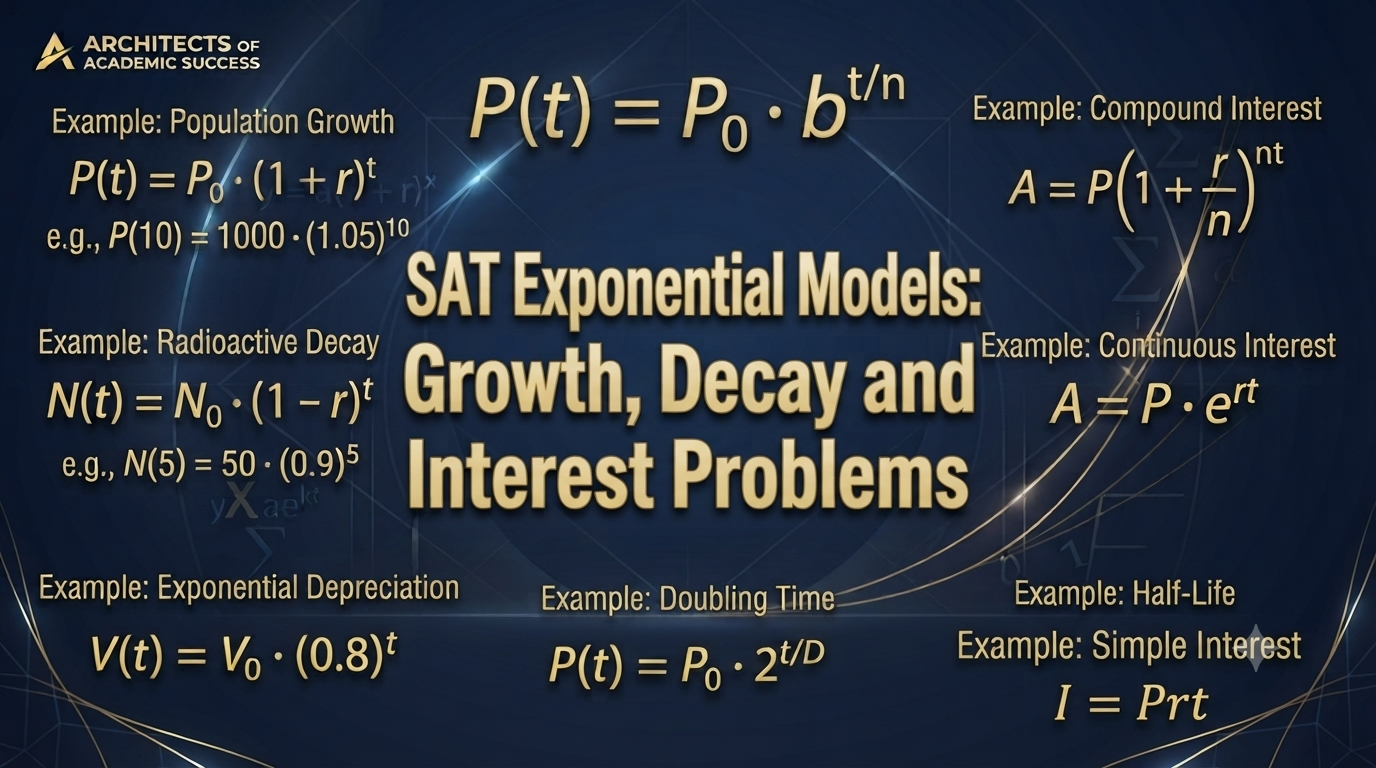
Now that you understand the mechanics of exponential growth and decay, it’s time to see how they appear on the exam. Click below to explore our SAT Math: Exponential Models – Growth, Decay guide, featuring targeted question categories and detailed, step-by-step solutions to help you achieve that 800.
View SAT-Style Questions & Solutions
One thought on “Essentials of SAT Exponential Growth & Decay”