



7 Essential SAT Quadratic & Parabola Question Types (With Bluebook-Style Examples)
7 Essential SAT Quadratic & Parabola Question Types
With Bluebook-Style Examples
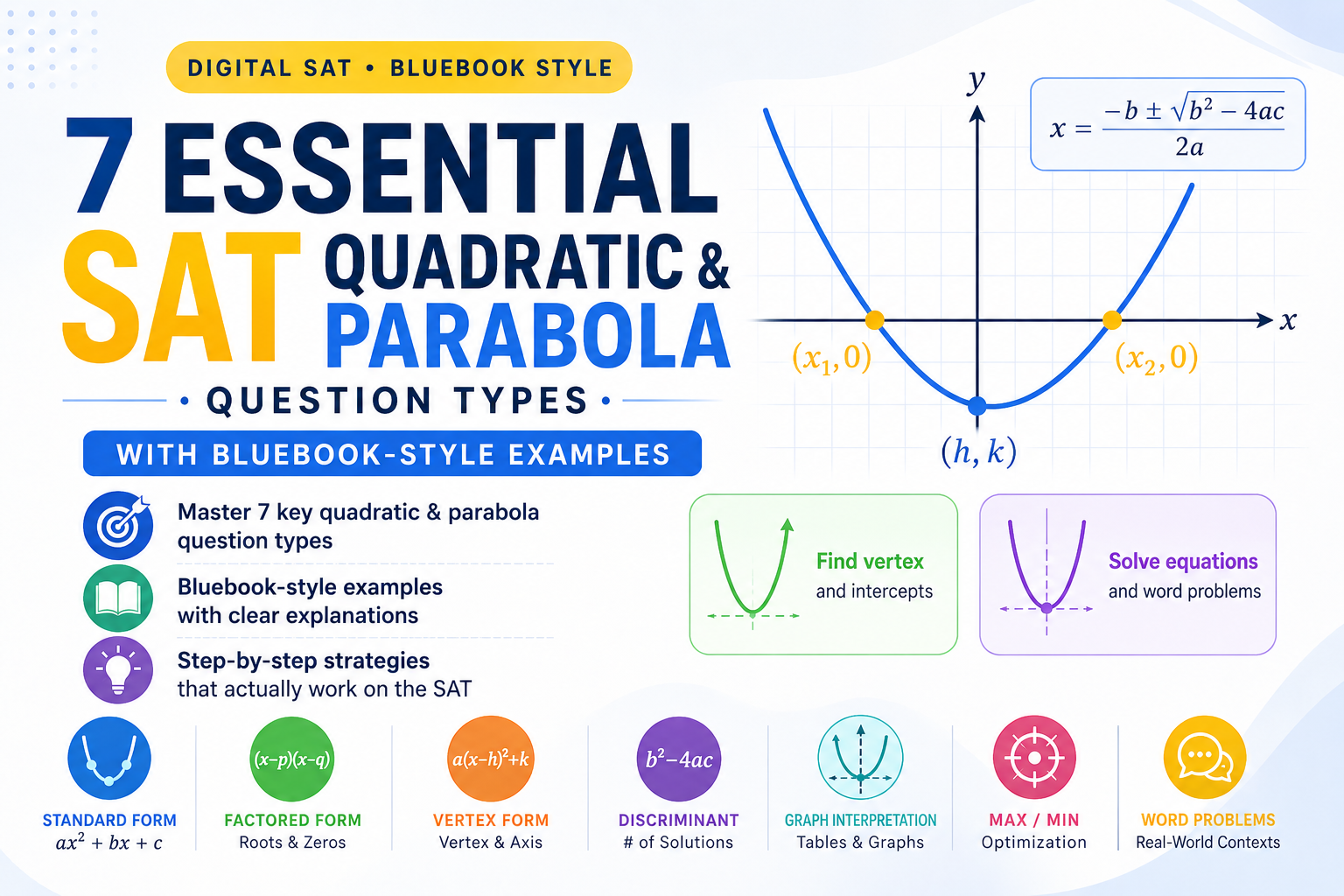
On the Digital SAT, quadratic and parabola questions usually fall into a small number of recurring patterns. Instead of memorizing dozens of formulas, master these 7 categories and you will be prepared for the vast majority of SAT quadratic questions.
Each section below includes Bluebook-style examples, visual explanations, and step-by-step SAT strategies.
Vertex, Minimum & Maximum
Find the vertex, axis of symmetry, and the minimum or maximum value of a parabola.
X-Intercepts & Roots
Determine where the graph crosses the x-axis using factoring and the zero-product rule.
Number of Real Solutions (Discriminant)
Use the discriminant to decide whether a quadratic has 2, 1, or 0 real solutions.
Y-Intercept Questions
Quickly find where the graph crosses the y-axis by setting x = 0.
Standard, Factored & Vertex Form
Recognize the same parabola written in three different forms and choose the fastest SAT strategy.
Function Transformations: f(x − h) + k
Understand how parabolas shift right, left, up, and down on Digital SAT function questions.
SAT Word Problems with Quadratics
Solve optimization, area, projectile, and revenue problems that are modeled by quadratic functions.
Quick SAT Roadmap
Vertex: Minimum & Maximum Questions
SAT quadratic questions often ask for the minimum value or maximum value of a function. The key idea is that these questions are really about the vertex of the parabola.

🌟 The Main Idea
A quadratic function creates a parabola. Every parabola has a special point called the vertex.
The vertex tells us where the graph reaches its lowest point or highest point.
That is why vertex questions are one of the most common SAT quadratic question types.
📌 The Vertex Formula
For a quadratic function in standard form
the x-coordinate of the vertex is
After finding xv, substitute it back into the function to get the y-value of the vertex.
📈 When Is It a Minimum? When Is It a Maximum?
a > 0
The parabola opens upward.
The vertex is the lowest point.
Minimum value
a < 0
The parabola opens downward.
The vertex is the highest point.
Maximum value
If a < 0, the parabola opens downward forever, so it cannot have a minimum value.
🎯 The #1 SAT Warning: Read the Question Carefully
Students often find the vertex’s x-coordinate and stop too early.
The SAT may ask for:
- the x-coordinate of the vertex, or
- the minimum/maximum value of the function.
These are different answers.
Find The X-Coordinate
Find The Minimum Or Maximum Value
Plug the vertex x-value back into the function.
⚡ Quick SAT Check
| If the SAT asks… | Your answer is… |
|---|---|
| x-coordinate of the vertex | xv |
| At what value of x does the minimum occur? | xv |
| What is the minimum value? | f(xv) |
| What is the maximum value? | f(xv) |
- Identify a.
- Decide whether the parabola opens up or down.
- Compute xv = −b 2a .
- Ask yourself: Do they want x or f(x)?
- If they want the minimum or maximum value, compute f(xv).
Detailed Worked Example
Example — Finding A Minimum Value
Suppose
Find the minimum value of the function.
Step 1 — Identify a, b, and c
Step 2 — Find the vertex x-coordinate
Step 3 — Compute the y-value
Many students stop after finding x = 3. The question asked for the minimum value, so the correct answer is 28.
🎯 Test Yourself — Vertex Questions
These original SATMath800 questions are designed to feel like official Digital SAT quadratic problems.
What is the minimum value of
Show Solution
What is the maximum value of
Show Solution
Since a = −3 < 0, the parabola opens downward, so the vertex gives the maximum.
A parabola has vertex (4, −7) and opens upward. What is its minimum value?
Show Solution
The vertex is (4, −7).
The minimum value is the y-coordinate of the vertex.
What is the x-coordinate of the vertex of
Show Solution
Notice that this question asks for x, not the minimum value.
What is the minimum value of
Show Solution
This is already in vertex form.
The vertex is (2, 9).
Because a = 4 > 0, the parabola opens upward.
When a question asks for the minimum value or maximum value, the answer is a y-value.
Then compute
If the question asks “At what value of x…?”, stop after finding xv.
X-Intercepts / Roots Questions
SAT quadratic questions frequently ask for the x-intercepts, zeros, roots, or solutions of a quadratic function. These are all different names for the same idea.

🌟 The Big SAT Idea
An x-intercept is a point where the graph crosses the x-axis.
At every x-intercept, the y-value is 0.
Therefore, to find the x-intercepts of a quadratic function, we set the function equal to 0.
📚 SAT Vocabulary
| SAT Wording | What You Do |
|---|---|
| x-intercepts | Set y = 0 |
| roots | Solve the equation |
| zeros | Solve the equation |
| solutions | Solve the equation |
| values of x where f(x)=0 | Solve the equation |
On the SAT, these phrases usually mean exactly the same task.
🔍 Example: Find The Roots
Suppose
To find the x-intercepts, set f(x)=0:
Factor the quadratic:
Use the zero-product rule:
So the graph crosses the x-axis at:
⚡ The Fastest SAT Shortcut
If a quadratic is already written in factored form, the roots can often be found in seconds.
Set each factor equal to zero:
In a factor (x − a), the root is x = a.
In a factor (x + a), the root is x = −a.
⚠️ The Most Common SAT Mistake
Students often forget to change the sign.
Factor
Factor
Think: “Set the factor equal to zero and solve.”
🎯 Roots vs. X-Intercepts
| Question Asks | Answer Format |
|---|---|
| What are the roots? | 2, 3 |
| What are the solutions? | 2, 3 |
| What are the x-intercepts? | (2,0), (3,0) |
Roots are numbers.
X-intercepts are points.
⚡ Quick SAT Check
Find the roots of
Factor:
Therefore:
- See the words root / zero / x-intercept / solution.
- Immediately set the quadratic equal to 0.
- Look for easy factoring first.
- If it factors, use the zero-product rule.
- Only use the quadratic formula if factoring is not obvious.
Detailed Worked Examples
Case 1 — Two Real X-Intercepts
Find the x-intercepts of
Step 1 — Set y equal to 0
Step 2 — Factor the quadratic
Step 3 — Solve each factor
Case 2 — A Repeated Root
Find the x-intercepts of
Step 1 — Set y equal to 0
Step 2 — Factor the quadratic
Step 3 — Solve
🎯 Test Yourself — X-Intercept Questions
Try each question before opening the solution. These are original SATMath800 questions designed to match the style and difficulty of official Digital SAT quadratics.
What are the roots of
Show Solution
What are the x-intercepts of
Show Solution
The function
has which zeros?
Show Solution
Which value of x is a root of
Show Solution
A quadratic has x-intercepts at (1,0) and (7,0). Which equation could represent the quadratic?
Show Solution
Roots 1 and 7 give factors
Expand:
If a question gives the x-intercepts and , immediately write
This is one of the fastest ways to build a quadratic equation on the SAT.
Number of Real Solutions (Discriminant)
Learn the fastest SAT method for deciding whether a quadratic equation has 2, 1, or 0 real solutions.
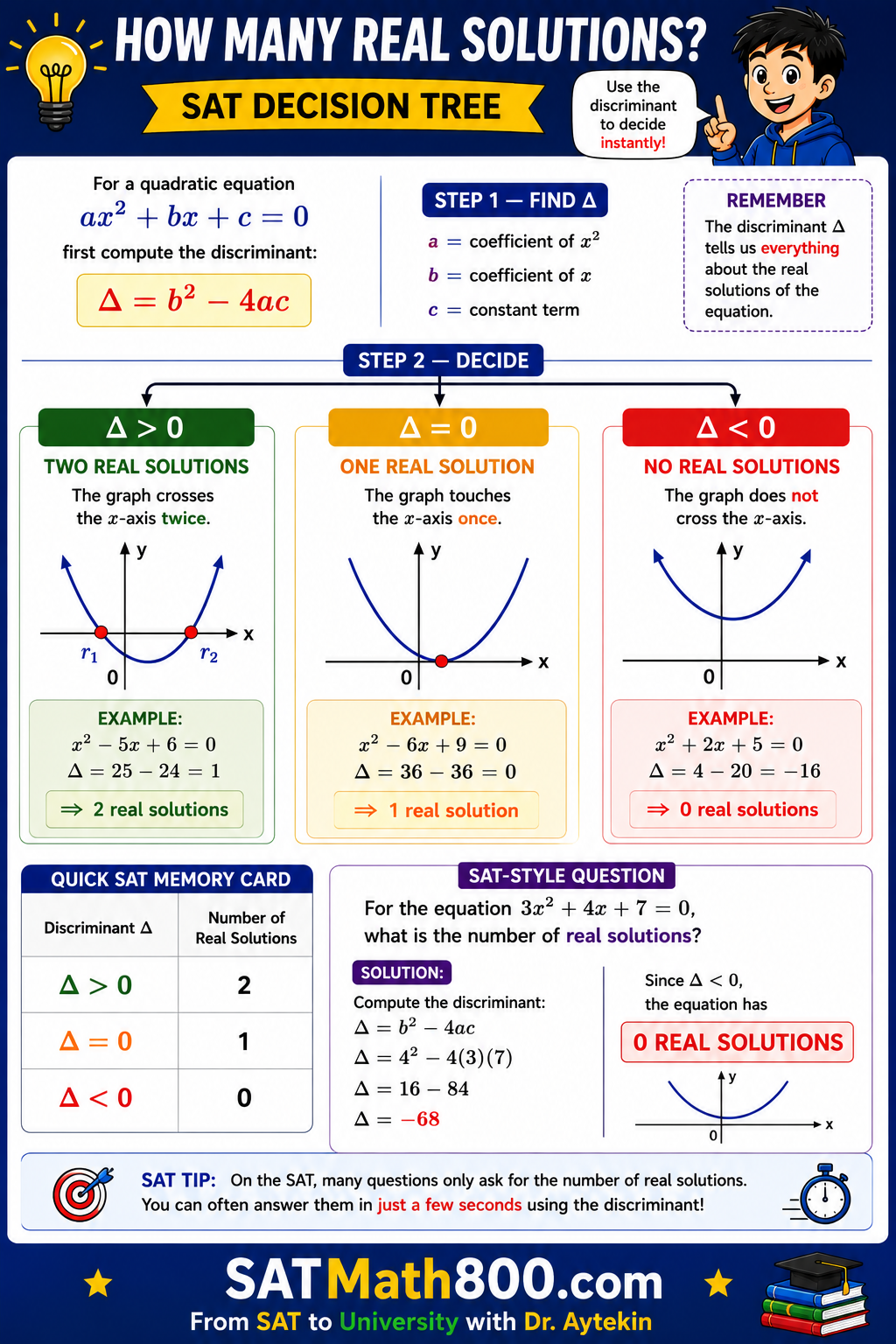
For a quadratic equation ax² + bx + c = 0, first compute the discriminant.
The sign of Δ tells you the number of real solutions without solving the equation completely.
After computing the discriminant, the roots of ax² + bx + c = 0 can be found using the quadratic formula.
On the SAT, you often need only the sign of Δ to determine the number of real solutions. Use the full quadratic formula only when the question asks for the actual roots.
Identify the Coefficients
Decide Using the Discriminant
Two Real Solutions
The parabola crosses the x-axis twice.
The parabola crosses the x-axis at two different points, so it has two distinct x-intercepts.
One Real Solution
The parabola touches the x-axis once.
The parabola touches the x-axis at exactly one point. This happens when the vertex lies on the x-axis, so the parabola is tangent to the axis and the root is repeated.
No Real Solutions
The parabola does not cross the x-axis.
Because the discriminant is negative, the square root in the quadratic formula would involve a negative number. The parabola stays above or below the x-axis and has no x-intercepts.
Detailed Worked Examples
Case 1 — Two Real Solutions
Determine the number of real solutions of x² − 5x + 6 = 0.
Two real solutions mean the parabola crosses the x-axis at two distinct intercepts: (2,0) and (3,0).
Case 2 — One Real Solution
Determine the number of real solutions of x² − 6x + 9 = 0.
One real solution means the vertex is exactly on the x-axis. The parabola touches the axis at (3,0) and turns around, so the graph is tangent to the x-axis.
Case 3 — No Real Solutions
Determine the number of real solutions of x² + 2x + 5 = 0.
No real solutions mean the parabola never reaches the x-axis. The graph has no x-intercepts, so there is no real value of x that makes the expression equal to zero.
Quick SAT Memory Card
| Discriminant | Number of Real Solutions |
|---|---|
| Δ > 0 | 2 |
| Δ = 0 | 1 |
| Δ < 0 | 0 |
🎯 Test Yourself — SAT-Style Questions
Try each question before opening the solution. These are original SATMath800 questions designed to match the style and difficulty of official Digital SAT quadratics.
How many real solutions does x² − 7x + 10 = 0 have?
Show Solution
The parabola crosses the x-axis at (2,0) and (5,0), so it has two distinct x-intercepts.
How many real solutions does x² − 12x + 36 = 0 have?
Show Solution
The vertex lies on the x-axis at (6,0), so the parabola touches the axis and turns around.
How many real solutions does 2x² + 5x + 9 = 0 have?
Show Solution
Because the discriminant is negative, the quadratic formula would involve √(−47). The parabola has no x-intercepts.
For what value of k does x² + 8x + k = 0 have exactly one real solution?
Show Solution
Exactly one real solution means Δ = 0.
When k = 16, the equation becomes x² + 8x + 16 = (x + 4)², so the parabola touches the x-axis at x = −4.
Which equation has no real solutions?
Show Solution
Check the discriminant of each choice.
Choice C has a negative discriminant, so its parabola never crosses the x-axis and therefore has no real solutions.
Y-Intercept Questions
SAT quadratic questions often ask for the y-intercept, f(0), or the point where the graph crosses the y-axis. This is one of the fastest SAT quadratic skills to master.

🌟 The 5-Second SAT Rule
For any quadratic in standard form
the y-intercept occurs when
Substitute x=0:
In standard form, the constant term c is immediately the y-value of the y-intercept.
🔍 Quick Recognition Examples
Example A
Here c = 11.
Example B
Here c = −9.
⚠️ The Most Common SAT Trap
Students often confuse f(0) with the y-intercept point.
Question
What is f(0)?
Question
What is the y-intercept?
f(0) is a number.
The y-intercept is a point.
📚 Different SAT Wordings
| SAT Wording | Answer Format |
|---|---|
| What is the y-intercept? | (0,c) |
| What is f(0)? | c |
| Where does the graph cross the y-axis? | (0,c) |
| What is the value of the function when x=0? | c |
These questions are usually testing the same underlying idea.
🚨 Important: Vertex Form Does NOT Show The Y-Intercept Directly
Suppose
Many students incorrectly think the y-intercept is (0, −5).
You must substitute x=0:
In vertex form, a quadratic is written as
The value k is the y-coordinate of the vertex.
Therefore, k tells you the vertex y-value, not the y-intercept.
⚡ Why Standard Form Is Useful
Standard Form
The y-intercept is visible immediately.
Vertex Form
You must substitute x=0.
This is why SAT questions about y-intercepts often use standard form.
⚡ Quick SAT Check
Find the y-intercept of
Because c=9,
- See y-intercept or f(0).
- Check whether the quadratic is in standard form.
- If yes, the answer is immediately the constant term c.
- If not, substitute x=0.
- Give a point for y-intercept questions and a number for f(0) questions.
Detailed Worked Examples
Case 1 — Read Directly From Standard Form
Find the y-intercept of
Step 1 — Identify the constant term
Step 2 — Compute f(0)
Step 3 — Write the y-intercept as a point
Case 2 — Vertex Form Trap
Find the y-intercept of
This function is in vertex form, so we must substitute x=0.
Step 1 — Substitute x = 0
Step 2 — Simplify
Step 3 — Write the point
The number −5 is the vertex y-value, not the y-intercept.
🎯 Test Yourself — Y-Intercept Questions
Try each question before opening the solution. These are original SATMath800 questions designed to match the style and difficulty of official Digital SAT quadratics.
What is the y-intercept of
Show Solution
The constant term is −8.
Find f(0) if
Show Solution
What is the y-intercept of
Show Solution
Which quadratic has y-intercept (0, −3)?
Show Solution
The y-intercept is the constant term c.
- A → 2
- B → −3
- C → −5
- D → 3
A parabola passes through (0, 15). What is the value of c in
Show Solution
The point (0,15) is the y-intercept.
If a quadratic is in standard form, you can usually answer y-intercept questions without any calculation.
The y-intercept is simply
This shortcut saves valuable time on the Digital SAT.
Three Forms of a Quadratic
The SAT often shows the same parabola in different forms. Strong students recognize the structure instantly instead of converting every equation into standard form.

🌟 The Big SAT Idea
A quadratic function can be written in three important forms. Each form reveals a different feature of the parabola most efficiently.
| Form | Best For |
|---|---|
| Standard: ax2 + bx + c | y-intercept, discriminant |
| Factored: a(x − r1)(x − r2) | x-intercepts / roots |
| Vertex: a(x − h)2 + k | vertex, minimum, maximum |
💡 No Need To Memorize Everything
You only need to understand three ideas:
- Vertex: the highest or lowest point
- X-intercepts: where y = 0
- Y-intercept: where x = 0
The three quadratic forms are simply different windows into the same parabola. Recognizing them saves valuable time on the Digital SAT.
1️⃣ Standard Form
This is the form that appears most often on the SAT.
What It Reveals Instantly
The constant term is c = 7.
Best Use
- Find f(0)
- Find the y-intercept
- Compute the discriminant
- Identify a, b, and c
2️⃣ Factored Form
This form is designed for finding x-intercepts.
Set each factor equal to zero:
Two parentheses multiplied together usually means "Think roots immediately."
3️⃣ Vertex Form
This form reveals the vertex instantly.
h
x-coordinate of the vertex
k
y-coordinate of the vertex
Because the coefficient of the squared term is positive, the parabola opens upward, so −4 is the minimum value.
🔄 One Parabola, Three Different Forms
Consider the quadratic function
Standard Form
Y-intercept: (0, 8)
Factored Form
Roots: 2 and 4
Vertex Form
Vertex: (3, −1)
⚡ The 1-Second SAT Recognition Trick
See + c at the end?
Think: Y-intercept
See two parentheses multiplied?
Think: Roots / X-intercepts
See a squared parenthesis + or − a constant?
Think: Vertex / Min / Max
🎯 Quick SAT Challenge
Which form is the fastest for each question?
| Question | Fastest Form |
|---|---|
| Find the y-intercept | Standard |
| Find the x-intercepts | Factored |
| Find the minimum value | Vertex |
| Find the vertex | Vertex |
| Find the discriminant | Standard |
Don't ask "How do I convert this?"
Ask "What is the question asking for?"
- Vertex? → Vertex form
- Roots? → Factored form
- Y-intercept or discriminant? → Standard form
This habit saves more time than memorizing extra formulas.
Detailed Worked Examples
Case 1 — Standard → Factored Form
Rewrite the quadratic in factored form:
Step 1 — Find two numbers that multiply to 6 and add to −5
Step 2 — Write the factors
Step 3 — Read the roots
Case 2 — Standard → Vertex Form
Rewrite the quadratic in vertex form:
Step 1 — Group the x terms
Step 2 — Complete the square
Half of −6 is −3, and (−3)2 = 9.
Step 3 — Factor the perfect square
Step 4 — Read the vertex
Since the coefficient of the squared term is positive, −4 is the minimum value.
Case 3 — Which Form Is Fastest?
Suppose you are asked:
What is the minimum value of y = (x − 4)2 + 1?
Recognize the form
This is already in vertex form:
Answer the actual SAT question
The question asks for the minimum value, which is the y-coordinate of the vertex.
Many students answer 4, which is the x-coordinate. Always check whether the question asks for x or f(x).
🎯 Test Yourself — Three Forms Of A Quadratic
Try each question before opening the solution. These are original SATMath800 questions designed to match the style and difficulty of official Digital SAT quadratics.
Which form is most useful for finding the y-intercept of
Show Solution
The equation is already in standard form, and the constant term 5 gives the y-intercept immediately.
Find the x-intercepts of
Show Solution
What is the vertex of
Show Solution
Compare with
Here h = −2 and k = −9.
Which equation is the factored form of
Show Solution
We need two numbers that multiply to 15 and add to −8.
Which equation represents the same parabola as
Show Solution
Expand the factors:
When you see a quadratic, ask:
- Need the vertex? → Use vertex form.
- Need the roots? → Use factored form.
- Need the y-intercept or discriminant? → Use standard form.
Expert SAT students choose the form that reveals the answer with the fewest steps.
Function Transformations
Learn how the SAT moves a parabola left, right, up, and down without changing its basic shape. This is one of the fastest ways to answer hard Digital SAT quadratic questions.

🌟 Start With The Parent Function
Every transformation begins with the basic parabola
Vertex
Shape
Opens upward
Axis of Symmetry
Think of this graph as the original template. Transformations simply move or stretch this template.
🧠 The Master SAT Transformation Formula
This single formula controls almost every SAT transformation question.
| Part | Effect |
|---|---|
| (x − h) | Shift right h units |
| (x + h) | Shift left h units |
| + k | Shift up k units |
| − k | Shift down k units |
| a > 1 | Vertical stretch |
| 0 < a < 1 | Vertical compression |
| a < 0 | Reflection across the x-axis |
⚠️ The SAT Sign Trick
Inside the parentheses, the direction is reversed.
Right 5
Left 5
Minus means right. Plus means left.
📈 What Does “Shifting a Parabola” Mean?
Start with the parent function y=x². The transformed graph keeps the same basic shape, but its vertex moves to a new location.
Right 3 Units
The vertex moves from (0,0) to (3,0).
Left 2 Units
The vertex moves to (−2,0).
Up 4 Units
The vertex moves to (0,4).
Down 3 Units
The vertex moves to (0,−3).
- Inside the parentheses changes the x-coordinate of the vertex.
- Outside the parentheses changes the y-coordinate.
- The basic "U" shape stays the same unless the coefficient a changes.
🔍 Quick Visual Examples
Example A
- Right 3
- No vertical shift
Example B
- Left 2
- Down 4
Example C — Everything Together
| Feature | What It Means |
|---|---|
| (x − 1) | Right 1 |
| +5 | Up 5 |
| −2 | Reflect downward and stretch by factor 2 |
⚡ Read It Without Expanding
Suppose the SAT gives you
Instead of expanding, read the information directly from the form.
| Question | Answer |
|---|---|
| Vertex | (−4, 2) |
| Horizontal shift | Left 4 |
| Vertical shift | Up 2 |
| Opening direction | Downward |
| Stretch factor | 3 |
No expansion was needed. Hard-module SAT questions are often testing whether you can read the transformation directly.
🎯 Mini SAT Challenge
For each function, identify the transformation from y=x2.
| Function | Transformation |
|---|---|
| (x − 7)2 | Right 7 |
| (x + 3)2 | Left 3 |
| x2 + 6 | Up 6 |
| −x2 | Reflect across the x-axis |
🔗 Why This Connects To Vertex Questions
Transformation questions are really vertex questions in disguise.
Once you can read a(x−h)2+k quickly, you can often answer SAT questions about:
- the vertex,
- the axis of symmetry,
- the minimum or maximum value,
- the opening direction,
- and the graph shifts
in under 10 seconds.
- Look for (x−h)2.
- Reverse the sign inside the parentheses.
- Keep the sign outside unchanged.
- Read the vertex as (h,k).
- Check whether a is positive or negative to decide minimum vs. maximum.
Detailed Worked Examples
Case 1 — Horizontal Shift Only
Find the vertex of
Step 1 — Compare with vertex form
Step 2 — Read the transformation
The graph of y=x2 is shifted right 6 units.
Case 2 — Horizontal + Vertical Shift
Analyze the function
Step 1 — Identify h and k
Step 2 — Determine the shifts
- (x+3) → left 3
- → up 8
Step 3 — Read the vertex
Step 4 — Find the axis of symmetry
Step 5 — Determine minimum or maximum
The coefficient of the squared term is positive, so the parabola opens upward.
In vertex form, the axis of symmetry is always x=h.
Case 3 — Reflection + Stretch
Analyze the function
Step 1 — Read the vertex
Step 2 — Determine the opening direction
Since a = −2 < 0, the parabola is reflected across the x-axis.
Step 3 — Identify the stretch
The absolute value |−2|=2, so the graph is stretched vertically by a factor of 2.
Step 4 — Find the maximum value
Because the parabola opens downward, the vertex gives the maximum.
🎯 Test Yourself — Function Transformations
Try each question before opening the solution. These are original SATMath800 questions designed to match the style and difficulty of official Digital SAT quadratics.
What is the vertex of
Show Solution
Compare with y=(x−h)2+k.
Describe the transformations from y=x2 for
Show Solution
- (x+5) → left 5
- −2 → down 2
What is the maximum value of
Show Solution
The vertex is (2,1).
Since the coefficient is negative, the parabola opens downward.
Which equation represents a parabola shifted left 3 and up 6 from y=x2?
Show Solution
Left 3 → (x+3)2
Up 6 →
A parabola has vertex (2, −5) and opens downward. Which equation could represent it?
Show Solution
Use vertex form:
To open downward, a<0.
When you see a(x−h)2+k, read the graph in this order:
- h → left or right shift
- k → up or down shift
- sign of a → minimum or maximum
- |a| → stretch or compression
This four-step process is often faster than graphing, expanding, or using a calculator.
SAT Word Problems With Quadratics
Learn how the SAT uses quadratics to model projectile motion, optimization, and real-world situations. This premium lesson focuses on visual understanding first, then efficient Bluebook-style problem solving.
🚀 What Does h(t)=at²+bt+c Actually Mean?
In SAT projectile problems, the function h(t) represents the height of an object above the ground after t seconds.
| Part | Meaning |
|---|---|
| h(t) | height above the ground |
| t | time in seconds |
| -16t2 | gravity pulls the object downward |
| +80t | the object is launched upward |
| +6 | the object starts 6 feet above the ground |
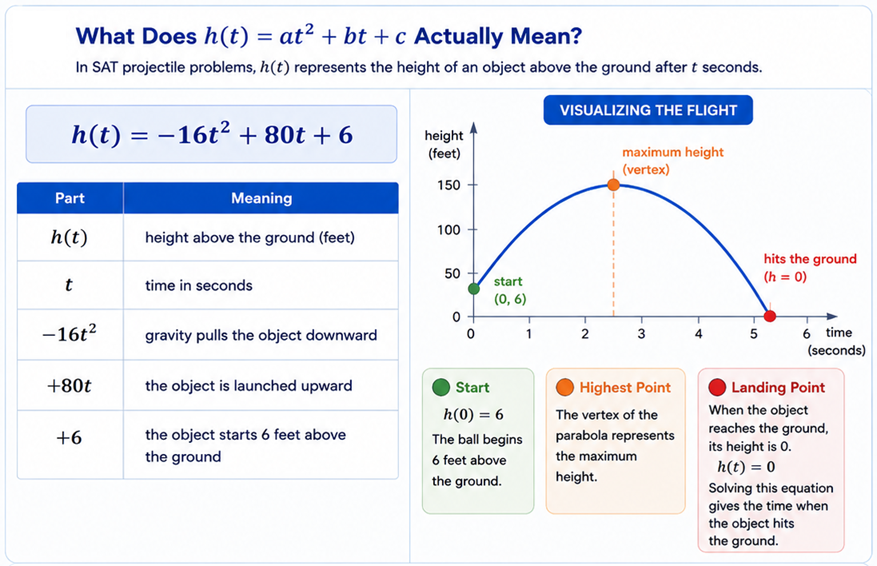
📈 Visualizing The Flight
🟢 Start
The ball begins 6 feet above the ground.
🟠 Highest Point
The vertex of the parabola represents the maximum height.
🔴 Landing Point
When the object reaches the ground, its height is 0.
Solving this equation gives the time when the object hits the ground.
🧩 Fully Worked SAT Projectile Example
A ball is launched from a platform. Its height is modeled by
Question 1: What is the maximum height?
Step 1 — Find Time Of The Vertex
Step 2 — Find The Maximum Height
Question 2: When does the ball hit the ground?
Step 3 — Set The Height Equal To Zero
Solve using the quadratic formula (calculator allowed on the SAT).
A negative time would mean the ball hit the ground before it was launched, which is not physically meaningful.
📐 Maximum Area Rectangle
A rectangle has perimeter 48 feet. What dimensions produce the largest possible area?
Step 1 — Write The Perimeter Equation
Step 2 — Write The Area Function
Step 3 — Find The Vertex
Step 4 — Find The Other Dimension
💰 Revenue Modeling Problem
A theater charges $20 per ticket and sells 300 tickets. For every $1 increase in the ticket price, 10 fewer tickets are sold.
Let x be the number of $1 increases.
What ticket price will produce the maximum revenue, and what is that maximum revenue?
Step 1 — Revenue Model
Step 2 — Expand
Step 3 — Find The Vertex
The revenue is maximized when x = 5, so the theater should increase the ticket price by $5.
Step 4 — Find The Maximum Revenue
🎯 Bluebook-Style Practice
Question 1 — Maximum Height
A projectile has height h(t) = -4t2 + 24t + 5. What is its maximum height?
Show Solution
Question 2 — Optimization
A rectangle has perimeter 60. What dimensions maximize the area?
Show Solution
For a fixed perimeter, the maximum-area rectangle is always a square.
🏭 Production And Profit Optimization
A company manufactures custom water bottles. The profit, in dollars, from producing x bottles is modeled by
How many bottles should the company produce to maximize profit?
Step 1 — Recognize The Quadratic Model
The coefficient of x2 is negative, so the parabola opens downward. The maximum profit occurs at the vertex.
Step 2 — Find The Vertex
Step 3 — Interpret The Result
In optimization problems, the SAT usually cares about the real-world meaning of the vertex. Here, the x-value represents the number of bottles, not the profit itself.
⚠️ Common SAT Traps
Trap 1
Finding the x-value of the vertex when the question asks for the maximum value.
Trap 2
Using a negative root for a time problem.
Trap 3
Forgetting to substitute the vertex value back into the function.
Trap 4
Confusing maximum area with maximum side length.
| Question Asks For | Use |
|---|---|
| Greatest / least value | Vertex |
| When something becomes zero | Roots |
| Starting amount | Y-intercept |
| Real-world maximum / minimum | Write a quadratic → Find the vertex → Interpret the answer |
If you can recognize vertex, roots, y-intercept, and vertex form inside a real-world situation, you have mastered the core quadratic skills required for the Digital SAT Math section.